
Short Answer
Quick Snapshot
Paris in 1871 was a wounded capital emerging from the Franco-Prussian War and the Prussian siege, then plunged into civil conflict. The most common encyclopedic meaning of “Paris in 1871” is the year of the Paris Commune: the revolutionary municipal government that held the city from 18 March to 28 May 1871. This article follows that scope, with particular attention to the newspaper record from January to June and to eyewitness accounts written by participants, journalists and diarists.
For Parisians, the year began with hunger, bombardment and political humiliation. It ended with ruins, mass arrests and mourning. Between those poles stood the Commune: red flags at the Hôtel de Ville, National Guard battalions, barricades of paving stones, decrees on rents and education, and a press that was both a weapon and a archive. Newspapers printed official notices, denunciations, rumors and appeals; diarists recorded the smell of smoke, the sound of cannon and the uncertainty of everyday life.
Paris in 1871
Paris in 1871 remained the great city of the Seine: a dense network of boulevards, arrondissements, workshops, cafés and apartment houses, ringed by fortifications and dominated by landmarks such as Notre-Dame, the Louvre, the Tuileries, the Hôtel de Ville and the butte of Montmartre. The Prussian siege had ended with an armistice in January, but the city was still scarred by cold, shortage and military defeat. The spring of 1871 brought not recovery but a new confrontation between radical Paris and the conservative national government at Versailles.
The atmosphere was febrile. National Guard units retained cannon and a sense of grievance; political clubs met in churches and halls; women organized ambulance and workshop committees; journalists moved between rumor and denunciation. The city’s geography mattered: Montmartre’s heights commanded the north, the Hôtel de Ville anchored revolutionary authority, and the western districts near the Arc de Triomphe and Porte Maillot became battle zones. Weather and season added to the strain: the memory of the hungry winter lingered, while spring brought smoke, bombardment and the fear of fire.
Population & Economy
Paris was one of Europe’s largest cities, with a population commonly estimated around 1.8 to 1.85 million in the early 1870s; the 1872 census recorded 1,851,792 inhabitants. The wartime years made exact 1871 figures uncertain, as death, displacement and military service altered the city’s numbers. The population included industrial workers, artisans, shopkeepers, clerks, servants, professionals and a large transient population of soldiers and National Guards.
The economy was severely disrupted. The siege had cut supply lines, closed many luxury trades and left unemployment and hunger. After March, the Commune’s authority rested partly on the National Guard’s daily pay and on emergency measures such as the suspension of rents. Food, fuel and clothing remained scarce, and the war with Versailles disrupted markets, transport and credit. Parisian industry was diverse—printing, metalwork, clothing, food processing, furniture and luxury goods—but in 1871 much of it served survival, armament or propaganda rather than ordinary commerce.
Government & Politics
The political landscape was divided between the National Assembly and government of Adolphe Thiers at Versailles and the radical republican and socialist forces in Paris. The capital had a strong tradition of republican and revolutionary politics, strengthened by the siege and by distrust of a monarchist-dominated assembly. In March, the Central Committee of the National Guard emerged as a rival authority after Thiers attempted to remove cannon from Montmartre. Municipal elections on 26 March produced the Commune, proclaimed on 28 March at the Hôtel de Ville.
The Commune governed through commissions—military, justice, finance, education, public services and others—and through figures such as Louis Charles Delescluze, Jules Vallès, Louise Michel, Raoul Rigault, Théophile Ferré, Édouard Vaillant and Gustave Courbet. There was no single mayor of Paris under the Commune; authority was collective and contested. Versailles denied the Commune’s legitimacy, while many Parisians saw it as the defense of municipal freedoms and the Republic. The conflict was thus both a civil war and a struggle over sovereignty.
Industry
Parisian industry in 1871 was a mixture of small workshops and larger enterprises. Printing and publishing were politically vital: newspapers, posters and pamphlets poured from the press. Metalworkers and armorers repaired weapons, while textile and clothing workers produced uniforms and bandages. The city’s traditional luxury trades—fashion, furniture, jewelry, bronzes and fine goods—had been damaged by the siege and now faced the collapse of normal markets. The Commune requisitioned some workshops and encouraged cooperative production, though its experiments were brief and improvised.
Women’s labor was conspicuous. The Union des femmes pour la défense de Paris et les soins aux blessés organized workshops and ambulance services, and women worked in canteens, hospitals and barricades. The economy of the Commune was therefore not only an economy of scarcity but also one of emergency mobilization, in which workshops, printing presses and depots became instruments of political survival.
Education
Education was one of the Commune’s most ambitious reform fields. Under Édouard Vaillant’s education commission, the Commune pressed for free, secular and compulsory schooling, and for girls’ education on terms closer to boys’. It sought to remove religious instruction from public schools and to open education to working-class children. These measures were announced amid chaos and could be only partially implemented, but they expressed a broader vision of a republican and secular city.
Paris already had a comparatively high literacy rate and a dense network of schools, libraries and learned institutions, but access remained unequal. The fighting closed or disrupted many schools, and teachers faced political pressures. Newspapers and political clubs also functioned as informal schools, debating citizenship, women’s rights, labor and the meaning of the Republic.
Transportation
Paris depended on horse-drawn omnibuses, cabs, trams and railways, as well as on walking. The Seine’s bridges linked the city’s banks, while the great stations—Gare du Nord, Gare de l’Est, Gare Saint-Lazare, Gare Montparnasse and Gare de Lyon—connected Paris to the nation. In 1871, however, transport was militarized and disrupted. Barricades blocked streets, troops and National Guards moved through the boulevards, and the railways carried soldiers and refugees rather than ordinary commerce.
The fortifications and the western approaches became strategic zones. The Versaillais bombardment and the fighting around Neuilly, Passy and the Porte Maillot made movement dangerous. Within the city, the Commune used messengers, posters and the press to coordinate authority, while rumors traveled faster than any vehicle. The siege and Commune also reinforced the importance of the telegraph and the newspaper as links between districts.
Everyday Life
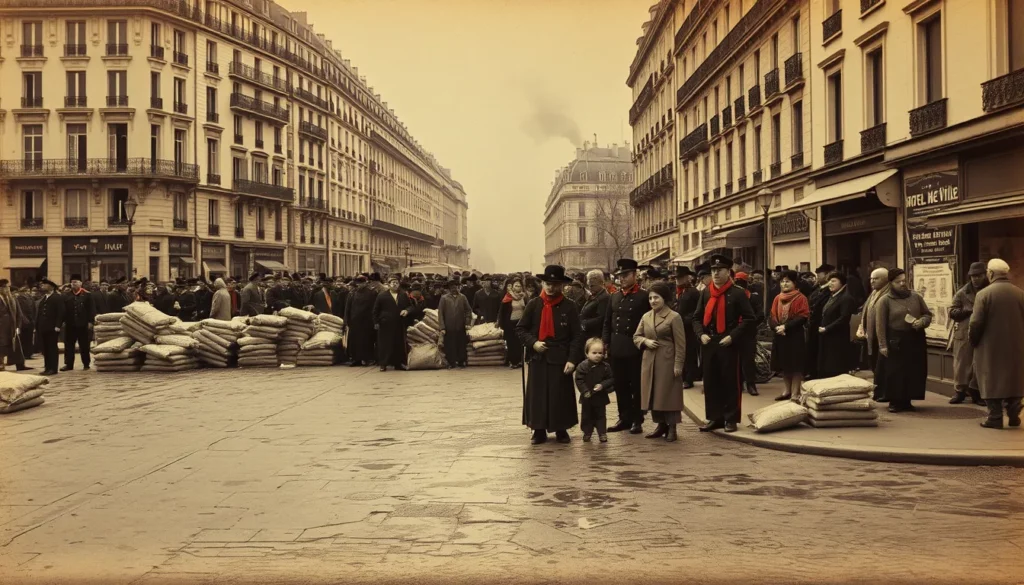
Everyday life in 1871 was dominated by scarcity and uncertainty. Bread, meat, milk, fuel and medicine were difficult to obtain; queues formed, prices rose and families relied on networks of neighbors and relatives. Housing was crowded, and the rent question became explosive. The Commune’s decrees suspending rent payments and regulating pawnshops addressed immediate anxieties, but they could not restore normal economic life.
Clothing reflected the crisis: National Guard uniforms, red scarves and practical working dress were common, while bourgeois Parisians tried to maintain respectable appearances. Cafés and theaters sometimes remained open, and political clubs met in churches and halls, but family life was disrupted by military service, death and displacement. Women nursed the wounded, cooked in canteens and organized relief; children witnessed barricades, fires and funerals. In diaries and letters, Parisians recorded the strange mixture of political excitement, fear and exhaustion.
Major Events
The defining event came on 18 March 1871, when Thiers ordered troops to seize cannon from Montmartre. Soldiers fraternized with the crowd, and Generals Lecomte and Thomas were killed. The government withdrew to Versailles, leaving Paris in the hands of the National Guard’s Central Committee. Municipal elections on 26 March were followed by the proclamation of the Commune on 28 March. On 3 April, Communard forces marched toward Versailles but were repulsed; the civil war then settled into siege and bombardment.
On 10 May, France and Prussia signed the Treaty of Frankfurt, ending the war and freeing Versailles to concentrate on Paris. On 16 May, the Vendôme Column was pulled down as a symbol of imperial militarism. On 21 May, Versaillais forces entered Paris, beginning the Bloody Week. The Tuileries and Hôtel de Ville burned; hostages, including Archbishop Darboy, were executed; Delescluze died on a barricade; and by 28 May the last Communard resistance had collapsed. Catulle Mendès dated his eyewitness narrative from 18 March to 29 May 1871.
What Newspapers Were Reporting
Newspapers were central to the Commune’s political life. The Journal officiel published decrees, official notices and proclamations under the Commune’s authority. Le Cri du Peuple, edited by Jules Vallès, gave voice to radical republican and social protest. Le Père Duchesne adopted the coarse, satirical persona of the revolutionary Everyman to attack enemies and rally supporters. Other papers—Le Vengeur, La Commune and various club and committee sheets—carried polemics, denunciations and reports of fighting. Conservative and moderate papers were suppressed or constrained, and Versailles also waged a press war against the Commune.
Digital collections show the richness of this press record. Calisphere’s Paris Commune Newspapers collection preserves 130 items published in Paris from January through June 1871, including issues of Bien public and Journal de Paris. These papers carried municipal notices, political commentary and advertisements, and they reveal how ordinary Parisians encountered the crisis in print. Eyewitness books often mimic headlines: Mendès’s chapter titles read like newspaper bulletins and private alarms.
“The morning of 18 March—Cannon—Movement in the Air—Who is at fault—Impasse” and “The Commune Exists—What Will It Be?” — Catulle Mendès, Seventy-Three Revolutionary Days of the Commune (1871)
Newspapers reported not only events but rumors: executions, arson, foreign agents, spies and the movements of troops. Their language was partisan, but their very partisanship makes them valuable evidence of how Parisians understood the struggle as it happened.
What People Were Talking About
Conversations in 1871 turned on legitimacy and survival. Was the Commune a lawful municipal government or an insurrection? Would Versailles bombard the city? Would the provinces rise in support? Could the rent decrees and pawnshop measures protect the poor? What role should women play in public life and in the defense of Paris? Church and state, education, labor and the memory of the siege were all debated in clubs, cafés, workshops and letters.
Diaries and memoirs also record fear of fire and massacre. Bourgeois observers such as Edmond de Goncourt described anxiety, resentment and a sense of social collapse; Communard memoirists described hope, betrayal and heroic sacrifice. Rumors of hostage executions and planned destruction circulated widely, and the burning of buildings during the Bloody Week confirmed many fears. These accounts do not give a neutral picture, but together they show a city arguing with itself about the meaning of 1871.
Historical Photographs
Photographs exist and are essential to the visual record. Bruno Braquehais photographed barricades, National Guards, ruins and the human face of the Commune, while other photographers recorded the toppled Vendôme Column, damaged buildings and the burnt shell of the Tuileries. Studio portraits of Communards and ordinary Parisians survive, as do stereographs and views of ruined streets. These images were often made for sale, commemoration or propaganda, and they helped shape later memory of the Commune.
The photographs are not a complete record: fighting, night scenes and the interior of barricades were difficult to capture. But they preserve architecture, clothing, gestures and the physical destruction that words alone cannot fully convey. Alongside newspaper engravings and sketches, they allow historians to compare the rhetoric of the press with the visible evidence of the city.
Documents & Primary Sources
Historians of Paris in 1871 rely on a wide range of primary sources. The Journal officiel and surviving newspapers provide decrees, debates, advertisements and rumor. Posters and proclamations record official messaging. National Guard records, police files, municipal registers and court-martial papers document mobilization and repression. Letters and diaries offer private perspectives, while memoirs by participants such as Lissagaray, Louise Michel and Catulle Mendès provide narrative accounts shaped by memory and politics.
Maps, photographs and architectural plans show the spatial history of barricades and destruction. Major collections include the Archives de Paris, the Bibliothèque nationale de France, the Musée Carnavalet and digitized newspaper collections such as Calisphere’s Paris Commune Newspapers. Used together, these sources allow historians to reconstruct both the event and the ways it was experienced, reported and remembered.
1871 Timeline
| Date | Event |
|---|---|
| 28 January | Armistice ends the Prussian siege of Paris. |
| 8 February | National Assembly elections produce a conservative majority. |
| 17 February | Adolphe Thiers becomes chief executive of the French Republic. |
| 18 March | Thiers orders seizure of Montmartre cannon; troops fraternize; Generals Lecomte and Thomas are killed. |
| 26 March | Municipal elections are held in Paris. |
| 28 March | The Paris Commune is proclaimed at the Hôtel de Ville. |
| 3 April | Communard forces march toward Versailles and are repulsed. |
| 10 May | Treaty of Frankfurt ends the Franco-Prussian War. |
| 16 May | The Vendôme Column is demolished. |
| 21–28 May | Bloody Week: Versaillais forces enter Paris; heavy fighting, executions and fires; Commune falls. |
| 29 May | Catulle Mendès ends his eyewitness narrative of the Commune. |
What Changed Next
The defeat of the Commune was followed by severe repression. Thousands were arrested, tried or exiled; some Communards fled abroad, while others were executed or imprisoned. The French government moved decisively toward a conservative republic, and Paris was rebuilt physically and politically. The memory of 1871 remained divisive for decades, with amnesty for exiled Communards coming only in 1880.
The Commune also left a powerful legacy for labor, socialist and republican movements. Its newspapers, photographs and memoirs became sources of inspiration and warning. For historians, 1871 marks a moment when the modern city, the popular press and mass politics collided with civil war, producing a documentary record of extraordinary intensity.
Sources
- Catulle Mendès, Seventy-Three Revolutionary Days of the Commune, translated by Janine C. Hartman, University of Cincinnati Digital Resource Commons, https://scholar.uc.edu/downloads/1g05fd05s?locale=en.
- Calisphere, Paris Commune Newspapers collection, https://calisphere.org/collections/26938/.
- Prosper-Olivier Lissagaray, History of the Paris Commune of 1871 (1876).
- Louise Michel, La Commune (1898) and other memoirs.
- Robert Tombs, The Paris Commune 1871 (1999).
FAQ
What was the population of Paris in 1871?
Paris had roughly 1.8 to 1.85 million inhabitants; the 1872 census recorded 1,851,792, though wartime death and displacement make the 1871 figure approximate.
What major events happened in Paris in 1871?
Key events include the Montmartre crisis of 18 March, the proclamation of the Commune on 28 March, the Vendôme Column demolition on 16 May, and the Bloody Week of 21–28 May.
What primary sources are available for studying Paris in 1871?
Researchers use newspapers such as Le Cri du Peuple and the Journal officiel, posters, National Guard records, police files, letters, diaries, memoirs, maps and photographs held in archives such as the Archives de Paris, the Bibliothèque nationale de France and the Musée Carnavalet.
How did daily life in Paris in 1871 differ from today?
Daily life was shaped by food shortages, poor housing, military mobilization and civil war; transport was horse-drawn or railway-based, news traveled through print, and political authority was violently contested.










Leave a Reply