
Short Answer
Quick Snapshot
In 1865, Washington, D.C., was a city on the edge of history. The Civil War, which had turned this sleepy capital into a bustling military hub, was drawing to a close. On April 9, General Robert E. Lee surrendered to General Ulysses S. Grant at Appomattox Court House, and the city erupted in celebration. But joy turned to horror just five days later when President Abraham Lincoln was shot at Ford’s Theatre on April 14. He died the next morning, making him the first American president to be assassinated. The city that had been the center of the Union war effort now became the center of national mourning.
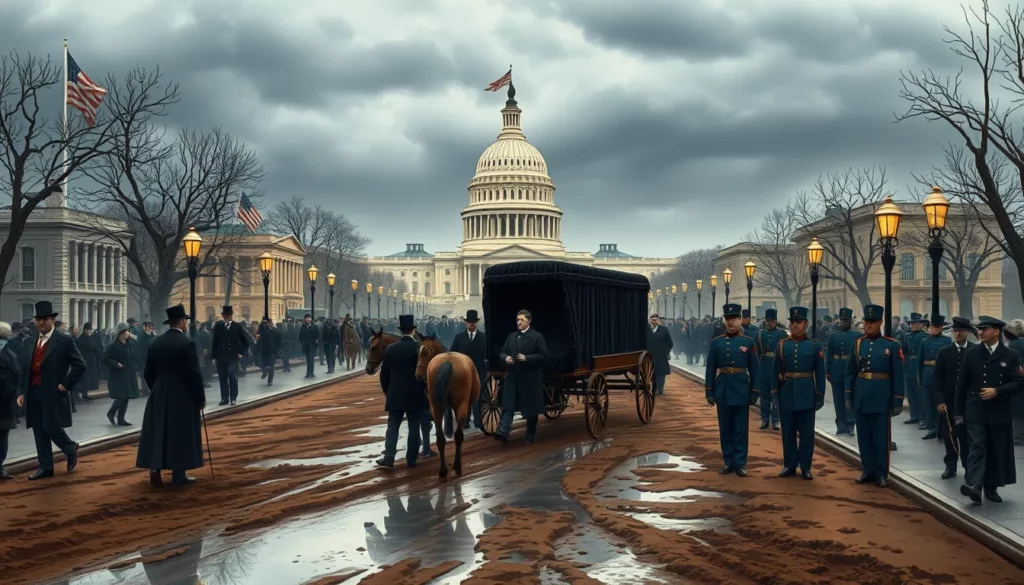
The assassination plunged Washington into a period of intense grief and uncertainty. Thousands of soldiers, government workers, and ordinary citizens lined the streets for the funeral procession. The unfinished Capitol dome, which had symbolized the nation’s divided state, now stood as a backdrop to Lincoln’s funeral. Andrew Johnson, the new president, attempted to dispel the funereal atmosphere by organizing victory parades in May, including the Grand Review of the Armies. Yet the city also grappled with the challenges of Reconstruction, the influx of freedpeople, and the trial of Lincoln’s conspirators.
This article examines Washington in 1865 through the lens of primary sources—newspapers, diaries, letters, photographs, and government documents—to capture a year when the capital became a stage for both national triumph and tragedy.
Washington in 1865
Washington, D.C., in 1865 was a city of contrasts. Situated on the Potomac River between Maryland and Virginia, it was the nation’s capital but still retained the feel of a small Southern town. The city’s climate was humid subtropical, with hot summers and cold winters; the spring of 1865 brought rain and mud, turning unpaved streets into quagmires. The unfinished Capitol dome, a symbol of the war’s interruption, loomed over Pennsylvania Avenue, while a ring of forts and earthworks encircled the city, a reminder of the Confederate threat that had once seemed imminent.
The war had transformed Washington. What had been a quiet city of 75,000 in 1860 was now swollen with soldiers, government clerks, freedpeople, and speculators. Hospitals, barracks, and supply depots dotted the landscape. The streets were crowded with military personnel, horse-drawn carriages, and streetcars. The air was thick with the sounds of drills, the clatter of printing presses, and the constant hum of political debate. Yet beneath the bustle lay a sense of exhaustion from four years of war and a deep anxiety about what peace would bring.
Population & Economy
The population of Washington in 1865 is difficult to pin down precisely, as the city was teeming with transient soldiers, government workers, and freedpeople. The 1860 census recorded 75,080 residents in the District of Columbia. By 1865, that number had likely grown to over 100,000, though no official count exists for that year. The 1870 census, taken five years later, would show 131,700 residents, reflecting the wartime boom. The influx included thousands of African Americans who had fled slavery and settled in the city, particularly after the Compensated Emancipation Act of April 1862 abolished slavery in the District.
The economy was dominated by the federal government and the military. The war had created a demand for everything from uniforms and weapons to food and housing. The government spent millions on supplies, and private contractors flocked to the city. Boarding houses, saloons, and hotels did a brisk business. The cost of living soared; rents were high, and inflation made everyday goods expensive. A room in a boarding house might cost $1 to $2 per day, a significant sum for a laborer. The city’s infrastructure, however, struggled to keep up with the growth, leading to overcrowding and sanitation problems.
Government & Politics
In 1865, Washington was governed by a mayor and a city council, but ultimate authority rested with Congress. The mayor was Richard Wallach, a Unionist who served from 1861 to 1868. Wallach worked to maintain order during the war and supported the Union cause. The political climate was intensely charged. Lincoln’s assassination shocked the nation and elevated Andrew Johnson, a Tennessee Unionist, to the presidency. Johnson’s approach to Reconstruction would soon clash with Radical Republicans in Congress, setting the stage for political battles that would dominate the post-war years.
Key political figures in Washington included Secretary of War Edwin M. Stanton, who managed the war effort and later the hunt for Lincoln’s assassins; Secretary of State William H. Seward, who was also targeted in the conspiracy but survived; and Senator Charles Sumner of Massachusetts, a leading Radical Republican. The city was a hotbed of political intrigue, with lobbyists, office-seekers, and journalists all vying for influence. The emancipation of slaves in the District and the influx of freedpeople added a new dimension to local politics, as debates over civil rights and suffrage began to take shape.
Industry
Washington’s industry was largely tied to the war effort. The Washington Navy Yard, located on the Anacostia River, was a major employer, producing ordnance and repairing ships. The Washington Arsenal, on the site of what is now Fort Lesley J. McNair, manufactured ammunition and weapons. The Government Printing Office, established in 1861, churned out official documents, newspapers, and currency. Private foundries and machine shops also thrived, supplying the army with ironwork, wagons, and equipment.
The city’s service sector boomed as well. Hotels like the Willard and the Metropolitan were packed with politicians, officers, and businessmen. Saloons, restaurants, and brothels catered to soldiers and workers. Newspapers were a major industry: the Daily National Intelligencer, the Evening Star, and the Washington Chronicle competed for readers, their presses running day and night to report on the war and, later, the assassination and its aftermath.
Education
Education in Washington in 1865 was limited but growing. The city had a public school system for white children, but African American children were largely excluded until after the war. Private schools and academies, such as Georgetown College (now Georgetown University) and Columbian College (now George Washington University), provided higher education for the elite. The war had disrupted schooling, with many buildings converted into hospitals or barracks.
The influx of freedpeople created a demand for education. Northern aid societies and the federal government established schools for African Americans, often staffed by volunteer teachers from the North. These “Freedmen’s Schools” were a beacon of hope for newly emancipated people, though they faced opposition and limited resources. Literacy rates among white residents were relatively high, but among African Americans, the legacy of slavery meant that most were illiterate. The efforts to educate freedpeople would become a lasting legacy of the war years.
Transportation
Getting around Washington in 1865 was a challenge. The streets were mostly unpaved, and in wet weather they turned to mud. Horse-drawn streetcars, operated by companies like the Washington and Georgetown Railroad, provided public transit along major avenues. Omnibuses and hacks (horse-drawn carriages for hire) were also common. The city was connected to the rest of the nation by railroads: the Baltimore and Ohio Railroad, the Washington and Alexandria Railroad, and the Baltimore and Potomac Railroad all served the capital. The Potomac River was a busy waterway, with steamboats carrying passengers and goods to and from Virginia and Maryland.
The war had also brought military transportation: supply trains, ambulances, and troop movements were a constant presence. The city’s infrastructure was strained, and congestion was common, especially around the Capitol and the White House.
Everyday Life
Daily life in Washington in 1865 was shaped by the war and its aftermath. Housing was scarce and overcrowded; many people lived in boarding houses or cramped apartments. The city’s sanitation was poor, and outbreaks of disease, such as typhoid and smallpox, were not uncommon. Food was available but expensive; the city markets, like the Centre Market on Pennsylvania Avenue, sold produce, meat, and fish, but prices had risen sharply during the war. Clothing followed Victorian fashions, with women in hoop skirts and men in frock coats and top hats, though many soldiers wore uniforms.
Entertainment included theaters—Ford’s Theatre, where Lincoln was shot, was a popular venue—as well as saloons, churches, and public lectures. Social customs were formal, but the war had loosened some conventions. Mourning became a public ritual after Lincoln’s death, with black crepe draped on buildings and women wearing black. Family life was disrupted by the war, with many men away fighting and women taking on new roles in the workforce.
Major Events
The year 1865 was punctuated by seismic events. On April 9, Lee’s surrender at Appomattox Court House sparked celebrations in Washington. On April 14, Lincoln was shot at Ford’s Theatre by John Wilkes Booth during a performance of Our American Cousin. He died at 7:22 a.m. on April 15 in the Petersen House across the street. The city was plunged into mourning. On April 19, a funeral service was held in the East Room of the White House, followed by a procession to the Capitol Rotunda, where Lincoln lay in state. His body then traveled by train to Springfield, Illinois, retracing his 1861 journey to Washington.
In May, the city hosted the Grand Review of the Armies, a massive military parade on May 23–24 that celebrated the Union victory. The trial of Lincoln’s conspirators began in May before a military commission and continued into June. These events drew thousands of visitors to Washington, further straining the city’s resources.
What Newspapers Were Reporting
Washington’s newspapers in 1865 were filled with dramatic headlines. The Daily National Intelligencer reported on April 10: “The Surrender of General Lee and the Army of Northern Virginia to General Grant.” The Evening Star on April 15 announced: “The Assassination of President Lincoln.” Reports described the scene at Ford’s Theatre, the flight of Booth, and the massive manhunt. On April 20, the Washington Chronicle described the funeral procession: “The streets were thronged with people, and every window was crowded with spectators, all eager to catch a glimpse of the funeral cortege.” Newspapers also covered the Grand Review and the trial of the conspirators, providing a daily record of the city’s emotional rollercoaster.
“The President was shot at Ford’s Theatre last night, and died this morning at twenty-two minutes past seven o’clock.” — Evening Star, April 15, 1865
What People Were Talking About
Conversations in Washington in 1865 were dominated by the war’s end and Lincoln’s assassination. Diaries and letters reveal a mix of relief, grief, and anger. Elizabeth Keckley, Mary Todd Lincoln’s dressmaker, recalled the First Lady’s anguish. Gideon Welles, Secretary of the Navy, wrote in his diary of the “deep gloom” that settled over the city. Rumors swirled about Confederate plots and the possibility of further attacks. People debated the fate of the South and the future of freedpeople. The trial of the conspirators was a constant topic, with speculation about who else might be involved. There was also hope: the end of the war meant that soldiers would soon return home, and the city could begin to rebuild.
Historical Photographs
Photographs from 1865 provide a powerful visual record of Washington during this pivotal year. Mathew Brady and Alexander Gardner had studios in the city and documented the era. There are photographs of Lincoln, including the last known portrait taken in February 1865, and images of Ford’s Theatre and the Petersen House. Photographers captured the funeral procession and the Grand Review, showing vast crowds and military formations. These images are invaluable for understanding the scale of events and the expressions on people’s faces. They also reveal the city’s architecture, from the unfinished Capitol dome to the rows of government buildings and hospitals.
Documents & Primary Sources
Historians studying Washington in 1865 rely on a rich array of primary sources. These include:
- Newspapers: The Daily National Intelligencer, Evening Star, and Washington Chronicle are available on microfilm and in digital archives.
- Diaries and letters: Gideon Welles’s diary, Elizabeth Keckley’s memoir, and the letters of soldiers and civilians held at the Library of Congress and the National Archives.
- Government records: The 1860 and 1870 censuses, military records, and congressional documents.
- Photographs: The Mathew Brady and Alexander Gardner collections at the National Archives and the Library of Congress.
- Maps: Civil War-era maps of Washington, including the defenses and street layouts.
1865 Timeline
| Date | Event |
|---|---|
| January 1 | New Year’s Day receptions at the White House; war still raging. |
| February 11 | Lincoln permits sculptor Clark Mills to make a life mask. |
| March 4 | Lincoln’s second inauguration; the Capitol dome is completed. |
| April 9 | Lee surrenders to Grant at Appomattox; Washington celebrates. |
| April 11 | Lincoln delivers his last public speech, advocating for Black suffrage. |
| April 14 | Lincoln is shot at Ford’s Theatre by John Wilkes Booth. |
| April 15 | Lincoln dies at 7:22 a.m.; Andrew Johnson becomes president. |
| April 19 | Funeral service at the White House; procession to the Capitol. |
| April 21 | Lincoln’s body leaves Washington for Springfield. |
| May 10 | Jefferson Davis captured in Georgia. |
| May 23–24 | Grand Review of the Armies on Pennsylvania Avenue. |
| May–June | Trial of Lincoln conspirators before a military commission. |
| July 7 | Four conspirators are hanged at the Washington Arsenal. |
What Changed Next
The events of 1865 set Washington on a new course. The city continued to grow, its population reaching 131,700 by 1870. The federal government expanded its role in Reconstruction, and Washington became a center for debates over civil rights, suffrage, and the meaning of the war. The assassination of Lincoln elevated him to martyrdom and shaped the nation’s memory of the Civil War. The trial of the conspirators and the hanging of four of them at the Washington Arsenal marked the end of the conspiracy but not the end of political violence. In the following years, President Johnson’s clashes with Congress led to his impeachment trial in 1868. Washington would remain the stage for these national dramas, its identity forever tied to the year it witnessed both the end of the war and the death of its president.
Sources
- Leech, Margaret. Reveille in Washington, 1860–1865. New York: Harper & Brothers, 1941.
- Smithsonian National Museum of American History. “Abraham Lincoln.” https://americanhistory.si.edu/explore/exhibitions/american-presidency/online/life-and-death/death-mourning/lincoln.
- Wikipedia. “Washington, D.C., in the American Civil War.” https://en.wikipedia.org/wiki/Washington,_D.C._in_the_American_Civil_War.
- Steers, Edward. The Lincoln Assassination Encyclopedia. New York: Harper Perennial, 2010.
- Kauffman, Michael W. American Brutus: John Wilkes Booth and the Lincoln Conspiracies. New York: Random House, 2004.
FAQ
What was the population of Washington, D.C., in 1865?
The exact population is unknown due to the transient wartime population, but it was likely over 100,000, up from 75,080 in 1860 and growing to 131,700 by 1870.
What major events happened in Washington in 1865?
Key events include Lee’s surrender (April 9), Lincoln’s assassination (April 14) and death (April 15), his funeral (April 19), the Grand Review of the Armies (May 23–24), and the trial and hanging of conspirators (May–July).
What primary sources are available for studying Washington in 1865?
Newspapers like the Daily National Intelligencer and Evening Star, diaries such as Gideon Welles’s, Elizabeth Keckley’s memoir, photographs by Mathew Brady and Alexander Gardner, census records, and government documents at the National Archives.
How did daily life in Washington in 1865 differ from today?
Daily life was marked by overcrowding, poor sanitation, horse-drawn transportation, gas lighting, and the constant presence of soldiers and war wounded. Modern conveniences like electricity, cars, and telephones did not exist.










Leave a Reply