
Short Answer
In the summer of 1963, as the March on Washington gathered at the Lincoln Memorial, the air was thick with hope and tension. African Americans and their allies had endured decades of segregation, violence, and disenfranchisement. Yet on that day, over 250,000 people stood together, demanding jobs and freedom. The civil rights movement, which spanned the 1950s and 1960s, was a coordinated crusade led by African Americans to end racial discrimination. Its story is preserved in primary sources—newspaper headlines, personal letters, photographs, and oral histories—that capture the raw emotions of the era. From the Supreme Court’s 1954 Brown v. Board decision to the Selma to Montgomery marches of 1965, these documents reveal how contemporaries understood their struggle. They show the courage of Rosa Parks, who refused to give up her bus seat; the determination of the Little Rock Nine; and the eloquence of Martin Luther King Jr., who wrote from a Birmingham jail that ‘injustice anywhere is a threat to justice everywhere.’ This article draws on these primary sources to reconstruct the movement as it was experienced, offering a window into a pivotal moment in American history.
What Happened?
The civil rights movement was a nationwide effort to secure equal rights for African Americans and end racial segregation. It took many forms, including sit-ins, boycotts, protest marches, freedom rides, and lobbying for legislative action. Key events include:
- Brown v. Board of Education (1954): The Supreme Court unanimously ruled that racial segregation in public schools was unconstitutional, overturning the “separate but equal” doctrine. Newspaper coverage proclaimed “Supreme Court Kills Segregation” (Library of Congress).
- Montgomery Bus Boycott (1955–1956): On December 1, 1955, Rosa Parks was arrested for refusing to surrender her bus seat to a white passenger. Her arrest sparked a 381-day boycott of Montgomery’s buses, led by Martin Luther King Jr., which ended when the Supreme Court ruled segregation on public buses unconstitutional.
- Little Rock Nine (1957): Nine African American students attempted to integrate Central High School in Little Rock, Arkansas, facing violent mobs. President Eisenhower dispatched federal troops to ensure their safety.
- Sit-ins and Freedom Rides (1960–1961): Students at lunch counters and activists on interstate buses challenged segregation through nonviolent direct action, often facing arrest and violence.
- Birmingham Campaign (1963): Protests in Birmingham, Alabama, met with police brutality, including fire hoses and attack dogs. The bombing of the 16th Street Baptist Church killed four young girls, galvanizing national outrage.
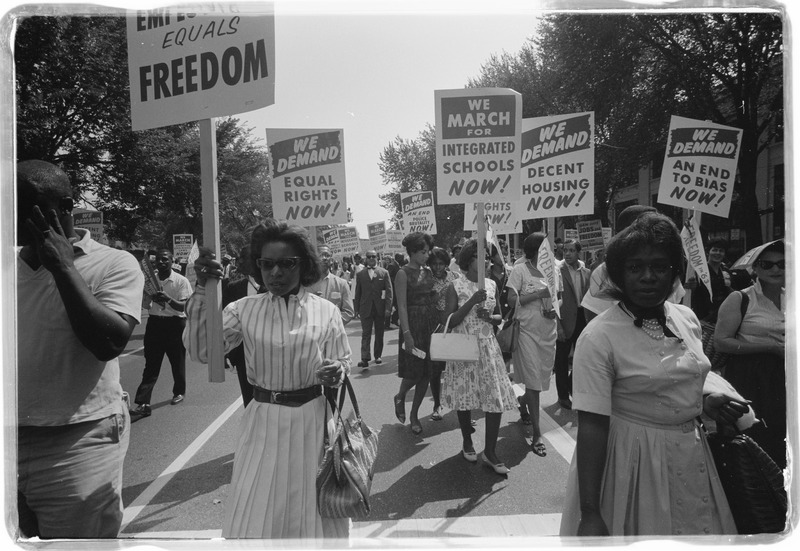
- March on Washington (1963): On August 28, over 250,000 people gathered at the Lincoln Memorial, where King delivered his “I Have a Dream” speech.
- Civil Rights Act (1964) and Voting Rights Act (1965): Following the Selma to Montgomery marches, Congress passed landmark legislation outlawing discrimination in public accommodations and protecting voting rights.
These events, documented in primary sources, transformed American law and society.
How It Was Seen at the Time
Contemporaries saw the civil rights movement as a moral struggle between justice and oppression. Many African Americans expressed a determination to end segregation, while white segregationists resisted fiercely. Rosa Parks later recalled her motivation: “People always say that I didn’t give up my seat because I was tired, but that isn’t true. I was not tired physically… No, the only tired I was, was tired of giving in.” (In her memoir, Parks wrote this reflection on her 1955 arrest, which is documented in the Library of Congress’s primary source set.)
“Injustice anywhere is a threat to justice everywhere.” — Martin Luther King Jr., “Letter from Birmingham Jail,” 1963
King’s letter, written in April 1963 and published in the Evening Star that year, became a manifesto for nonviolent resistance. The prevailing mood among activists was one of hope and urgency. The March on Washington was seen as a turning point, with organizers Bayard Rustin and Cleveland Robinson planning the event. Photographs show the Lincoln Memorial crowded with participants, many holding signs for jobs and freedom.
Historical Snapshot
| Aspect | Detail |
|---|---|
| Date | 1954–1965 (key events: Brown v. Board, 1954; Montgomery Bus Boycott, 1955–56; Little Rock, 1957; Birmingham, 1963; March on Washington, 1963; Selma, 1965) |
| Place | Montgomery, Alabama; Little Rock, Arkansas; Birmingham, Alabama; Washington, D.C.; Selma, Alabama |
| People | Rosa Parks, Martin Luther King Jr., Thurgood Marshall, the Little Rock Nine, Bayard Rustin, John Lewis |
| What Happened | Nonviolent protests, legal challenges, and civil disobedience against racial segregation and disenfranchisement |
| Why It Mattered | Led to the Civil Rights Act of 1964 and Voting Rights Act of 1965, ending legal segregation and protecting voting rights |
Contemporary Newspaper Coverage
Newspapers played a crucial role in shaping public perception of the civil rights movement. The Library of Congress holds a primary source set that includes a newspaper clipping with the headline “Supreme Court Kills Segregation” from the Brown v. Board decision. This headline captured the momentous nature of the ruling. Coverage of the Montgomery Bus Boycott and the March on Washington was extensive, with photographs and articles documenting the events. The Evening Star published King’s “Letter from Birmingham Jail” in 1963, bringing his words to a national audience. Press reports often reflected the racial tensions of the era, with some Southern newspapers defending segregation while national outlets highlighted the injustices.
“Supreme Court Kills Segregation” — Headline from a newspaper covering Brown v. Board of Education, 1954 (Library of Congress)
Eyewitness Accounts
Eyewitness accounts provide intimate glimpses into the movement. Rosa Parks, whose arrest on December 1, 1955, sparked the Montgomery Bus Boycott, later described her refusal to give up her seat: “People always say that I didn’t give up my seat because I was tired, but that isn’t true. I was not tired physically… No, the only tired I was, was tired of giving in.” (This quote is from her memoir, and the arrest is documented in the Library of Congress’s primary source set.)
Freeman A. Hrabowski, who was a child at the time, remembered the bombing of the 16th Street Baptist Church in Birmingham, which killed four girls. His testimony, preserved in the Library of Congress’s oral history collection, conveys the horror and resolve that followed. In a recorded interview, he described the impact of the event on the community and his determination to fight for justice.
“I remember the bombing of the 16th Street Baptist Church. It was a turning point for me and for many others.” — Freeman A. Hrabowski, oral history, Library of Congress
Letters & Diaries
Personal letters and diaries offer a window into the thoughts of activists. Martin Luther King Jr.’s “Letter from Birmingham Jail,” written in April 1963, is a seminal document. In it, he defended nonviolent resistance and wrote, “Injustice anywhere is a threat to justice everywhere.” The letter was published in the Evening Star in 1963, reaching a wide audience. Other letters, such as those from students involved in sit-ins, reveal the personal sacrifices made. The Civil Rights Movement Archive preserves many such documents, including internal organizational letters and personal correspondence, which show the strategic planning and emotional toll of the struggle.
“Injustice anywhere is a threat to justice everywhere.” — Martin Luther King Jr., “Letter from Birmingham Jail,” 1963
Key Documents
- Brown v. Board of Education decision (1954) — Supreme Court ruling that declared segregation in public schools unconstitutional.
- Rosa Parks’s arrest record (1955) — The police report that triggered the Montgomery Bus Boycott.
- Martin Luther King Jr.’s “Letter from Birmingham Jail” (1963) — A defense of nonviolent civil disobedience.
- Program for the March on Washington (1963) — The official schedule and list of speakers, including King’s address.
- Civil Rights Act of 1964 and Voting Rights Act of 1965 — Landmark legislation that outlawed discrimination and protected voting rights.
Aftermath
The civil rights movement achieved major legislative victories with the Civil Rights Act of 1964 and the Voting Rights Act of 1965. However, the struggle continued, with ongoing resistance and violence. The movement’s legacy is preserved in archives and primary source collections, allowing future generations to understand the sacrifices made. The Library of Congress and the Civil Rights Movement Archive provide access to these materials, ensuring that the voices of the past remain audible.
The primary sources of the civil rights movement—newspapers, letters, photographs, and oral histories—offer an unmediated view of a transformative era. They capture the courage of individuals like Rosa Parks and Martin Luther King Jr., the fear of facing violent mobs, and the hope for a better future. By examining these documents, we gain a deeper appreciation of the movement’s complexity and its enduring impact on American society.
FAQ
What role did primary sources play in understanding the civil rights movement?
Primary sources such as newspapers, letters, photographs, and oral histories provide direct evidence of how contemporaries experienced the movement. They capture the emotions, strategies, and daily realities of activists and opponents, offering a more nuanced view than secondary interpretations. For example, Rosa Parks's own account of her arrest and Martin Luther King Jr.'s 'Letter from Birmingham Jail' reveal the personal motivations and philosophical underpinnings of the struggle.
How did newspapers cover the Brown v. Board decision?
Newspapers covered the Brown v. Board decision with dramatic headlines, such as 'Supreme Court Kills Segregation,' as preserved in the Library of Congress's primary source set. The coverage reflected the significance of the ruling, which declared racial segregation in public schools unconstitutional. Some Southern newspapers resisted the decision, while national outlets highlighted its importance.












Leave a Reply