
Short Answer
Quick Snapshot
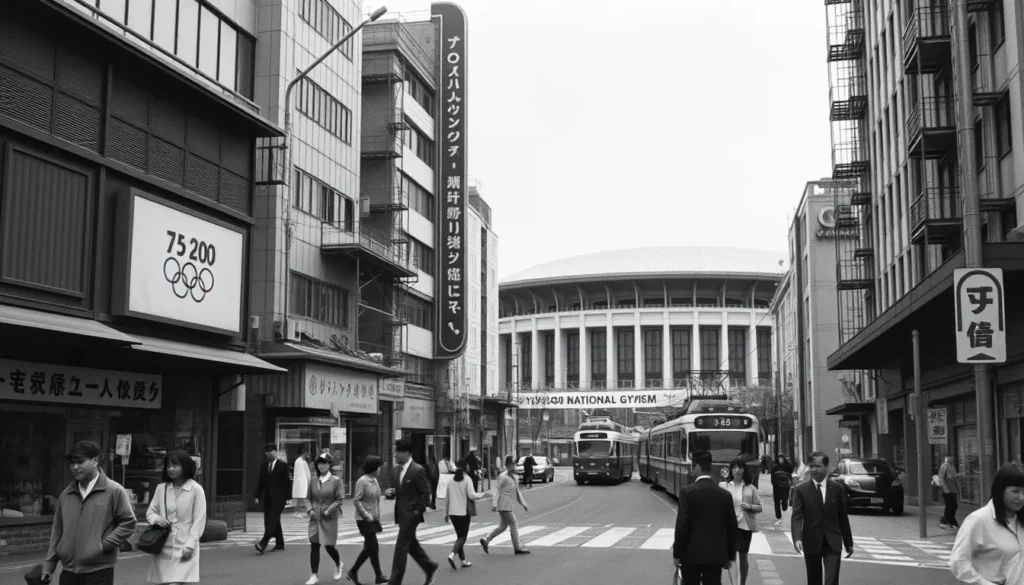
Tokyo in 1964 stood at the hinge of postwar recovery and global arrival. The city was still a patchwork of wooden neighborhoods, tram lines, canals and new concrete expressways, but the 1964 Summer Olympics, held from 10 to 24 October, gave it an unmissable international stage. The Games were the first Olympics in Asia and were presented as proof that Japan had moved from defeat and occupation to a modern industrial democracy.
The year was also marked by the Tokaido Shinkansen, opened on 1 October 1964, and by a rush of infrastructure: expressways, subways, hotels, airport links and sports venues. Yet historians such as Christian Tagsold caution that the Olympics did not completely transform Japan; rather, they symbolized and accelerated changes already under way. The Games allowed Japan to rebrand itself as modern and peaceful while subtly rehabilitating symbols, including Emperor Hirohito, that had been compromised by the war.
For ordinary Tokyoites, 1964 was a year of excitement, disruption and aspiration. Construction dust, traffic controls and crowded trains coexisted with television broadcasts, souvenir shops, school outings and street-corner discussions of the ‘Olympic blue’ sky.
Tokyo in 1964
Tokyo lay on the Kantō Plain at the head of Tokyo Bay, crossed by rivers such as the Sumida and Arakawa and ringed by growing suburbs. The metropolitan area was still visibly scarred by wartime firebombing, but rebuilding had been rapid. Low-rise wooden houses, narrow lanes, small factories and neighborhood shops stood beside department stores, office buildings and new concrete structures. The Olympics focused attention on Shinjuku, Shibuya, Yoyogi, Komazawa and the waterfront, where venues and roads were rushed to completion.
Autumn in Tokyo is generally mild and clear, and the 10 October opening took place under bright skies that newspapers and later reminiscences remembered as ‘Olympic blue’. Organizers nevertheless feared typhoons and heavy rain during the Olympic season, and construction schedules were driven by the fixed deadline. The atmosphere was not simply festive. It was also tense, hurried and self-conscious, as authorities and residents knew that foreign visitors, journalists and television audiences would judge the city.
Population & Economy
Tokyo Metropolis had roughly 10.8 million residents by 1964, with the wider metropolitan region substantially larger. Migration from rural areas, suburban expansion and the return of population to the capital had made Tokyo one of the world’s largest cities. The economy was booming. Japan’s high-growth era, supported by the income-doubling plan of Prime Minister Ikeda Hayato, had raised living standards and consumer spending. Tokyo was the center of finance, publishing, manufacturing, transport and government services.
Employment was expanding in construction, engineering, electronics, retail and office work. Olympic preparations created demand for cement, steel, machinery, furniture, textiles and hotel services. For many households, televisions, washing machines and refrigerators were becoming symbols of a new middle-class life, even as housing remained cramped and prices rose. The Games were promoted as a national investment, but the benefits and burdens were unevenly distributed across wards and neighborhoods.
Government & Politics
Tokyo was governed by Governor Ryōtarō Azuma, who served from 1959 to 1967, alongside the Tokyo Metropolitan Assembly and ward authorities. National politics were dominated by the Liberal Democratic Party, which had overseen Japan’s conservative postwar settlement and economic growth. Prime Minister Ikeda Hayato was in office during the Olympics; he resigned shortly afterward because of ill health and was succeeded by Satō Eisaku in November 1964.
The Olympics gave national and municipal authorities a powerful argument for speed. Land acquisition, road building, slum clearance and building regulations were pushed forward in the name of international prestige. As Tagsold notes, advocates could use the Olympic deadline and the fear of embarrassment to overcome opposition. The Games also required careful political symbolism. Emperor Hirohito declared the Games open, but his role was framed as patron of the Olympics rather than head of state, a subtle distinction intended to avoid domestic and international controversy.
Industry
Tokyo’s economy combined heavy industry, light manufacturing and services. Factories in Tokyo and the nearby Keihin industrial belt produced machinery, chemicals, printed materials, cameras, watches, electrical goods and consumer appliances. Construction firms and engineering companies worked at full speed on stadiums, hotels, expressways, subway extensions and the Shinkansen. Seiko served as official timekeeper for the Tokyo Olympics and used the occasion to display Japanese precision timing, including quartz technology.
The Games also boosted tourism, retail and advertising. Department stores prepared displays and souvenirs, hotels trained staff for foreign guests, and publishers issued maps, guides and commemorative books. Small workshops remained important in the city’s neighborhoods, but the direction of policy and investment favored large firms, modern infrastructure and Tokyo’s role as a national command center.
Education
Japan’s postwar education system provided nine years of compulsory schooling, and high-school attendance was rising steadily. Tokyo was home to prestigious institutions including the University of Tokyo, Waseda University, Keio University, Hitotsubashi University and the Tokyo Institute of Technology. Literacy was near universal, and competition for entrance examinations was intense.
Schools also participated in the Olympic mood. Students learned about the Games, practiced English phrases for visitors and followed events in newspapers and on television. At the same time, universities were sites of political debate. The memory of the 1960 Anpo protests against the U.S.-Japan security treaty remained alive, and student activism would grow again later in the decade. In 1964, however, the dominant public language was less protest than national achievement and international recognition.
Transportation
Transport was transformed in 1964. On 1 October the Tokaido Shinkansen opened between Tokyo and Osaka, using the sleek 0 Series trains and cutting the journey to about four hours. The Tokyo Monorail began service on 17 September, linking Haneda Airport with Hamamatsuchō. New expressways, widened roads and subway extensions were rushed into service, while trams, buses, taxis and the Yamanote loop line continued to carry millions of daily passengers.
The improvements were impressive but incomplete. Traffic congestion, crowded trains and construction detours were part of daily life. Olympic traffic controls and parking restrictions were imposed in central areas. For many Tokyoites, the Shinkansen and monorail were dazzling symbols of a future that had arrived, even as the ordinary commute remained slow, smoky and crowded.
Everyday Life
Daily life in Tokyo mixed old and new. Families might live in wooden houses with tatami rooms, futons, family altars and small kitchens, or in newer danchi apartment blocks. Rice, miso soup, grilled fish, pickles and noodles remained staples, while bread, curry, coffee and Western-style restaurants were increasingly familiar. Clothing ranged from kimono and work uniforms to the suits, dresses and school uniforms of a modernizing city.
Television was central to the year. The Tokyo Olympics were the first Games broadcast internationally by satellite, including live pictures to North America via Syncom 3, and NHK carried extensive coverage in Japan. Families and neighbors gathered around TV sets, and public viewing spaces attracted crowds. Movies, baseball, coffee shops, pachinko parlors and department stores offered entertainment. Women increasingly worked in offices and shops as ‘office ladies’, though gender roles remained conservative. For many, 1964 felt like a threshold: the war was receding, but material comfort was still new and unevenly shared.
Major Events
The central event was the 1964 Summer Olympics. The opening ceremony on 10 October featured athletes from around the world, and the final torch was lit by Yoshinori Sakai, born in Hiroshima on 6 August 1945, a choice that symbolically linked the Games to the atomic bombing. The torch relay had begun in Okinawa, then under United States administration, adding another layer of postwar meaning. Kenzo Tange’s Yoyogi National Gymnasium, with its sweeping suspended roof, became the architectural emblem of the Games, linked by an axis to Meiji Shrine.
Other milestones included the Shinkansen and monorail openings, Japan’s accession to the OECD in April 1964, and the Tokyo Paralympics in November. The Games were also a media event, showcasing color television, satellite transmission and Japanese cameras and timing equipment. Politically, the year ended with Satō Eisaku becoming prime minister, marking a new phase in Japan’s postwar leadership.
What Newspapers Were Reporting
Tokyo’s major newspapers, including the Asahi Shimbun, Yomiuri Shimbun and Mainichi Shimbun, gave saturation coverage to the Olympics. Banner headlines announced the opening ceremony, medal results, new records and the arrival of foreign athletes. The Shinkansen received extensive attention as a symbol of Japanese engineering, with reports on its speed, safety and sleek design. Newspapers also published maps of Olympic venues, expressway routes and traffic restrictions.
Editorials generally framed the Games as Japan’s return to the community of nations and as proof of postwar reconstruction. Advertisements promoted televisions, cameras, watches, beer and travel. At the same time, papers reported on congestion, delays, weather worries and the cost of preparations. The tone was celebratory but not uniformly uncritical; readers were reminded that the world was watching and that the city’s performance would shape Japan’s image.
What People Were Talking About
Public conversation centered on the Olympics, the Shinkansen and the new face of Tokyo. People talked about ‘Olympic blue’, the handsome Yoyogi gymnasium, the foreign visitors and the emotional moment when Sakai lit the cauldron. The torch relay from Okinawa prompted reflection on Japan’s postwar boundaries and the U.S. presence. Families debated whether to buy a television, and workers discussed the new expressways and the disruption caused by construction.
There were also concerns about evictions, land prices, traffic accidents and pollution. Some intellectuals questioned whether national prestige should be measured by spectacle. Ishihara Shintarō wrote in 1964:
‘It is a bit frivolous to dwell on the Olympics regarding the fate of the state and its people, since the relationship between both is substantially weak. But since we have this opportunity anyway, why not start by slowly reconsidering ourselves, and our present situation?’
Such comments reveal that the Games were not merely a celebration; they were also an occasion for self-examination.
Historical Photographs
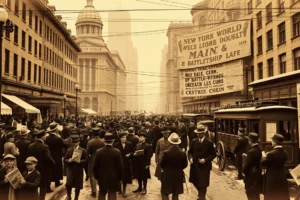
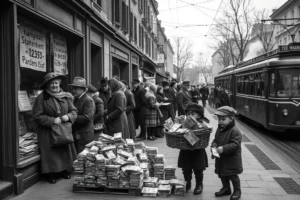
An abundant photographic record survives. Newspaper photographers and agencies captured the opening ceremony, Emperor Hirohito declaring the Games open, athletes marching in the National Stadium and Yoshinori Sakai lighting the cauldron. Images of Kenzo Tange’s Yoyogi National Gymnasium show its dramatic roof and the crowds drawn to the new architecture. Photographs also document the Shinkansen’s first trains, the Tokyo Monorail, construction sites, traffic jams and street scenes of souvenir shops and public television viewing.
Collections such as the Mainichi Photobank, the Asahi Shimbun Photo Archive, the Tokyo Metropolitan Archives and NHK’s broadcast footage preserve these images. They are valuable not only as records of famous events but also as evidence of everyday life: schoolchildren in uniforms, workers in helmets, housewives shopping, and families gathered around television sets.
Documents & Primary Sources
- The official report of the Organizing Committee for the Games of the XVIII Olympiad, Tokyo 1964, which documents venues, ceremonies, results and operations.
- Tokyo Metropolitan Government records on urban planning, roads, land acquisition and Olympic preparations.
- Japanese census and population statistics for Tokyo Metropolis in the early 1960s.
- Newspapers such as the Asahi Shimbun, Yomiuri Shimbun and Mainichi Shimbun, including advertisements, maps and editorials.
- NHK television and radio broadcasts, Olympic posters, tickets, photographs and personal diaries from Tokyo residents.
1964 Timeline
| Date | Event |
|---|---|
| 28 April 1964 | Japan becomes a member of the OECD. |
| 17 September 1964 | Tokyo Monorail opens between Haneda Airport and Hamamatsuchō. |
| 1 October 1964 | Tokaido Shinkansen opens between Tokyo and Osaka. |
| 10 October 1964 | Tokyo Olympics opening ceremony; Yoshinori Sakai lights the cauldron. |
| 24 October 1964 | Tokyo Olympics closing ceremony. |
| 8–12 November 1964 | Tokyo Paralympics are held. |
| 9 November 1964 | Satō Eisaku becomes Prime Minister of Japan. |
What Changed Next
The 1964 Olympics did not create modern Japan by themselves, but they gave postwar transformation a powerful public symbol. The Shinkansen network expanded, expressways multiplied, and Tokyo consolidated its role as a global city. The Olympics also left a legacy of sports facilities and urban infrastructure, though pollution, housing shortages and congestion worsened in the following years. In 1967 Ryokichi Minobe was elected governor of Tokyo on a reformist platform, signaling new concerns about welfare and the environment.
The 1970 Osaka Expo and the 1972 reversion of Okinawa continued Japan’s postwar normalization. Later, Tokyo would host the 2020 Olympics, often invoking 1964 as a founding myth of national revival. Historians continue to debate that legacy, but the images of 1964—the Shinkansen, the Yoyogi gymnasium, the cauldron and the crowded streets—remain central to how Japan remembers its emergence from the shadow of war.
Sources
- Tagsold, Christian. ‘Symbolic Transformation: The 1964 Tokyo Games Reconsidered.’ Japan Focus, 2020. https://doi.org/10.1017/s1557466020029514
- Tagsold, Christian. ‘Modernity, space and national representation at the Tokyo Olympics 1964.’ Urban History, 2010. https://www.cambridge.org/core/journals/urban-history/article/abs/modernity-space-and-national-representation-at-the-tokyo-olympics-1964/786B2D8E20744FCF5A804C8A1ECFCD30
- Organizing Committee for the Games of the XVIII Olympiad. The Games of the XVIII Olympiad: Tokyo 1964 Official Report. Tokyo, 1964.
- Tokyo Metropolitan Government. Tokyo Metropolitan Archives: Olympic and urban planning records.
FAQ
What was the population of Tokyo in 1964?
Tokyo Metropolis had roughly 10.8 million residents in 1964, with the wider metropolitan region substantially larger.
What major events happened in Tokyo in 1964?
The 1964 Summer Olympics were held from 10 to 24 October. The Tokaido Shinkansen opened on 1 October, the Tokyo Monorail opened in September, Japan joined the OECD, and the Tokyo Paralympics followed in November.
What primary sources are available for studying Tokyo in 1964?
Key sources include the Tokyo 1964 official report, Tokyo Metropolitan Government records, census statistics, newspapers such as Asahi Shimbun and Yomiuri Shimbun, NHK broadcasts, photographs, posters, tickets and personal diaries.
How did daily life in Tokyo in 1964 differ from today?
Daily life was marked by crowded trains, trams, wooden housing, tatami rooms and rising but limited consumer ownership. Televisions were newly central, smartphones and digital communications did not exist, and many households still lacked modern conveniences now taken for granted.










Leave a Reply