
Short Answer
In October 1973, Kuwait City was a crossroads of anxiety and ambition. The Yom Kippur War raged, and the United States had just pledged $2.2 billion in emergency military aid to Israel. On October 19, the Organization of Arab Petroleum Exporting Countries (OAPEC) struck back with an oil embargo that would quadruple prices and transform the global economy. Kuwait, a founding member of OAPEC, stood at the center. Its oil minister, Abdul Rahman al-Atiqi, explained to the American ambassador that the cuts were deliberate: a cumulative reduction in production designed to force Israel to withdraw and to restore Palestinian rights. For Kuwaitis, the embargo was a moment of power and pride; for Americans, it was a season of gas lines and inflation. This article reconstructs the crisis through contemporary reports, official documents, and the voices of those who lived it.
What Happened?
The 1973 oil embargo unfolded in a swift sequence of decisions and counter-decisions. The Arab-Israeli conflict of October 1973—known as the Yom Kippur War—prompted the United States to resupply the Israeli military. On October 17, the eleven members of OAPEC announced an immediate 5 percent cutback in oil production, to be followed by successive monthly cuts of 5 percent until Israel withdrew from territories occupied in 1967 and the legal rights of the Palestinians were restored. In a separate move, the six Persian Gulf members of OPEC unilaterally raised the price of oil by 70 percent, from $3.01 to $5.12 a barrel.
Then, on October 19, 1973, immediately after President Richard Nixon requested $2.2 billion in emergency aid to Israel, OAPEC instituted a total embargo on oil exports to the United States. The embargo was later extended to the Netherlands, Portugal, and South Africa. Production cuts continued, and by January 1974 the price of oil had risen from $2.90 a barrel before the embargo to $11.65 a barrel—a near quadrupling. The embargo lasted until March 1974, when OAPEC members, citing progress in peace negotiations, agreed to lift it.
Kuwait played a prominent role. According to a U.S. State Department historical document, the Kuwaiti Minister of Oil and Finance, Abdul Rahman al-Atiqi, explained to Ambassador William A. Stoltzfus on October 18 that the cumulative effect of the initial production reductions was intended to result in a total embargo against the United States. Kuwait was among several countries that announced or threatened a total embargo, including Libya and Saudi Arabia.
How It Was Seen at the Time
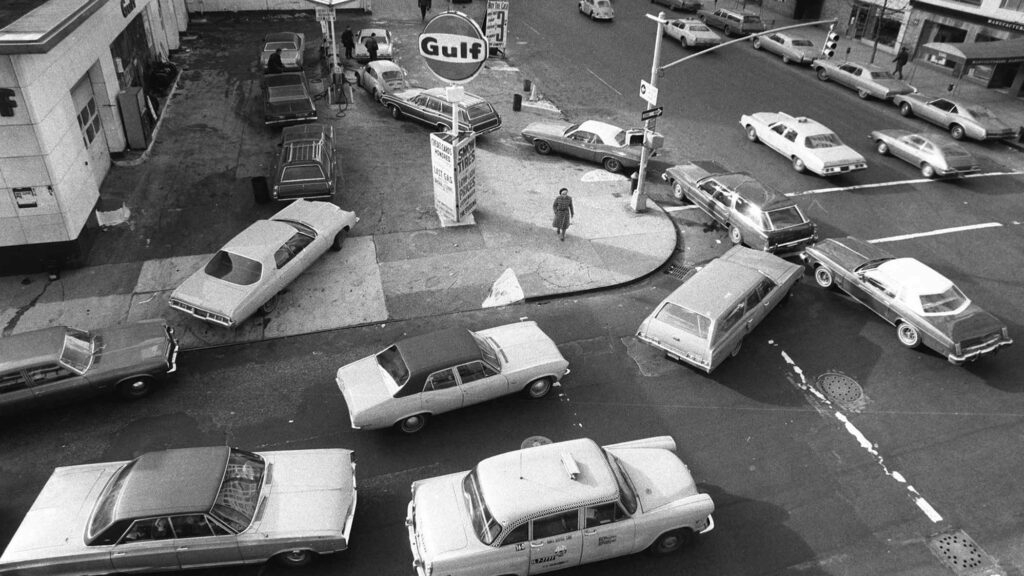
Contemporary observers saw the embargo as a watershed. The Federal Reserve History notes that the embargo “complicated the macroeconomic environment” of the early 1970s, which was already troubled by inflation and a falling dollar. In the United States, drivers faced long lines at gas stations, and signs read “Gas shortage! Sales limited to 10 gallons of gas per customer.” The mood was one of shock and bewilderment; Americans had never felt so vulnerable to foreign energy politics.
In Kuwait, the mood was more triumphant. The government saw the embargo as a legitimate weapon of diplomacy. As Minister al-Atiqi told the U.S. ambassador, the cutbacks were intended to “result in a total reduction of oil production” until Israel withdrew to the 1967 frontiers and the “legal rights” of the Palestinians were restored. The official language of the time emphasized solidarity with the Arab cause and the use of oil as a political lever.
Historical Snapshot
| Aspect | Detail |
|---|---|
| Date | October 19, 1973 – March 1974 |
| Place | Kuwait, other Arab oil-producing states, and the global market |
| People | OAPEC members (Kuwait, Saudi Arabia, Libya, Abu Dhabi, etc.), U.S. President Richard Nixon, Kuwaiti Minister Abdul Rahman al-Atiqi |
| What Happened | OAPEC imposed an embargo on the U.S. and other Israel supporters, with production cuts and price increases. |
| Why It Mattered | Oil prices quadrupled, causing global economic disruption and signaling the rise of petro-power. |
Official Reports
The U.S. State Department’s historical series (FRUS) records the events in detail. The editorial note from Volume XXV, Arab-Israeli Crisis and War, 1973, states that on October 17, OAPEC announced a 5% production cut, and on October 19, the embargo was imposed. The same report notes that the six Gulf OPEC members raised prices by 70% from $3.01 to $5.12 a barrel. The Federal Reserve’s history of the oil shock confirms the price increase to $11.65 a barrel by January 1974 and emphasizes the embargo’s effect on U.S. monetary policy.
These official documents also reveal the internal Kuwaiti perspective. The FRUS editorial note recounts the conversation between the Kuwaiti Minister and the U.S. Ambassador, showing that Kuwait was not only a participant but also an architect of the production cut strategy. The cumulative cut was intended to create a “total embargo” against the United States, a clear statement of Kuwait’s intentions.
Different Perspectives
The Kuwaiti Perspective
From Kuwait’s vantage, the embargo was a justifiable measure to assert Arab rights. The Kuwaiti government, as noted in the FRUS, explained that the production cuts were designed to force Israel to withdraw and to restore Palestinian legal rights. Kuwait also used the crisis to solidify its leadership in the Arab world, as highlighted in a 2024 study by Shigeto Kondo, which emphasizes Kuwait’s diplomacy in shaping Arab oil policies.
The American Perspective
For the United States, the embargo was a political and economic shock. The Federal Reserve history describes it as a “major complication” to the already difficult macroeconomic environment. The U.S. government saw the embargo as a retaliation for its support of Israel, and it prompted a search for energy independence. The State Department’s history notes that the embargo both banned exports to the U.S. and introduced production cuts, which destabilized a decades-old pricing system.
What People Feared
At the time, the embargo sparked fears of a permanent oil shortage and a global economic collapse. In the United States, the public feared that gas rationing would become permanent, and that the cost of living would spiral. The Federal Reserve noted that the embargo “complicated” inflation and added to the “Great Inflation” of the 1970s. There were also fears that the embargo would lead to a military conflict in the Middle East, or that the oil companies would lose control of pricing to producing nations. In Kuwait, the government worried about the long-term consequences of using oil as a weapon, including the risk of retaliation by the West.
Aftermath
The embargo ended in March 1974, but its effects persisted. The price of oil remained high, and the global economy entered a period of stagflation. The United States established the Strategic Petroleum Reserve and began to push for fuel efficiency standards. For Kuwait, the crisis brought unprecedented wealth and influence. Oil revenues surged, and Kuwait became a major investor in the global economy. The embargo also reshaped the oil industry: the power of OPEC grew, and the era of cheap oil was over.
How Historians See It Today
Historians now view the 1973 embargo as a pivotal moment in the rise of petro-power. Contemporary reports focused on the immediate crisis, but modern scholarship, such as the 2024 study by Shigeto Kondo, emphasizes Kuwait’s diplomatic role in the formulation of Arab oil policies. Historians argue that the embargo was not simply a punitive act but a calculated strategy to use oil as leverage in the Arab-Israeli conflict. The embargo also accelerated the shift from a buyer’s market to a producer’s market, and it permanently altered the global economic order. The Federal Reserve history notes that the crisis exposed the U.S. economy’s vulnerability to foreign oil, a lesson that still resonates.
In conclusion, the 1973 oil embargo was a turning point that reshaped Kuwait’s role in the world and transformed the global economy. The primary sources—from the U.S. State Department’s official records to the Federal Reserve’s analysis—reveal a crisis that was as much about economic power as about geopolitics. Kuwait’s own actions, as explained by its minister, show a nation embracing its new influence. The embargo ended, but the world was never the same.
FAQ
Why did Kuwait participate in the 1973 oil embargo?
Kuwait participated as a member of OAPEC, using oil as a political weapon to pressure the United States to change its support for Israel during the Yom Kippur War. The Kuwaiti Minister of Oil and Finance, Abdul Rahman al-Atiqi, explained that the production cuts were intended to force Israel to withdraw to the 1967 frontiers and to restore Palestinian rights.
How did the oil embargo affect the global economy?
The embargo caused oil prices to quadruple from about $2.90 to $11.65 per barrel, leading to inflation, recession, and a global energy crisis. The Federal Reserve history notes that it complicated the macroeconomic environment of the early 1970s and contributed to the 'Great Inflation'.









Leave a Reply