
Short Answer
On the morning of October 4, 1957, Americans opened their newspapers to learn that the Soviet Union had sent Sputnik, a 23-inch aluminum sphere, into orbit. The radio signals it emitted were a technological triumph, but the press framed the event as a national humiliation. The New York Times, the St. Louis Post-Dispatch, and the Los Angeles Times all ran the story with language of defeat and dread. As a contemporary study of that coverage later concluded, the satellite itself was “not in itself significant, but the language of reaction and interpretation was.” That language would shape the entire Space Race, from the shock of Sputnik to the triumph of Apollo 11.
What Happened?
On October 4, 1957, the Soviet Union launched Sputnik I, the first artificial satellite, from the Baikonur Cosmodrome. The 23-inch aluminum ball sent radio signals to Earth, proving that space exploration was possible. This event marked the beginning of the Space Race, a fierce competition between the United States and the Soviet Union for technological and ideological supremacy. The United States responded by accelerating its own space program, creating NASA in 1958 and launching Explorer I in January 1958. The race reached its climax on July 20, 1969, when Apollo 11 landed on the Moon, with Neil Armstrong and Buzz Aldrin walking on the lunar surface. Newspapers across the world covered every step, from the first satellite to the first human footprint.
How It Was Seen at the Time
The immediate reaction in American newspapers to Sputnik was one of shock and fear. A qualitative assessment of the coverage in the New York Times, St. Louis Post-Dispatch, and Los Angeles Times found that the satellite was depicted in “dramas of defeat, of national mortification, and of doom and dread.” The press framed the event as a military and technological defeat, not merely a scientific achievement. The language of reaction and interpretation, as the study notes, was more significant than the satellite itself. In the years that followed, newspapers continued to shape public expectations, offering predictions about space travel and the future of the race.
Historical Snapshot
| Aspect | Detail |
|---|---|
| Date | October 4, 1957 – July 20, 1969 |
| Place | Earth orbit and the Moon |
| People | Soviet and American astronauts, scientists, and the public |
| What Happened | The Soviet Union launched Sputnik, beginning the Space Race; the United States responded with the Apollo 11 Moon landing. |
| Why It Mattered | The Space Race became a proxy for Cold War competition, affecting national pride, education, and technology. |
Contemporary Newspaper Coverage
American newspapers covered Sputnik with an intensity that matched the public’s anxiety. The New York Times, St. Louis Post-Dispatch, and Los Angeles Times all used language of defeat and dread, as the study on Sputnik coverage shows. The coverage was not just about the satellite itself but about what it meant for American security and prestige. The study’s conclusion is particularly telling:
“A 23-inch aluminum ball able (only) to send radio signals to earth was not in itself significant, but the language of reaction and interpretation was.”
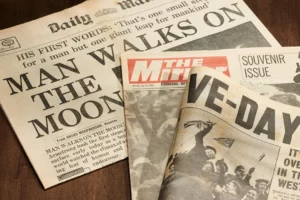
For Apollo 11, British newspapers provided extensive coverage. The Daily Mail and the Daily Express both published two-page spreads on July 21, 1969, while the Daily Mirror ran a multi-page insert on July 11, 1969, before the landing. These newspapers included large photographs and technical details, reflecting the public’s fascination with the event.
Different Perspectives
African American Newspapers
African American newspapers offered a distinct perspective on the Space Race. A thesis from the University of Texas, “Space Race: African American Newspapers Respond to Sputnik and Apollo 11,” examined how these publications covered the events. They did not simply follow the mainstream narrative; they placed the space race within the context of the civil rights movement. Their coverage asked whether the United States could claim technological superiority while denying equality to its own citizens. They highlighted the contributions of African American scientists and used the space race to advocate for social justice, providing a counter-narrative to the dominant Cold War discourse.
What People Feared
The dominant fear in American newspapers was that the Soviet Union had achieved permanent technological and military superiority. The language of “doom and dread” permeated the coverage. Newspapers warned about a “missile gap” and criticized the state of American education, which was seen as falling behind Soviet science. Some commentators feared that Sputnik could be used for reconnaissance or even to carry nuclear weapons. These fears were often exaggerated, but they reflected genuine public anxiety about national security and prestige.
What People Expected Would Happen Next
Newspapers in the Space Race era were filled with predictions about the future of space exploration. A study of newspapers near NASA’s main centers, conducted in 2020, examined predictions made between 1957 and July 1969. These included the first Moon landing, space stations, and even journeys to other planets. Many predictions were optimistic, while some were remarkably accurate. The public expected that Apollo 11 would be the first step toward a permanent human presence in space, and the newspapers reflected that expectation.
How Historians See It Today
Modern historians view the Space Race not just as a technological contest but as a cultural and political phenomenon. The study of Sputnik coverage directly showed that the “language of reaction and interpretation” was central to the event’s impact. The framing of the race in newspapers shaped public opinion and influenced national policy. The predictions made in the press, as analyzed in the 2020 study, reveal the era’s hopes and fears. Historians also recognize the importance of African American newspapers in providing a critical counter-narrative to the mainstream Cold War story.
Conclusion
The Space Race, as seen through contemporary newspapers, was a period of intense emotion and anxiety. From the shock of Sputnik to the triumph of Apollo 11, the press shaped how the public understood the race for space. The language of defeat and doom, the predictions of future missions, and the voices of African American newspapers all contributed to a complex picture of the era. These primary sources remind us that the Space Race was not just about technology but about national identity, fear, and hope.
FAQ
What was the main reaction to Sputnik in American newspapers?
American newspapers reacted with language of defeat, national mortification, and doom. A study of the New York Times, St. Louis Post-Dispatch, and Los Angeles Times found that the coverage was framed as a dramatic loss, with the satellite itself being less significant than the language used to describe it.
How did African American newspapers cover the Space Race?
African American newspapers, as documented in a thesis at the University of North Texas, provided a distinct perspective. They connected the Space Race to the civil rights movement, questioning the contradiction between American technological superiority and racial inequality. They also highlighted contributions of African Americans to the space program.














Leave a Reply