Short Answer
November 1989 in Prague was a month of cold streets and hot fear. The city had been quiet, oppressed for twenty-one years since Soviet tanks crushed the Prague Spring. But on the morning of Saturday, 18 November, a young railway worker named Pavel Kmoch read something extraordinary in the newspapers that arrived on the trains. For the first time in his memory, the official press told a truth: a demonstration had occurred, it had been unauthorized, and the police had brutally suppressed it. He put down the paper and said to himself, “Something is happening.” That afternoon he walked to Wenceslas Square, where he found no speakers, no organizers—only angry people, and a crowd that had already begun to tear down the police cameras. This is the Velvet Revolution as it was experienced: a sudden crack in the monolith of silence, a wave of bare hands raised against batons, and a nation discovering that the regime could no longer lie.
What Happened?
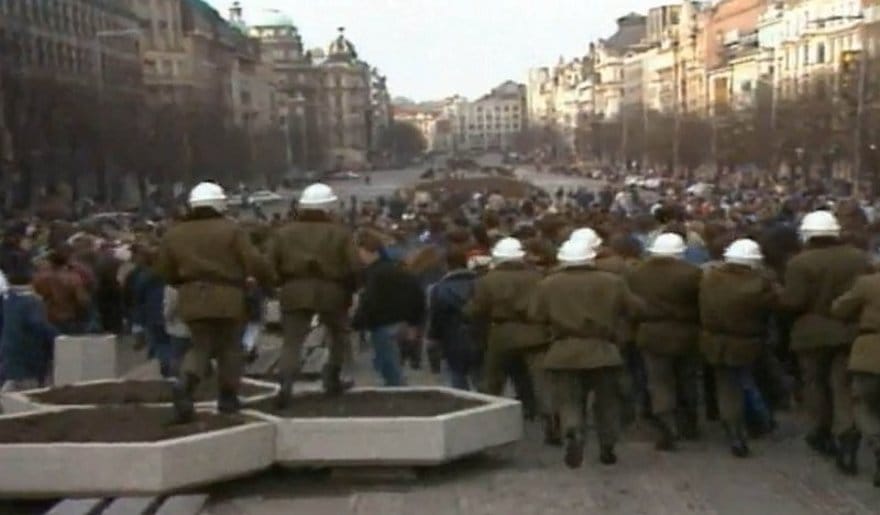
The Velvet Revolution (17 November – 29 December 1989) was a non-violent revolution that ended communist rule in Czechoslovakia. The catalyst was a peaceful student demonstration in Prague on Friday, 17 November 1989, which was brutally suppressed by police on Národní třída (National Avenue). The date was chosen to mark the 50th anniversary of the Nazi occupation and the death of a student, but it became a flashpoint. As the crowd attempted to march, police used batons and tear gas, injuring dozens. The regime’s attempt to crush the protest backfired.
Over the following days, protests spread. On 19 November, the Civic Forum (Občanské fórum) was formed, led by Václav Havel. A series of mass demonstrations, the largest of which drew over half a million people, forced the Communist Party to negotiate. On 29 December 1989, the Federal Assembly elected Václav Havel president, ending the revolution. The transition was remarkably bloodless—only a few injuries and no deaths—earning the name “Velvet.”
How It Was Seen at the Time
Contemporaries experienced the revolution as a sudden, almost surreal loosening of fear. The mood was a mixture of euphoria and disbelief. Milan Podobský, a 23-year-old student activist, recalled the chants of the crowd at Národní třída:
“Everybody was chanting: ‘We have bare hands!’ and lifting them up. I lifted mine either too late or wrong, and didn’t cover my face, so the baton hit my face.”
The phrase “We have bare hands” became a symbol of the revolution—a statement that the power of the people lay in their bodies and their unity, not in weapons. The prevailing interpretation was that the regime could no longer rely on its usual tactics of censorship and force; the truth had leaked out, and the streets were filling with people who had lost their fear.
Historical Snapshot
| Aspect | Detail |
|---|---|
| Date | 17 November – 29 December 1989 |
| Place | Prague, Czechoslovakia (primarily Národní třída, Wenceslas Square, Laterna) |
| People | Students, workers, intellectuals, dissidents, and ordinary citizens; the Communist regime under Miloš Jakeš |
| What Happened | Police suppressed a student demonstration on 17 November; the suppression was reported truthfully, sparking mass protests and the formation of the Civic Forum; the regime collapsed in negotiations |
| Why It Mattered | It ended one-party communist rule in Czechoslovakia without a single death, setting a precedent for peaceful regime change in Eastern Europe |
What People Knew at the Time
| What People Knew Then | What We Know Now |
|---|---|
| That the police had brutally suppressed a demonstration on 17 November, but details were scarce and often contradictory. | The suppression was part of a planned police action; the demonstration was peaceful and the police used disproportionate force. |
| That the newspapers had published a report that was true—an unusual occurrence under the communist regime. | This was a turning point; the truth broke the regime’s monopoly on information. |
| That the regime was shaken, but no one knew if it would survive. | We know the regime collapsed in 42 days, and that the Civic Forum negotiated a rapid transfer of power. |
| That the Soviet Union might intervene as it did in 1968. | The Soviet Union was already in decline and did not intervene; the Warsaw Pact was disintegrating. |
Eyewitness Accounts
Two accounts from the Memory of Nations archive capture the revolution from the perspective of ordinary people.
Pavel Kmoch (b. 1968) was a railway worker. He described how the truth arrived:
“November 17th was Friday, it happened at night, and I had a night shift from Saturday to Sunday, and they always came to us, at two in the morning the trains arrived, and they brought fresh newspapers. And suddenly there was a report in two newspapers that was simply true, which did not happen under the Bolsheviks. There was simply a short message about the fact that there was a demonstration, that it was unauthorized and that brutally suppressed by the police. So I thought to myself: ‘Um, something is happening.’ Therefore, the second morning after my shift, I immediately went to Wenceslas square. Moreover, that was actually the first demonstration that was; no one had organized it yet. There were no speakers, just people, who were quite angry. And they were angry in the way that there was a police camera, the one that stared at the horse on Wenceslas Square, someone climbed up to the newsstand and grabbed that camera…”
Milan Podobský (b. 1966) was a student activist. He was injured during the 17 November demonstration:
“I didn’t even bother to pick up my glasses; it damaged my pupil a bit so it wouldn’t work for two weeks. It stayed open wide, so I couldn’t see well. A medicine student took me to Karlovo náměstí hospital from Národní. Doctor Štěpán gave me treatment at the Third Internal Medicine Ward – and I wish to thank him for the treatment – though his surname was kind of suspect back then. They cleaned my wound and gave me an ice bag. I worked as a deterrent after that. I visited friends who worked for various Bolshevik papers. I came to Večerní Praha; they kicked me out. I was received kindly at Rudé právo; they…”
These accounts reveal the spontaneity and the human cost—a student with a damaged eye, a worker who decides to go to the square, and the fear of visiting the regime’s newspapers.
Contemporary Newspaper Coverage
The official press initially ignored the demonstration or condemned it as a “hooligan action.” However, the fact that two newspapers published a truthful report—even a short one—was a seismic shift. Pavel Kmoch noted that this was “simply true, which did not happen under the Bolsheviks.” The newspapers he referred to were likely Rudé právo (the Communist Party’s daily) and Večerní Praha (the evening paper). Milan Podobský’s experience with these papers shows the divide: Večerní Praha kicked him out, while Rudé právo received him kindly—perhaps because he was an injured student. The regime’s media were in disarray, unable to control the narrative. Independent leaflets and radio broadcasts (such as the clandestine Radio Free Europe) filled the gap, but the most powerful medium was word-of-mouth and the streets themselves.
What People Feared
The dominant fear, especially among older Czechs, was a repeat of 1968. As the CBC reporter Nancy Durham recalled, “The crushing of the ‘Prague Spring’ in 1968 by Soviet tanks saw hundreds of academics purged from universities and intellectuals from all walks of life pushed to the margins.” Many feared that the Soviet Union would send tanks again. There was also the fear of a violent crackdown by the communist secret police. The fact that the police had used batons on 17 November showed that the regime was willing to use force. Yet the peaceful nature of the protests—and the regime’s hesitation—gradually reduced this fear.
What People Expected Would Happen Next
Most contemporaries did not expect a quick victory. They anticipated a long, drawn-out struggle, perhaps months of strikes and negotiations. Pavel Kmoch, when he went to the square, had no idea that a revolution was underway; he just knew that “something was happening.” The general strike on 27 November was a turning point, but even then, many expected the regime to cling to power. The rapid resignation of the Communist leadership and the election of Havel on 29 December came as a surprise to many. As the revolution unfolded, the prevailing expectation shifted from a vague hope to a concrete demand for free elections.
Timeline
- 17 November 1989 – A peaceful student demonstration on Národní třída is brutally suppressed by police; the first injuries occur.
- 18 November – Newspapers report the event truthfully; the first spontaneous protest on Wenceslas Square occurs.
- 19 November – The Civic Forum is founded in Prague.
- 27 November – A two-hour general strike takes place, with millions participating.
- 29 December 1989 – Václav Havel is elected President of Czechoslovakia, ending the communist regime.
The Velvet Revolution was a testament to the power of truth and the courage of ordinary people. The eyewitness accounts of Pavel Kmoch and Milan Podobský remind us that history is not made by abstract forces, but by individuals who read a newspaper, raise their hands, and refuse to be silent. Their fear of a new 1968 was real, but so was their hope—and that hope proved stronger.
FAQ
What was the role of the police on 17 November 1989?
The police used batons and tear gas to suppress a peaceful demonstration on Národní třída, injuring several students. This act of brutality triggered the revolution.
Why is it called the 'Velvet' Revolution?
The term 'velvet' was used because the transition from communist rule to democracy was peaceful, without the large-scale violence seen in other Eastern European countries.

Leave a Reply