
Short Answer
On the night of July 27, 1953, along a 155-mile Korean battlefront, the sound of artillery and small arms fire—which had been nearly continuous for 37 months—suddenly stopped. At 10:00 p.m. Korea time, the ceasefire mandated by the armistice signed earlier that day took effect. The silence that followed was, in the words of one United Press reporter, “the strange silence of the cease-fire” settling over the moonlit lines. It was a quiet filled with uncertainty, as soldiers on both sides prepared to pull back and diplomats braced for the delicate work of a negotiated peace. This is how the world learned of that moment—through the dispatches of war correspondents, the headlines of evening newspapers, and the cautious words of officials who knew the fighting might not be over for good.
What Happened?
The Korean War armistice was signed at 10:01 a.m. on July 27, 1953, in the truce village of Panmunjom, ending a conflict that had begun in June 1950. The signing ceremony lasted just ten minutes. The agreement stipulated that all shooting would stop exactly twelve hours later, at 10:00 p.m. that evening.
- 10:01 a.m. – Armistice documents signed at Panmunjom.
- 9:50 p.m. – The last Red artillery shells of the war burst on the eastern front.
- 10:00 p.m. – Ceasefire orders broadcast to both sides; the shooting stops.
- After the ceasefire – UN troops began destroying bunkers and fortifications, then withdrew 1.25 miles to form a 2.5-mile buffer zone between the armies.
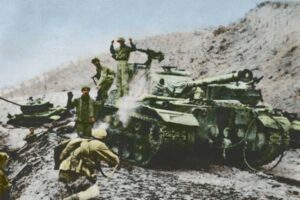
According to United Press correspondents on the front lines, the final hours were marked by intense shelling. “Intense artillery barrages rumbled across the front until minutes of the cease-fire deadline,” one dispatch read. The last Red artillery shell fell on the eastern front at 9:50 p.m., just ten minutes before the deadline. On the central front, South Korean troops “had the satisfaction of firing the last shots of the war,” as they kept up small arms, mortar, and tank fire until the very moment of the ceasefire.
How It Was Seen at the Time
Contemporaries understood the moment as a halt to fighting, but not necessarily a permanent peace. The United Press described it as a “negotiated truce” and a “strange silence.” The mood was tense and uneasy, as the armistice was a military ceasefire, not a political settlement.
“The uncertain and uneasy quiet of a negotiated truce settled over the Korean battle lines.” — United Press, July 27, 1953
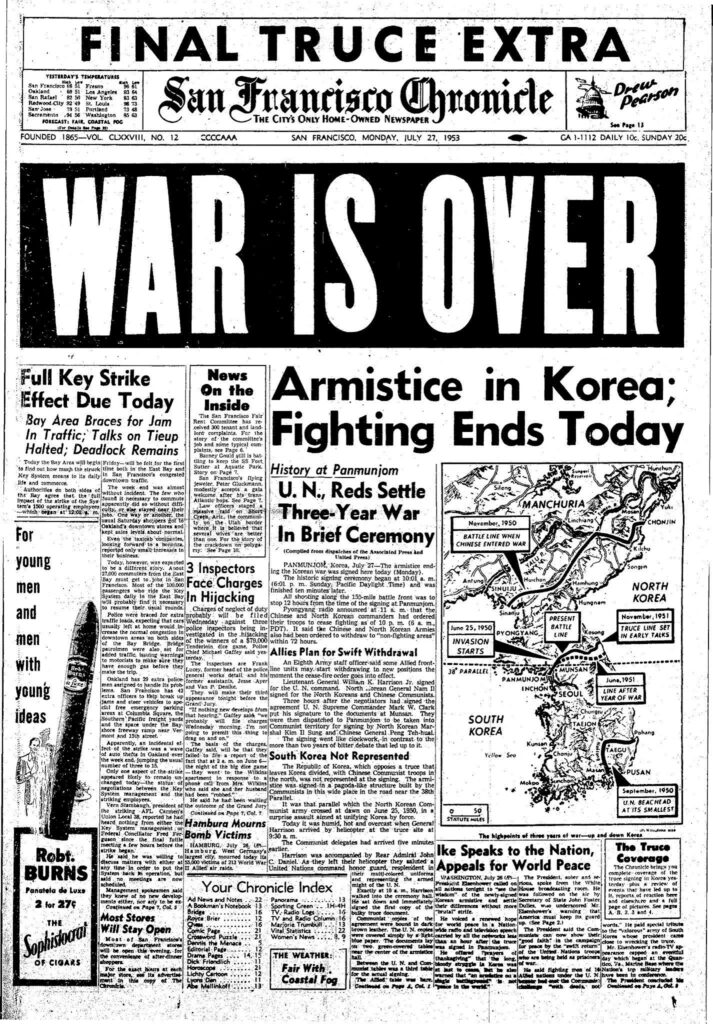
The San Francisco Chronicle’s front page the next morning declared simply: “Korean War is over,” but the article itself noted the armistice was only a first step, with “delicate meetings” to follow. Newspapers across the country, like the Medford, Oregon Mail Tribune, headlined the signing and the upcoming political negotiations, reflecting the cautious hope that the shooting had truly ended.
Historical Snapshot
| Aspect | Detail |
|---|---|
| Date | July 27, 1953 |
| Place | Panmunjom, Korea (signing); Korean battle front (ceasefire) |
| People | UN forces (including U.S. troops), Chinese and North Korean forces, South Korean troops |
| What Happened | Armistice signed; ceasefire effective at 10 p.m.; both sides withdrew 1.25 miles to create a 2.5-mile buffer zone |
| Why It Mattered | Ended 37 months of active combat, but the war remained technically unresolved |
Contemporary Newspaper Coverage
The press treated the armistice as the biggest story of the year. United Press dispatches from Seoul and the front lines provided the most detailed and immediate coverage. The UPI wire story, published in many newspapers on July 27, 1953, described the final hours:
“The shooting in the Korean war ended at 10 o’clock tonight Korea time. The uncertain and uneasy quiet of a negotiated truce settled over the Korean battle lines.” — UPI
The San Francisco Chronicle’s front page, dated July 27, 1953, carried the headline “Korean War is over” and reported: “The armistice ending the Korean War was signed here today. The historic signing ceremony began at 10:01 a.m. and was finished ten minutes later.” The Medford Mail-Tribune in Oregon ran a front-page story with the headline “Delicate Meetings to Follow Signing of Truce Document,” capturing the prevailing sense that the ceasefire was only the beginning of a difficult process.
Eyewitness Accounts
United Press correspondents on the front lines provided the most vivid, immediate eyewitness testimony. Their dispatches were the raw material for the newspapers’ coverage.
“United Press Correspondent William Miller described the final Red artillery barrage along the western front as among the heaviest in several days. United Press Correspondent Frank Jordan reported from the central front that diehard South Koreans had the satisfaction of firing the last shots of the war. They kept blazing away, with small arms, mortar and tank fire, until the very moment of the cease-fire.” — UPI, July 27, 1953
These correspondents were not merely observers; they were embedded with the troops and felt the ground shake from the final barrages. Their reports conveyed the exhaustion and the relief of the soldiers, as well as the lingering tension that the war might not be over.
What People Expected Would Happen Next
Contemporaries did not expect the armistice to bring a permanent peace immediately. The Medford Tribune headline spoke of “delicate meetings to follow.” The UPI noted that the ceasefire was a “negotiated truce,” and that the military phase was ending, but the political phase was just beginning. Many expected that a peace conference would follow, and that the Korean War would be resolved through diplomacy. But there was also apprehension. The armistice had been signed by the UN Command, the Chinese, and the North Koreans, but not by South Korea, which had refused to sign. This foreshadowed continued tension. In the short term, the immediate expectation was that both armies would complete their withdrawals to the buffer zone within 72 hours, as ordered.
Aftermath
In the immediate aftermath, the front lines fell silent. Troops began to destroy their bunkers and fortifications, and by the end of the 72-hour period, they had withdrawn to create the 2.5-mile buffer zone. The Korean War, however, did not formally end. The armistice was a ceasefire agreement, not a peace treaty. The war would continue on a technical basis for decades, with no formal peace treaty ever signed. The UPI and other newspapers of the time did not know this, of course; they reported the ceasefire as a significant step toward peace, but also noted the uncertainties ahead. The “delicate meetings” that the Medford Tribune predicted did indeed follow, leading to the Geneva Conference of 1954, but they failed to produce a permanent settlement.
How Historians See It Today
Modern historians view the Korean War armistice as a pivotal moment in the Cold War, but also as an incomplete resolution. The armistice ended the active military conflict, but the war never formally concluded. The Korean Peninsula remains divided, and the armistice is still the legal basis for the ceasefire. Historians also emphasize that the armistice was not a peace treaty and that South Korea’s refusal to sign the document meant that the Republic of Korea was not a party to the agreement. The newspapers of July 1953 captured the immediate relief and uncertainty, but they could not know that the “truce” would last for over seventy years. Modern scholarship also points out that the armistice was a military agreement that did not resolve the political issues of Korea’s division, leading to a permanent state of tension. The primary source reporting from July 1953 provides a valuable snapshot of that moment, but it must be read with the knowledge that the “end” of the war was only a pause.
The Korean War armistice of July 27, 1953, was a turning point in the conflict, but as the primary sources show, it was a fragile and uncertain peace. The newspapers of the day, with their vivid dispatches from the front lines, captured the relief, the tension, and the hope that the killing had finally stopped. They also captured the deep awareness that the war was not truly over—only the shooting. The primary sources teach us that history is often experienced as a mixture of relief and dread, and that the future is never as clear to contemporaries as it is to later generations.
FAQ
Why was the Korean War armistice signed in 1953?
The armistice was signed on July 27, 1953, to stop the fighting in the Korean War, which had been underway for 37 months. It was a negotiated agreement between the United Nations Command, China, and North Korea, to establish a ceasefire and a buffer zone between the armies. It was not a peace treaty, so the war technically never ended.
What time did the ceasefire actually take effect?
The ceasefire went into effect at 10:00 p.m. Korea time on July 27, 1953, exactly twelve hours after the armistice was signed at Panmunjom. The last artillery shells were fired just minutes before the deadline.

Leave a Reply