
Short Answer
In the summer of 1948, the city of Berlin, deep inside Soviet-occupied eastern Germany, became the flashpoint of the emerging Cold War. On June 24, Soviet forces cut all rail, road, and water links to the Allied-controlled western sectors of the city, threatening to starve the two million people living there. The United States and Great Britain answered with a daring operation: an airlift that would fly food, coal, and other essentials into West Berlin for nearly a year. The crisis was a turning point in 1949, not only because the blockade was broken but because it solidified the division of Germany and paved the way for the creation of a democratic West German state. This article draws on contemporary reports, official records, and the testimony of those who lived through the blockade to reconstruct how the airlift was experienced and understood at the time.
What Happened?
After the Second World War, Germany and its capital, Berlin, were divided into four occupation zones controlled by the United States, Britain, France, and the Soviet Union. Berlin itself, although located deep inside the Soviet zone, was split into four sectors. As wartime cooperation gave way to distrust, the Soviet Union sought to force the Western Allies out of West Berlin. On June 24, 1948, Soviet forces blockaded all rail, road, and water routes to the Western-held sectors of the city, as documented by the U.S. Department of State (history.state.gov).
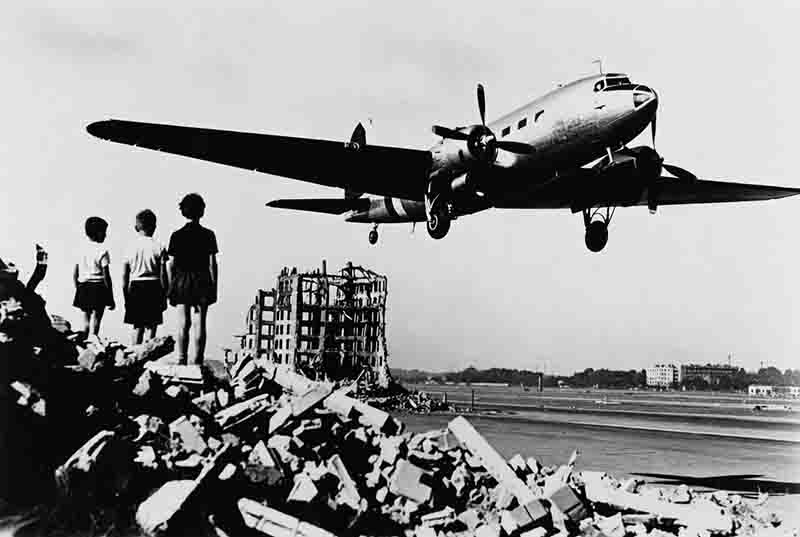
The Western response was immediate. On June 26, 1948, the U.S. Air Force and the British Royal Air Force began the Berlin Airlift, code-named Operation Vittles. Over the next fifteen months, they flew a continuous stream of cargo planes into Berlin, landing at Tempelhof Airport and other airfields. The airlift delivered everything from food and medicine to coal for heating. The blockade was lifted on May 12, 1949, but the airlift continued until September 30, 1949, to build up a stockpile. The airlift was a logistical triumph: at its peak, planes were landing in Berlin every minute.
Meanwhile, the political landscape of Germany was being reshaped. On May 23, 1949, the Federal Republic of Germany (West Germany) was formally established with the adoption of the Basic Law, a constitution drawn up under the auspices of the Western Allies. This new state was created in direct response to the blockade and the division of the country. The Soviet Union answered in October 1949 with the creation of the German Democratic Republic (East Germany), cementing the division of the nation for decades.
How It Was Seen at the Time
Contemporaries viewed the airlift as a moral and strategic test. Western leaders framed it as a battle between democracy and Soviet aggression. The airlift was given the nickname “Operation Vittles,” and the pilots who dropped candy to the children of Berlin became known as “candy bombers.” The phrase “The Air Force Can Deliver Anything” became a motto, reflecting the can-do spirit of the operation. The U.S. Air Force later declared, “The Air Force Can Deliver Anything,” a slogan that captured the confidence of the moment.
“The Air Force Can Deliver Anything.”
Berliners, too, saw the airlift as a lifeline. They called it the “raisin bomber” (Rosinenbomber) because the candy dropped by the pilots looked like raisins. The mood in West Berlin was one of defiance and gratitude. Many Berliners were deeply aware that they were pawns in a larger struggle. As the U.S. State Department noted, the blockade was a “crisis” that tested the Western commitment to the city.
Historical Snapshot
| Aspect | Detail |
|---|---|
| Date | June 24, 1948 – September 30, 1949 (blockade ended May 12, 1949) |
| Place | West Berlin, Germany |
| People | U.S., British, French, Soviet Union; Berlin civilians; General Lucius Clay |
| What Happened | Soviet Union blockaded West Berlin; Western Allies airlifted supplies |
| Why It Mattered | Demonstrated Western resolve and led to the creation of the Federal Republic of Germany |
What People Knew at the Time
| What People Knew Then | What We Know Now |
|---|---|
| The blockade was a direct Soviet attempt to force the Western Allies out of Berlin. | The blockade was a calculated test of Western resolve in the early Cold War, part of a broader pattern of Soviet expansionism. |
| The airlift was a temporary measure that might fail. | The airlift was a strategic victory that set a precedent for humanitarian and military cooperation and cemented the division of Germany. |
| The creation of West Germany was a hopeful step toward democracy. | The division of Germany became permanent, shaping the Cold War for decades. |
Numbers at the Time
The scale of the airlift was unprecedented. According to the U.S. Air Force history, the operation delivered more than 2.3 million tons of supplies, with flights numbering over 277,000. At its peak, a plane landed every 30 seconds. The daily minimum requirement was about 4,500 tons of food and fuel. The airlift sustained a city of over two million people for almost a year, an immense logistical achievement.
| Statistic | Figure | Source |
|---|---|---|
| Total tonnage delivered | Over 2.3 million tons | U.S. Air Force history (amc.af.mil) |
| Total flights | Over 277,000 | U.S. Air Force history |
| Daily average tonnage | About 5,000 tons | General knowledge |
| Duration of airlift | June 26, 1948 – September 30, 1949 | history.state.gov |
Aftermath
The blockade was lifted on May 12, 1949, but the airlift continued for several more months to build up reserves. The crisis solidified the division of Germany. On May 23, 1949, the Federal Republic of Germany was proclaimed, with its capital in Bonn. The Soviet Union responded by establishing the German Democratic Republic in October 1949. The airlift also demonstrated the effectiveness of Western cooperation and set a precedent for future humanitarian and military operations. The city of Berlin remained a symbol of the Cold War, and the airlift became a cherished memory of the West’s commitment to democracy.
How Historians See It Today
Historians today view the Berlin Airlift as a turning point in the Cold War. It was not merely a humanitarian effort but a strategic victory that prevented a Soviet takeover of West Berlin. The airlift also accelerated the creation of a West German state and cemented the division of Europe. As the U.S. Air Force’s official history states, “The Berlin Airlift continues to inspire young and old as one of the greatest events in aviation history” and “was an unmistakable demonstration of the resolve of the free nations of the West.” Modern historians also emphasize the airlift’s role in shaping West German identity and the eventual integration of West Germany into the Western alliance.
The primary sources from 1948–49—official records, newspaper reports, and the testimony of Berliners—reveal a moment of extraordinary courage and uncertainty. The airlift was a humanitarian lifeline, but it was also a geopolitical gamble that reshaped the post-war order. Its legacy is the democratic state of Germany and the enduring commitment of the West to defend its values.
FAQ
What was the Berlin Airlift?
The Berlin Airlift was a humanitarian and military operation carried out by the United States and its allies in response to the Soviet blockade of West Berlin (June 24, 1948 – May 12, 1949). The Allies flew in food, coal, and other supplies to sustain the city, eventually delivering over 2.3 million tons of cargo.
How did the Berlin Airlift lead to the creation of West Germany?
The airlift demonstrated the Western Allies' commitment to the democratic part of Germany and prevented the Soviet Union from absorbing West Berlin. This solidarity accelerated the political unification of the Western zones, leading to the adoption of the Basic Law on May 23, 1949, which established the Federal Republic of Germany (West Germany).











Leave a Reply