
Short Answer
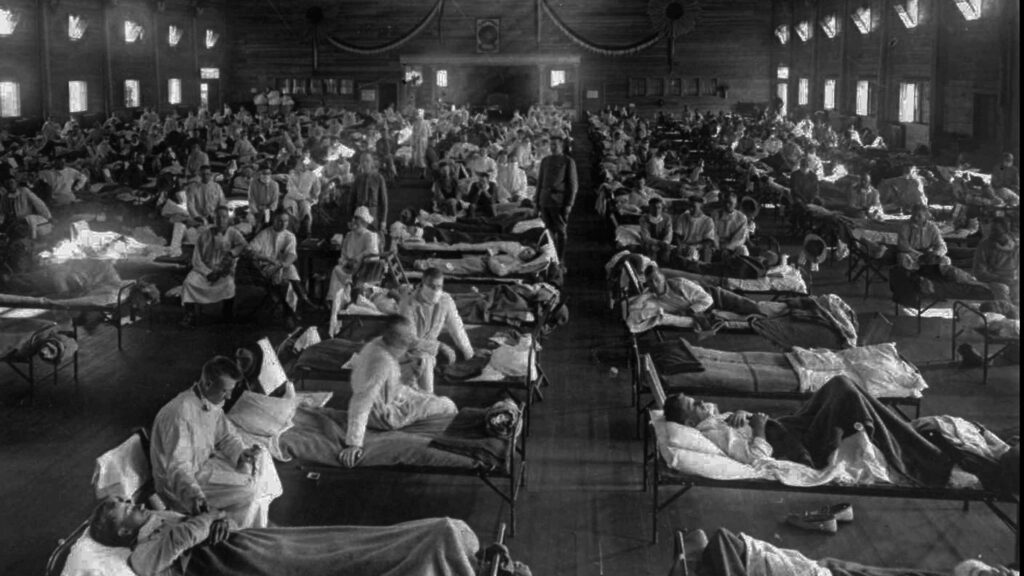
In early October 1918, as the First World War ground toward its final weeks, a Norwegian-American student named Sigvart Rugland sat down in his dormitory at Luther College in Decorah, Iowa, to write to his sister. “Five boys are sick with Spanish Influenza and about a dozen more are sick in bed with colds, headaches, etc.,” he reported. His brother Gerhard had gone to bed with a headache and sore throat. The flu had arrived on a quiet Midwestern campus, and the young men were among the first to feel its grip. Across the globe, similar scenes were unfolding—in military camps, factories, and homes—as a disease that would eventually kill more people than the war itself swept through a world already exhausted by conflict. What did people at the time know, believe, and fear? Their own words, preserved in letters, medical journals, and folklore collections, offer a remarkable window into that anxious autumn.
What Happened?
The 1918–1919 influenza pandemic—often called the “Spanish flu”—was the most lethal global disease outbreak since the Black Death, according to contemporary medical reports. Estimates of total fatalities range from 20 to 40 million or more, with the United States alone recording 675,000 deaths—more than the American Civil War. The first wave appeared in the spring of 1918, but the second, deadlier wave struck in the autumn of 1918, just as the war was ending. A third wave followed in early 1919.
- Spring 1918: Initial outbreaks reported in military camps and cities, but relatively mild.
- Autumn 1918: A second, virulent wave sweeps across Europe, North America, and the rest of the world. It hits young adults particularly hard.
- October 1918: At Luther College in Iowa, five students are sick with influenza; the disease spreads rapidly through campuses and army camps.
- 1919–1920: A third wave occurs, but the pandemic gradually fades.
The pandemic was so deadly that it killed more people than combat in the First World War, as noted by medical historians. The exact number of deaths was unknown at the time, but contemporaries understood that the disease was devastating. The term “Spanish flu” arose because neutral Spain had no wartime censorship, so its press freely reported on the epidemic, making it appear that Spain was the epicenter—although the disease likely originated elsewhere.
How It Was Seen at the Time
At the time, people did not know what caused the flu. The virus was not isolated until 1933, and many believed it was a bacterial disease or a consequence of wartime conditions. The prevailing mood was a mixture of fear, confusion, and fatalism. In his letter of October 1, 1918, Sigvart Rugland wrote: “Everybody is taking steps to check the spread of Spanish Influenza.” But those steps—mask wearing, quarantine, closing schools—were based on incomplete knowledge. The name “Spanish flu” itself was a misnomer, as contemporaries recognized, but it stuck. The medical community scrambled to find a cure, but they had no effective antiviral treatments. The letters and reports from the time reflect a sense of helplessness and a desperate hope that the disease would burn out.
Historical Snapshot
r>PeopleSoldiers, civilians, medical workers, students; all age groups, but especially young adults
| Aspect | Detail |
|---|---|
| Date | 1918–1920 (with the deadliest wave in autumn 1918) |
| Place | Global, with severe outbreaks in the United States, Europe, and Asia |
| What Happened | A deadly influenza pandemic that killed an estimated 20–40 million people worldwide, more than the Great War |
| Why It Mattered | It overwhelmed healthcare systems, disrupted daily life, and reshaped public health policy for decades |
What People Knew at the Time
r>Doctors had no specific treatment; they used quinine, aspirin, and supportive care.We now have antivirals and vaccines, but they were unavailable in 1918.
| What People Knew Then | What We Know Now |
|---|---|
| The disease was called “Spanish influenza” because Spain’s neutral press reported it openly. | The origin is still debated, but it was likely not Spain; the name is a historical accident. |
| People believed it was caused by a bacterium or a “germ” spread through the air. | It is caused by an influenza A virus (H1N1), identified in 1933. |
| Many thought the pandemic would end quickly with the end of the war. | The pandemic lasted until 1920, with multiple waves. |
Contemporary Newspaper Coverage
Newspapers and medical journals of the time reported the pandemic with a mixture of alarm and reassurance. The term “Spanish flu” first appeared in the press in the spring of 1918, and by autumn, headlines were full of death tolls and quarantine orders. The Journal of the American Medical Association and other medical publications published reports from physicians on the front lines. However, wartime censorship suppressed full reporting in many countries, especially the Allied powers, to avoid alarming the public and undermining morale. The result was that the press often minimized the danger. For instance, in the United States, some newspapers initially downplayed the flu’s severity, but by October 1918, they could no longer ignore it. A contemporary editorial in a medical journal noted: “The epidemic is a grave one, and the public must be told the truth without panic.” The press also played a role in spreading misinformation, such as recommending useless remedies like tobacco smoke or special diets.
Eyewitness Accounts
The most vivid primary sources come from ordinary people. In the late 1930s, the Irish Folklore Commission enlisted schoolchildren to collect stories about the “Big Flu” from their parents and grandparents. These accounts, preserved in the National Folklore Collection, describe how entire villages were stricken, funerals were rushed, and people feared the dead were being buried without proper rites. One account from County Tipperary tells of a family that lost three children in a week. Another records that “the doctor could not attend all the sick, and the priest had to bury the dead without a coffin.” These oral histories, though collected later, capture the raw terror and grief of the pandemic.
Letters & Diaries
Personal letters are the most immediate primary sources. The Rugland brothers’ correspondence from Luther College in Iowa provides a direct glimpse into the campus experience. On October 1, 1918, Sigvart wrote to his sister: “There are five boys sick with Spanish Influenza and about a dozen more sick in bed with colds, headaches etc. Gerhard has been in bed all day with a headache.” The next day, Gerhard himself wrote: “I went to bed Sunday with a headache and sore throat and Monday morning I was not better but got up anyway at 6:15 and went out to breakfast. But then I had something [amiss] right away and…” The letters show the casual, almost routine way the flu was treated, even as it spread. They also reveal the isolation and worry: the brothers’ parents were in North Dakota, and they could only wait for news. These letters are preserved in the Luther College archives and offer a rare glimpse into the daily reality of a student during the pandemic.
Aftermath
The pandemic ended in 1920, but its effects lingered. Millions of lives were lost, and the world’s healthcare systems were strained. In the United States, the pandemic contributed to a new emphasis on public health, the establishment of the National Institutes of Health, and a wave of influenza research. However, the memory of the pandemic faded quickly in the public consciousness, overshadowed by the war. It was not until the COVID-19 pandemic of 2020 that historians and the public revisited the 1918 event with fresh eyes. The primary sources from the time—letters, diaries, and press reports—remain vital to understanding how a society copes with a sudden, invisible threat.
The contemporary sources of the Spanish flu pandemic remind us that the past is not a single story. They capture the confusion, the courage, and the fragility of human life. They show that even in the midst of war, a disease could reshape the world. And they teach us that the best we can do is to listen to the voices of those who lived through it—their words are our most honest guide to what it meant to be alive in 1918.
FAQ
Why was the 1918 pandemic called the 'Spanish flu'?
Because neutral Spain had no wartime censorship, its press was the first to report openly on the flu, making it seem as if Spain was the epicenter. The name stuck even though the virus likely originated elsewhere.
What did people at the time think caused the flu?
They did not know the cause. Many believed it was a bacterial infection or a result of wartime conditions. The influenza virus was not identified until 1933.











Leave a Reply