
Short Answer
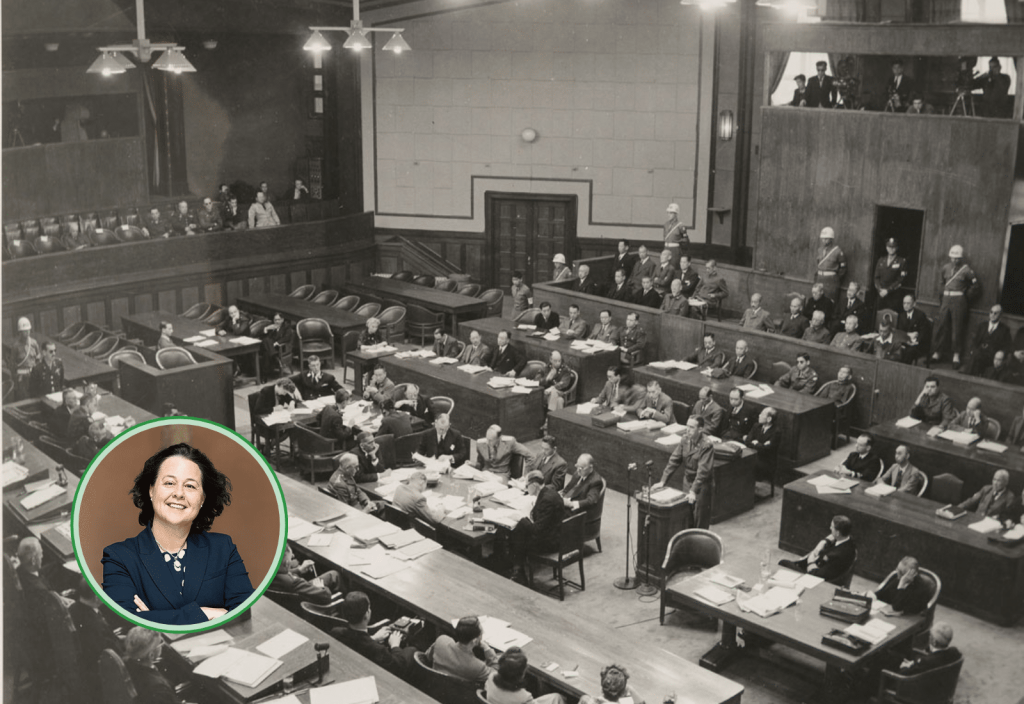
In November 1945, the ruined city of Nuremberg—once the ceremonial stage for the Nazi Party’s annual rallies—was the setting for an unprecedented event in international law. Inside the Palace of Justice, the International Military Tribunal convened to try twenty-four of the leading figures of the defeated Nazi regime. Newsreel cameras with floodlights captured the faces of the defendants, projecting images of Hermann Goering, Rudolf Hess, Joachim von Ribbentrop, and their co-defendants into cinemas across the world. The official transcript of the proceedings, later published in the forty-two-volume “Blue series,” recorded every word spoken in the courtroom. Together, the transcript and the newsreel created a unique record of a moment when the world attempted to put war itself on trial.
What Happened?
The International Military Tribunal held its proceedings at Nuremberg from 14 November 1945 to 1 October 1946, according to the Library of Congress’s record of the trial. The court was established by the London Agreement of 8 August 1945, signed by the United States, the United Kingdom, France, and the Soviet Union. The tribunal’s jurisdiction covered three categories of crimes: crimes against peace, war crimes, and crimes against humanity.
The trial opened with the reading of the indictment. A Pathe Gazette newsreel released on 29 November 1945 reported on the first four days of proceedings, showing twenty-four top Nazis charged. The newsreel listed the defendants—Goering, Hess, Ribbentrop, Keitel, Frick, Streicher, Funk, Schacht, Raeder, Baldur von Schirach, Seyss-Inquart, and Speer—and recorded that each answered “not guilty” to the charges. The newsreel also captured speeches by Lord Justice Lawrence, the presiding judge, Chief Prosecutor Robert H. Jackson, and Major Coogan, who presented the American indictment.
The trial proceeded in stages:
- November 1945: Opening statements and the reading of the indictment.
- December 1945 – March 1946: The prosecution’s case, with documentary evidence and witness testimony.
- March – July 1946: The defense case, including testimony for each defendant and the indicted organizations.
- August – September 1946: Closing statements and final verdicts.
The official record of the trial, the “Blue series,” includes the indictment, motions, orders of the tribunal, presentation of cases, testimony of witnesses, and the final report on the evidence for the defense of organizations alleged to be criminal. The Avalon Project at Yale Law School provides a digital collection of these records, including the report of Robert H. Jackson, the United States representative to the London Conference of 1945.
How It Was Seen at the Time
Contemporaries viewed the trial as an unprecedented experiment in justice. The newsreel coverage framed it as a solemn reckoning—the leaders of the defeated enemy being called to account in a public court rather than through summary execution. The Pathe Gazette emphasized the gravity of the case, showing the defendants in the dock and the judges presiding.
The courtroom itself was a place of tension. On 5 March 1946, Lord Justice Lawrence read an announcement to the tribunal concerning an article published in the Berliner Zeitung on 2 February 1946. The article, titled “A Defense Counsel,” criticized Dr. Hans Marx, one of the German defense counsel, for an error in his cross-examination of a witness when he deputized for Dr. Babel on behalf of the SS. The tribunal announced that the article suggested Marx was “behaving most improperly” and “expressing private and personal views under the guise of acting as counsel.” The incident shows how intensely the trial was watched, and how quickly controversy could erupt over the conduct of the proceedings.
“The article suggested that in asking the question he did, he was behaving most improperly, that he was expressing private and personal views under the guise of acting as counsel.” — Lord Justice Lawrence, reading the Berliner Zeitung article before the tribunal, 5 March 1946.
Historical Snapshot
| Aspect | Detail |
|---|---|
| Date | 14 November 1945 – 1 October 1946 |
| Place | Palace of Justice, Nuremberg, Germany |
| People | Lord Justice Lawrence (presiding), Robert H. Jackson (US prosecutor), twenty-four Nazi defendants |
| What Happened | The first international criminal trial, charging Nazi leaders with crimes against peace, war crimes, and crimes against humanity |
| Why It Mattered | Established the principle of individual accountability under international law |
Eyewitness Accounts
The most direct eyewitness record of the trial is the official transcript itself. The transcript of the session of 5 March 1946, preserved in the IMT Nuremberg Archives at Stanford University, shows Lord Justice Lawrence presiding and reading the announcement about the Berliner Zeitung article. It is a verbatim window into the courtroom—the formal language, the procedural steps, and the public tensions of the trial.
The Pathe Gazette newsreel of 29 November 1945 is another form of eyewitness. It captured the first four days of the trial, showing the defendants in the courtroom and the judges on the bench. The newsreel described the scene as twenty-four top Nazis being charged and answering “not guilty” to crimes against peace, war crimes, and crimes against humanity. For millions of cinemagoers, this footage was their only direct visual encounter with the trial.
Contemporary Newspaper Coverage
Newspapers around the world covered the trial extensively. The Berliner Zeitung published an article on 2 February 1946 titled “A Defense Counsel,” which criticized Dr. Marx’s conduct. The article was so significant that the tribunal itself addressed it in open session on 5 March 1946. The incident reveals that the press was not merely reporting the trial—it was actively scrutinizing the conduct of the defense and the proceedings themselves.
The Pathe Gazette newsreel, released on 29 November 1945, was itself a form of news coverage—a visual newspaper for cinema audiences. It was part of the Pathe Gazette issue No. 45/96, and its summary noted that it covered “the first four days in the Nuremberg Court House as twenty-four top Nazis are charged.” The newsreel was a primary source for the public’s understanding of the trial.
Official Reports
The official record of the trial is the “Blue series,” a forty-two-volume transcript published by the International Military Tribunal. The Library of Congress holds the complete set, covering the proceedings from 14 November 1945 to 1 October 1946. The transcript includes the indictment, the opening statements, the motions, the testimony of witnesses, and the final verdicts.
The Avalon Project at Yale Law School provides a digital collection of the trial records, including the “Key Documents Related to the Proceedings” and the “Documents of the Post War Military Government.” It also includes the report of Robert H. Jackson, the United States representative to the International Conference on Military Trials held in London in 1945, which documents the negotiations that established the tribunal’s legal framework.
What People Expected Would Happen Next
During the trial, there was widespread speculation about the verdicts and sentences. The world expected that the defendants would be found guilty, but the specific sentences were unknown. The newsreel of the opening days showed the defendants entering their pleas, and the world waited to see whether the tribunal would impose death sentences or lesser penalties. Many contemporaries believed that the trial would establish a precedent for international justice—a hope that was only partially realized, as the International Military Tribunal would be the only such court for decades.
How Historians See It Today
Modern historians view the Nuremberg trials as a turning point in international law. The trial established the principle that individuals—not just states—can be held accountable for crimes against peace and crimes against humanity. The “Blue series” remains the primary record of the trial. Historians also note that the trial was not without its critics: some contemporaries called it “victor’s justice,” and the inclusion of the Soviet Union as a prosecutor, given its own wartime record, was a source of controversy. The trial’s legacy is enduring—it directly influenced the establishment of the International Criminal Court and the development of international human rights law.
At the time, the trial was understood as a moral reckoning with the Nazi regime; modern historians offer a more nuanced view, emphasizing the political and legal constraints under which the court operated. But the core achievement—the record of the trial, preserved in the transcript and the newsreel—remains a monumental source for understanding the aftermath of the Second World War.
The Nuremberg trials stand as a testament to the world’s attempt to confront the horrors of war through the rule of law. The primary sources—the official transcripts, the newsreels, and the newspaper accounts—allow us to see the trial as contemporaries did: a moment of unprecedented, of uncertainty, and of hope for a more just world.
FAQ
How long did the Nuremberg Trials last?
The International Military Tribunal held its proceedings from 14 November 1945 to 1 October 1946, according to the Library of Congress record. The trial included opening statements, the prosecution's case, the defense case, and closing statements, followed by verdicts.
Who were the defendants at the Nuremberg Trials?
Twenty-four top Nazi leaders were charged, including Hermann Goering, Rudolf Hess, Joachim von Ribbentrop, Wilhelm Keitel, Karl Frick, Albert Streicher, Walther Funk, Hjalmar Schacht, Erich Raeder, Baldur von Schirach, Arthur Seyss-Inquart, and Albert Speer. Each answered "not guilty" to the charges, as reported in the Pathe Gazette newsreel of 29 November 1945.
What were the charges at the Nuremberg Trials?
The defendants were charged with crimes against peace, war crimes, and crimes against humanity, as reported by the Pathe Gazette newsreel and the official trial record.












Leave a Reply