
Short Answer
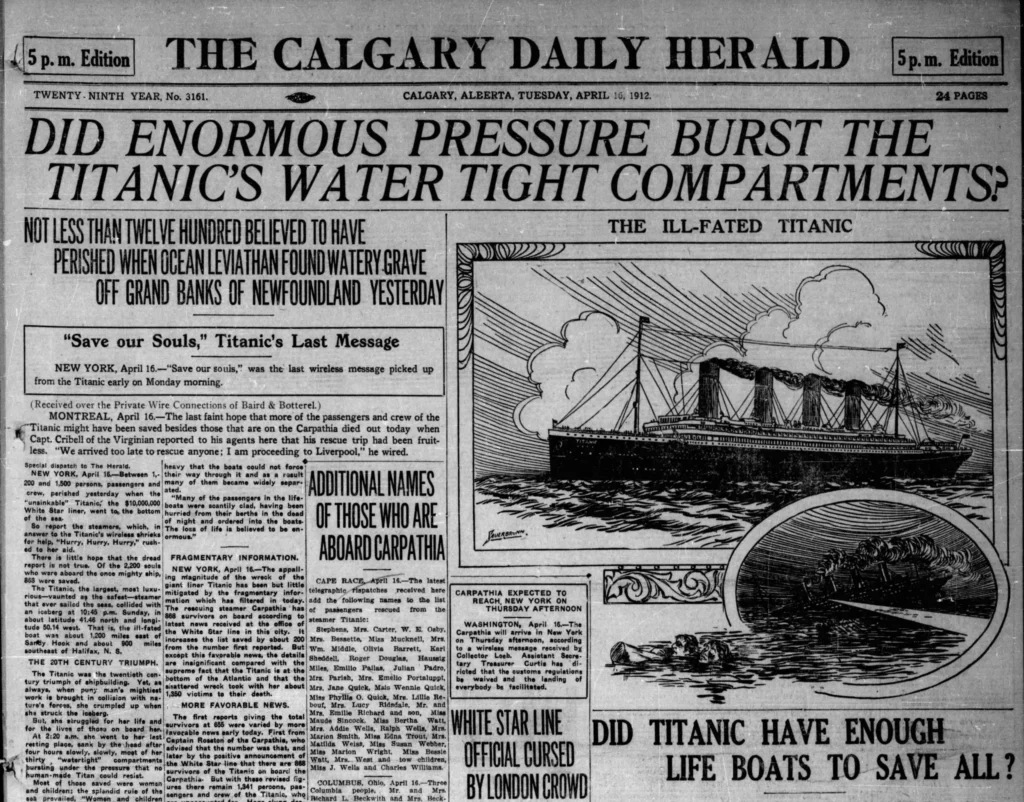
In the early hours of April 15, 1912, the world’s most celebrated ocean liner, the Titanic, lay dying in the North Atlantic. The first news of the catastrophe did not arrive as a single, clear announcement but as a series of fragmented wireless signals, rockets, and lamp flashes sent by the stricken ship and picked up by nearby vessels. As the sun rose, the Cunard liner Carpathia began pulling hundreds of freezing survivors from lifeboats, while thousands of miles away, newspapers on both sides of the Atlantic scrambled to make sense of garbled telegraphic reports. What the public learned over the next few days was a story of confusion, rumor, and finally, a staggering truth: the “unsinkable” ship had gone down, taking more than 1,500 people with it.
What Happened?
On the night of April 14, 1912, the Titanic was on her maiden voyage from Southampton to New York when she struck an iceberg at approximately 11:40 p.m. ship’s time. The collision tore a series of gashing holes in the hull, and within two hours and forty minutes, at 2:20 a.m. on April 15, the largest ship in the world slipped beneath the waves. The vessel had been designed to be unsinkable, but it carried only enough lifeboats for about half of the people aboard.
According to the New York Times report of April 16, 1912, the ship “plunged to the bottom at 2:20 A.M.” and “probably 1,250 perished” while “866 rescued by Carpathia.” The first ship to reach the scene, the Carpathia, had received the Titanic’s wireless distress calls and steamed through the night, arriving about an hour and a half after the Titanic had gone down. The survivors—more than 700 people, packed aboard the Carpathia—were taken to New York, arriving three days later.
The timeline of events was pieced together from the wireless messages and survivor testimony. The BBC notes that “the surviving messages form a real-time record of the events of that night,” including warnings of ice that had been sent to the Titanic by other ships earlier in the day, and the increasingly frantic calls for assistance after the collision. The last message received from the Titanic was a distress call that was cut off as the ship went down.
How It Was Seen at the Time
Contemporary observers did not initially grasp the scale of the disaster. Early wireless reports were confused and contradictory, leading some newspapers to report that the Titanic was being towed into harbour. The New York Times article of April 16, 1912, noted that the White Star Line’s manager, Franklin, “insisted the Titanic was unsinkable even after she had gone down.” This belief in the ship’s invulnerability was widespread; even as survivors arrived, many could not accept that the massive vessel had actually sunk.
The prevailing mood was one of shock and disbelief. The New York Times headline captured the tone: “Titanic Sinks Four Hours After Hitting Iceberg; 866 Rescued By Carpathia, Probably 1,250 Perish; Ismay Safe, Mrs. Astor Maybe, Noted Names Missing.” The paper’s coverage emphasized the “Rule of the Sea” and the heroism of women and children being placed in lifeboats first. The public was fascinated by the tragedy because, as the Library of Virginia’s exhibit notes, it “revealed the full breadth of human potential for bravery, self-sacrifice, cowardice and willful negligence.”
Historical Snapshot
| Aspect | Detail |
|---|---|
| Date | April 14–15, 1912 |
| Place | North Atlantic Ocean, about 375 miles south of Newfoundland |
| People | Passengers and crew of the RMS Titanic; rescue ship RMS Carpathia; wireless operators on ships and land stations |
| What Happened | The “unsinkable” ship struck an iceberg and sank; more than 1,500 people died; about 700 were rescued by the Carpathia |
| Why It Mattered | It exposed the hubris of modern technology and led to major safety reforms in maritime travel, including the requirement of sufficient lifeboats and the establishment of the International Ice Patrol |
Contemporary Newspaper Coverage
Newspapers around the world covered the disaster with unprecedented speed and intensity. The New York Times devoted its entire front page to the story on April 16, 1912, with a headline that read: “Titanic Sinks Four Hours After Hitting Iceberg; 866 Rescued by Carpathia, Probably 1,250 Perish; Ismay Safe, Mrs. Astor Maybe, Noted Names Missing.” The paper reported that “women and children were placed in lifeboats” and that the “Carpathia rushed to New York” with the survivors. The article also noted that the ship’s manager, J. Bruce Ismay, was aboard and had been rescued.
The Library of Virginia explains that the widespread use of the telegraph and photographs allowed newspapers to report the story quickly, though not always accurately. The Titanic disaster is considered a key event that pushed newspapers to better exploit new technologies. As the ABC News article explains, the first survivors reached port three days later, and journalists scrambled to interview them, “piecing together” the story.
“Titanic Sinks Four Hours After Hitting Iceberg; 866 Rescued by Carpathia, Probably 1,250 Perish; Ismay Safe, Mrs. Astor Maybe, Noted Names Missing.”
What People Knew at the Time
| What People Knew Then | What We Know Now |
|---|---|
| That the Titanic sank after hitting an iceberg, with around 866 survivors and 1,250 dead (according to early reports) | That the Titanic sank after hitting an iceberg, but the death toll was about 1,500 (or 1,517) and survivors numbered about 706 |
| That the ship was “unsinkable” and that it might have been towed to port (early confusion) | The ship was not unsinkable; it broke apart and sank in less than three hours, and no towing occurred |
| That the Carpathia had rescued all survivors and was heading to New York | The Carpathia rescued the 706 survivors, but many died in the water; the rescue took several hours |
What the Sources Got Wrong
Contemporary reporting was plagued by errors. The most glaring mistake was the initial claim that the Titanic was being towed to port, which appeared in some newspapers based on garbled wireless reports. The ABC News article notes that “its initial wireless reports were confused, leading some papers to report that the Titanic was being towed into harbour.” This was entirely false; the ship had sunk.
Another error concerned the number of casualties. The New York Times headline reported “866 Rescued” and “Probably 1,250 Perish.” Later, the official death toll was revised to 1,517 (or 1,500), and the number of survivors to 706. The confusion arose because the Carpathia had picked up more people than initially known, and because the ship’s passenger list was incomplete.
Furthermore, the New York Times reported that “Mrs. Astor Maybe” was among the missing, but it turned out that Madeleine Astor survived. The paper also stated that “J. Bruce Ismay, head of the White Star Line, was safe,” but this was initially uncertain. The rush to publish led to many such inaccuracies, which were corrected in the days that followed.
Timeline
- April 14, 1912, 11:40 p.m. – The Titanic strikes an iceberg in the North Atlantic.
- April 15, 1912, 12:00 a.m.–2:20 a.m. – The ship sends distress signals; lifeboats are launched; the Carpathia receives the calls and steams toward the scene.
- April 15, 1912, 2:20 a.m. – The Titanic sinks.
- April 15, 1912, 4:00 a.m. – The Carpathia arrives and begins rescuing survivors from lifeboats.
- April 15–18, 1912 – The Carpathia carries survivors to New York; news of the disaster spreads via wireless and telegraph.
- April 18, 1912 – The Carpathia arrives in New York; journalists interview survivors.
- April 19, 1912 – The U.S. Senate begins an inquiry into the disaster.
Aftermath
In the immediate aftermath, the world was consumed by the tragedy. The New York Times reported that “Vincent Astor called at the White Star Office for news of his father and left weeping.” The White Star Line’s manager, Franklin, insisted the ship was unsinkable even after the loss, a statement that became a symbol of corporate denial. The Carpathia arrived in New York with 706 survivors, and the press interviewed them extensively, slowly assembling the true story.
The disaster led to sweeping changes in maritime safety. In 1913, the International Convention for the Safety of Life at Sea (SOLAS) was adopted, requiring sufficient lifeboats, radio watch, and the creation of an International Ice Patrol. The Titanic’s sinking also shattered the era’s confidence in technology and “progress,” a sentiment that would echo through the twentieth century.
The primary sources of April 1912—the wireless messages, the newspapers, the survivors’ testimonies—reveal not only what happened, but how a generation struggled to comprehend a catastrophe that defied its expectations. The world learned the news in a fog of error and shock, and the lessons of that night remain a powerful reminder of the limits of human mastery.
FAQ
How many people actually survived the Titanic sinking?
According to modern research, 706 people survived the Titanic disaster. Early newspaper reports, such as the New York Times, initially reported 866 rescued, but the final count was later confirmed as 706.
Why did newspapers report that the Titanic was being towed to port?
The initial wireless reports were confused. Some messages suggested the ship was still afloat and being towed, but in reality it had sunk. This misinformation led to several newspapers printing the false claim.












Leave a Reply