
Short Answer
In the summer of 1935, Caroline A. Henderson sat down in her farmhouse in Eva, Oklahoma, to write a letter to a friend in Maryland. For twenty-eight years she and her husband had farmed the plains, but now the world outside her door had turned to dust. She described the recent transition from rain-soaked eastern Kansas—with its green pastures and abundant flowers—to the “dust-covered desolation of No Man’s Land,” a change that was “difficult to crowd into one short day’s travel.” She and her daughter Eleanor wore shade hats, tied handkerchiefs over their faces, and applied Vaseline to their nostrils to keep out the grit. Her words, published in the Atlantic Monthly in 1936, gave the nation an intimate look at a catastrophe that was both natural and human. Across the same years, photographer Dorothea Lange traveled the back roads of California, documenting families who said, “We’ve been blown out.” Their photographs and letters, together with the work of other contemporary witnesses, preserve a world in which the land itself seemed to rise up against the people who had tried to tame it.
What Happened?
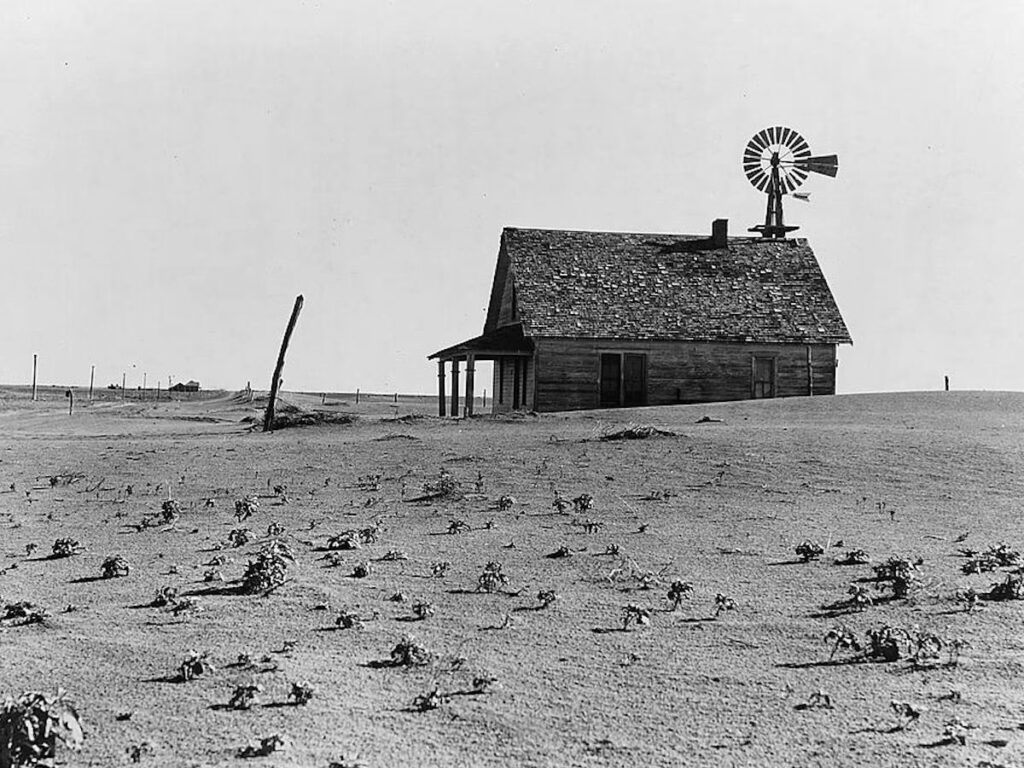
Beginning in 1934, states in the Great Plains were hit with severe drought, causing soil erosion and creating a series of massive dust storms. The region—already suffering under the financial crisis of the Great Depression—saw thousands of small farmers uprooted, many heading west in search of a better life. The storms, often called “black blizzards” or “dust storms,” stripped topsoil from overworked fields and carried it hundreds of miles. The most affected areas included the Oklahoma and Texas panhandles, western Kansas, and southeastern Colorado.
The federal government responded with the Farm Security Administration (FSA), a New Deal agency created to provide relief to migrant refugees. Dorothea Lange and her husband, social scientist Paul Taylor, were hired by the State of California to document the plight of these refugees. Their photographs soon caught the attention of the federal government, and Lange worked on and off for the FSA for the next several years, producing some of her most iconic images. In April 1936, a photograph was taken in Cimarron County, Oklahoma—the heart of the Dust Bowl—showing a farmer and his two sons walking through a dust storm, a visual that became a symbol of the era.
- 1934: Severe drought hits the Great Plains, leading to soil erosion.
- 1935: Massive dust storms, including the “Black Sunday” storm of April 14, 1935.
- 1936: Dorothea Lange photographs Dust Bowl refugees in Cimarron County, Oklahoma.
- 1937–1938: Continued drought and storms; migration to California intensifies.
- 1939: Lange and Taylor publish An American Exodus: A Record of Human Erosion.
How It Was Seen at the Time
Contemporaries understood the Dust Bowl as both a natural disaster and a human tragedy. The language they used was filled with images of erasure, displacement, and the land turning against its inhabitants. Caroline Henderson wrote of the “dust-covered desolation of No Man’s Land,” a phrase that captured both the physical barrenness and the sense of abandonment. She spoke of the effort to “tie a knot in the end of the rope and hang on,” a phrase that became a rallying cry for those who stayed.
Dorothea Lange, describing her encounters with refugees, recorded a family who said, “We’ve been blown out.” She later reflected on the broader meaning: “This shaking off of people from their own roots started with those big storms, and it was like a movement of the earth.” The prevailing mood was one of shock and endurance—people did not yet know that the drought would last for years, but they knew their lives had been irrevocably altered.
“We’ve been blown out.” — a family to Dorothea Lange, quoted in the Oakland Museum of California’s Dorothea Lange Digital Archive
Historical Snapshot
| Aspect | Detail |
|---|---|
| Date | 1934–1940 (peak 1934–1936) |
| Place | Great Plains, especially Oklahoma, Texas, Kansas, Colorado, New Mexico |
| People | Caroline A. Henderson (farmer and letter writer), Dorothea Lange (photographer), Paul Taylor (social scientist), thousands of displaced farm families |
| What Happened | Severe drought and wind erosion produced massive dust storms, destroying crops and soil, and forcing farmers to migrate west. |
| Why It Mattered | The Dust Bowl exposed the ecological and economic vulnerability of the Great Plains, led to New Deal relief programs, and became a symbol of the Great Depression era. |
Letters & Diaries
The most intimate primary sources from the Dust Bowl are the letters of Caroline Henderson, written from Eva, Oklahoma, to a friend in Maryland. Henderson’s letters, published in The Atlantic Monthly in 1936, are a vivid account of daily life under the dust. In her letter of June 30, 1935, she describes the family’s arrival back from a trip to Kansas:
“Our recent transition from rain-soaked eastern Kansas with its green pastures, luxuriant foliage, abundance of flowers, and promise of a generous harvest, to the dust-covered desolation of No Man’s Land was a difficult change to crowd into one short day’s travel.”
She also describes the practical measures taken to survive: “Wearing our shade hats, with handkerchiefs tied over our faces and Vaseline” to protect against the dust. These letters are significant because they show the Dust Bowl as a lived experience—the physical discomfort, the emotional toll, and the determination to stay. Henderson’s phrase “tie a knot in the end of the rope and hang on” became a kind of motto for those who refused to leave.
Eyewitness Accounts
Dorothea Lange’s photographs are accompanied by the testimonies she collected. Her archive at the Oakland Museum of California preserves the words of the people she met. In one account, she stopped at a gas station and found a family in a car:
“I stopped at a gas station to get some gas, and there was a car full of people, a family there. . . They said, ‘We’ve been blown out.’ . . . They told me about the dust storm.”
Lange also captured the broader meaning of the disaster in her own words: “This shaking off of people from their own roots started with those big storms, and it was like a movement of the earth.” Her photographs, such as the one taken in Cimarron County, Oklahoma, in April 1936, show the dust as a physical presence that blotted out the sun and covered everything in a fine, gray film.
Daily Life
Daily life in the Dust Bowl was dominated by the fight against dust. Caroline Henderson’s letters describe the protective clothing: shade hats, handkerchiefs, and Vaseline to keep the dust out of noses and mouths. Houses had to be sealed against the fine particles that seeped through every crack. Furniture was wiped down, but the dust returned within hours. Meals were eaten with a cloth over the plate, and people often woke with dust on their beds. The storms were so thick that they darkened the sky, sometimes for days, and people wore goggles to protect their eyes.
For those who stayed, the work continued—planting, weeding, and harvesting—but with diminished returns. For those who left, the journey westward was a caravan of broken-down cars and trucks, carrying families and their belongings. Dorothea Lange’s photographs show the exhausted faces of mothers and children, the piles of mattresses and pots, and the roadside camps where they stayed. The daily routine was a constant calculation of survival: where to get water, how to find food, whether to keep going or turn back.
Contemporary Terminology
The era produced its own vocabulary. The term “Dust Bowl” itself was coined by a reporter, Robert Geiger, in 1935, to describe the region that was being “blown away.” The people of the region spoke of “No Man’s Land” to describe the abandoned, desolate areas—a term that Caroline Henderson used. “Blown out” was a common phrase among refugees, meaning that the dust storms had destroyed their homes and livelihoods. The phrase “tractored out” also appeared, referring to farmers who were evicted when large landowners replaced labor with tractors, a practice that Dorothea Lange and Paul Taylor documented in their book An American Exodus. These terms reflect the dual nature of the disaster: natural (drought, dust) and human (economic pressures, displacement).
How Historians See It Today
At the time, the Dust Bowl was understood primarily as a natural disaster—a drought that had struck the Great Plains. Contemporary letters and photographs emphasized the weather, the dust, and the suffering. But modern historians have expanded the interpretation, pointing to human factors: the over-plowing of the prairies, the removal of native grasses, and the economic pressures of the Great Depression that led to unsustainable farming practices. The Farm Security Administration photographs, while intended as documentary, were also used as propaganda for New Deal policies. Today, historians view the Dust Bowl as a classic example of environmental and human-made catastrophe, where the land itself was a victim of human error, and the people were victims of both nature and policy. The primary sources—the letters, the photographs, and the oral histories—remain the foundation for understanding how ordinary people lived through this extraordinary time.
In the end, the letters and photographs of the Dust Bowl are not just records of a disaster; they are records of endurance. Caroline Henderson’s phrase “tie a knot in the end of the rope and hang on” captures the spirit of those who stayed, while Dorothea Lange’s images and testimonies capture the pain of those who left. The dust may have settled, but the stories of those who lived through it remain, as vivid as the day they were written.
FAQ
What was the Dust Bowl?
The Dust Bowl was a period of severe drought and dust storms that affected the Great Plains of the United States from 1934 to 1940. It was caused by a combination of drought, over-plowing, and the removal of native grasses that held the soil in place. The storms destroyed crops and forced thousands of farmers to migrate, especially to California.
Who was Caroline Henderson?
Caroline A. Henderson was a farmer in Oklahoma who wrote letters describing the Dust Bowl experience. Her letters, published in The Atlantic Monthly in 1936, are a primary source of what it was like to live through the dust storms, including her efforts to 'tie a knot in the end of the rope and hang on.'
How did Dorothea Lange document the Dust Bowl?
Dorothea Lange, a photographer working for the Farm Security Administration, documented the Dust Bowl refugees in California and the Great Plains. Her photographs, along with her notes and testimonies, captured the suffering and resilience of the displaced farmers, and she published them in 'An American Exodus' with her husband Paul Taylor.


Leave a Reply