
Short Answer
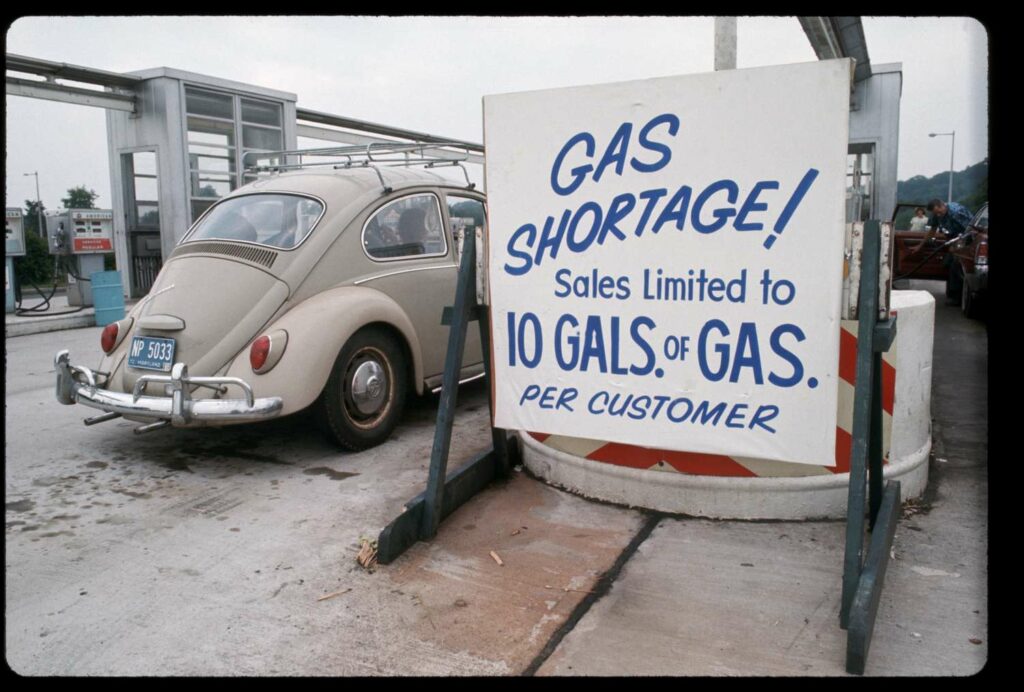
In October 1973, Americans woke to a world that seemed to be running out of gas. The Yom Kippur War had erupted in the Middle East, and the United States had thrown its support behind Israel. In retaliation, Arab oil producers cut exports and imposed an embargo on America and its allies. Within weeks, the price of crude oil nearly quadrupled, and long lines of cars snaked around gasoline stations across the country. A photograph from a Connecticut filling station captured the moment: a hand-painted sign read, “Gas shortage! Sales limited to 10 gallons of gas per customer.” The era of cheap, abundant oil was over, and the 1970s would never be the same.
What Happened?
On October 6, 1973, Egypt and Syria launched a surprise attack on Israel, beginning the Yom Kippur War. The conflict was the latest chapter in a decades-long Arab-Israeli struggle, and it drew the superpowers into its orbit. When President Richard Nixon requested $2.2 billion in emergency military aid for Israel on October 19, the Arab states responded with an economic weapon. The Organization of Arab Petroleum Exporting Countries (OAPEC), led by Saudi Arabia’s King Faisal, announced a total oil embargo against the United States, Canada, Japan, the Netherlands, the United Kingdom, and later Portugal, Rhodesia, and South Africa. The embargo cut off U.S. imports from participating OAPEC nations and introduced production cuts that sent global oil prices soaring.
- October 6, 1973: Egypt and Syria attack Israel, beginning the Yom Kippur War.
- October 19, 1973: Nixon asks Congress for $2.2 billion in emergency aid to Israel; OAPEC declares embargo on the U.S.
- October 1973: Embargo extends to other nations, including the Netherlands, Portugal, and South Africa.
- January 1974: Oil prices nearly quadruple from $2.90 to $11.65 per barrel.
- March 1974: OAPEC lifts the embargo, but prices remain high and the global economy is shaken.
The embargo was not just a ban on exports; it also cut production, which pushed prices up worldwide. By March 1974, the price of oil had risen by nearly 300 percent, from about $3 per barrel to almost $12 per barrel. In the United States, prices were even higher than the global average. The crisis triggered a wave of panic buying, shortages, and rationing, and it exposed the vulnerability of industrialized nations to foreign oil.
How It Was Seen at the Time
To contemporaries, the oil crisis felt like a national emergency. The word “embargo” was on everyone’s lips, and the term “gas shortage” became a daily refrain. Americans believed that the country was under attack from foreign oil, and the sense of vulnerability was palpable. President Richard Nixon instituted a rationing program intended to safeguard supplies and keep prices low, but his policy backfired, leading to shortages at the pump. The mood was one of frustration and fear. A photograph from the Library of Congress shows cars waiting in long lines at a gas station, a common sight in 1973–74. The Federal Reserve History notes that the embargo “further complicated the macroeconomic environment of the early 1970s,” and the United States suffered simultaneous recession and inflation—a condition known as “stagflation.”
“Gas shortage! Sales limited to 10 gallons of gas per customer.” — Sign posted at a Connecticut filling station, October 1973.
People spoke of “foreign oil” as a threat, and the phrase “energy crisis” entered the national vocabulary. The mood was anxious, and many wondered whether the crisis would never end.
Historical Snapshot
| Aspect | Detail |
|---|---|
| Date | October 1973 – March 1974 |
| Place | United States, Middle East, Netherlands, Portugal, and other nations |
| People | King Faisal of Saudi Arabia, President Richard Nixon, OAPEC members |
| What Happened | Arab oil producers embargoed oil exports to the U.S. and its allies, causing a global energy crisis. |
| Why It Mattered | Oil prices quadrupled, leading to gas lines, rationing, and a lasting shift in global economic and political power. |
What People Knew at the Time
| What People Knew Then | What We Know Now |
|---|---|
| The embargo was a direct response to U.S. support for Israel in the Yom Kippur War. | Historians confirm this, but also note that OAPEC’s action was part of a longer struggle over oil pricing and control. |
| Gasoline shortages were caused by a lack of oil imports. | Shortages were worsened by Nixon’s price controls and rationing program, which discouraged production and caused panic buying. |
| The embargo was a temporary crisis that would soon end. | The embargo ended in March 1974, but it permanently altered the global energy landscape and led to the creation of the Strategic Petroleum Reserve. |
Daily Life
For ordinary Americans, the crisis meant hours spent waiting in line at the gas station. Stations rationed fuel, limiting sales to 10 gallons per customer, and many closed on Sundays. The federal government introduced odd-even rationing, where drivers with license plates ending in an even number could buy gas on even days, and odd-numbered plates on odd days. The lines were often long, and tempers flared. A photograph from the Library of Congress shows a line of cars waiting at a station, a scene repeated across the country. People also changed their driving habits—carpooling, using public transit, and forgoing weekend trips. The crisis touched every aspect of life, from the cost of groceries (which rose as transport costs increased) to the morale of the nation.
Numbers at the Time
| Statistic | Value | Source |
|---|---|---|
| Oil price before embargo | $2.90 per barrel | Federal Reserve History |
| Oil price in January 1974 | $11.65 per barrel | Federal Reserve History |
| Global price increase | Nearly 300% | Wikipedia |
| U.S. emergency aid to Israel | $2.2 billion | Federal Reserve History |
| Embargo duration | October 1973 – March 1974 | State Department |
Aftermath
The embargo was lifted in March 1974, but the damage was done. Oil prices remained high, and the United States, along with other industrialized nations, entered a period of stagflation—simultaneous inflation and recession. The crisis spurred the creation of the Strategic Petroleum Reserve, the formation of the International Energy Agency, and a global push for energy conservation. It also shifted the geopolitical balance, giving oil-producing nations new leverage. In the years that followed, the American public would never again take cheap oil for granted.
How Historians See It Today
Historians now view the 1973 oil crisis as a turning point in global economic and political history. At the time, many Americans saw it as a temporary punishment from Arab states. Today, scholars emphasize that the embargo was part of a broader struggle over oil pricing and control, and that the crisis exposed the deep vulnerability of industrialized nations to energy supply disruptions. The Federal Reserve History notes that the crisis “further complicated the macroeconomic environment,” and the Yale Energy History project calls it a key moment in U.S. political, cultural, and economic history. The crisis also reshaped the relationship between oil producers and consumers, and its effects are still felt today.
The 1973 oil crisis was a wake-up call. Through the eyes of contemporaries, we see a nation caught off guard, waiting in line for fuel, and wondering what the future would bring. The primary sources—photographs, signs, and government reports—capture the anxiety and the resilience of a country that would never be the same. The gas lines were more than a nuisance; they were a symbol of a new era of scarcity and global interconnectedness.
FAQ
Why did the 1973 oil embargo happen?
The embargo was a response to U.S. support for Israel in the Yom Kippur War. On October 19, 1973, President Nixon requested $2.2 billion in emergency aid to Israel, and the Arab members of OPEC retaliated by cutting oil production and embargoing exports to the U.S. and its allies.
How long did the oil embargo last?
The embargo began in October 1973 and was officially lifted in March 1974, lasting about five months. However, the effects on oil prices and the global economy lasted much longer.











Leave a Reply