
Short Answer
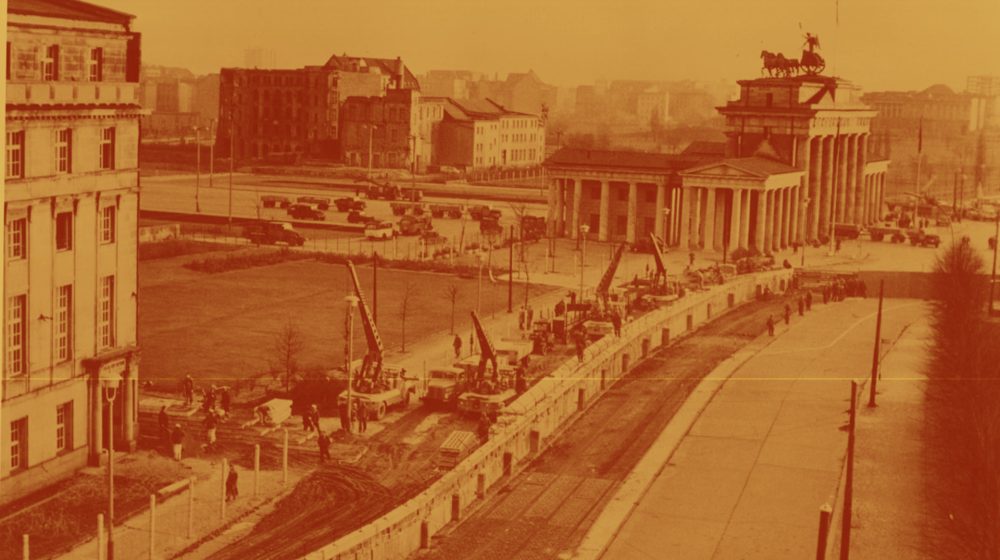
In the early hours of August 13, 1961, Berliners woke to a city being torn apart. At the Brandenburg Gate, East German workers with small cranes moved huge cement flower pots across the roadways, sealing the border with flowers. To the right and left, rolls of barbed wire unspooled along the sector lines, soon to be replaced by a masonry wall that would divide families, friends, and a continent. That morning, journalists were called to the border, West Berliners gathered in anger and anguish, and the world learned that the Cold War had taken a concrete, physical form.
What Happened?
On August 13, 1961, the German Democratic Republic (GDR) began sealing the border between East and West Berlin. The operation, which had been planned in secret, was executed by East Germany’s National People’s Army (NVA) and construction crews loyal to the communist government. In most locations, the first barriers were rolls of barbed wire, but within days, these were replaced by a masonry wall that would eventually stretch for more than 150 kilometers.
The immediate trigger was the exodus of East Germans through Berlin. Between 1949 and 1961, more than 2.5 million people had fled the GDR, many through the open sector border in Berlin. To stem this drain of citizens, the East German government decided to close the border completely. The operation was launched on a Sunday morning, when most people were asleep, to minimize resistance.
- Early hours of August 13, 1961: East German police and troops sealed the sector border with barbed wire, cutting off all access routes from East to West Berlin.
- August 13, 1961: The Brandenburg Gate was closed, and the headline “Brandenburg Gate Closed” appeared in the Associated Press (AP) news agency report.
- August 15, 1961: Construction of the concrete wall began, replacing the barbed wire and temporary barriers.
- Over the following weeks: The wall was extended and reinforced, incorporating the lower levels of some buildings and creating a death strip.
By the end of the night of August 13, all access between the two sides of Berlin was effectively closed. The Berlin Wall, a symbol of oppression and division, had been born.
How It Was Seen at the Time
Contemporary observers described the events with a mixture of shock, disbelief, and foreboding. The BBC’s Peter Woods, reporting from Berlin on August 16, 1961, described the “ominous events” that had taken place, including the closure of an underground station and the movement of some East Berliners across the border. He noted that by the end of the night, it was likely that all access between the two sides of Berlin would be closed.
“The East Germans with little cranes were moving huge cement flower pots and positioning them across the roadways that go under the Brandenburg Gate. And so it looked like a joke at first—they’re sealing it off with flowers.” — Robert MacNeil, NBC correspondent, recalling August 12–13, 1961 (PBS News)
NPR’s Daniel Schorr, who was called in his Berlin hotel room in the early hours of August 13, recalled: “What I saw was East German police sealing the sector border with rolls of barbed wire that would soon be replaced by a masonry wall. West Berliners gathered nearby in anger and anguish.” The prevailing mood was one of fear and uncertainty—no one knew how far the East would go or how the Western powers would respond.
Historical Snapshot
| Aspect | Detail |
|---|---|
| Date | August 13, 1961 (construction began); wall stood until November 9, 1989 |
| Place | Berlin, Germany (East Berlin and West Berlin) |
| People | East German government, National People’s Army (NVA), East Berlin residents, West Berlin residents, Western Allied forces |
| What Happened | The GDR sealed the border between East and West Berlin with barbed wire and then a concrete wall, preventing East Germans from fleeing to the West. |
| Why It Mattered | The wall became a physical symbol of the Cold War division of Europe and a barrier to freedom; it remained until 1989. |
Eyewitness Accounts
The most vivid accounts come from journalists and ordinary Berliners who were present. Robert MacNeil, then a junior correspondent for NBC News, described the initial confusion:
“The East Germans with little cranes were moving huge cement flower pots and positioning them across the roadways that go under the Brandenburg Gate. And so it looked like a joke at first—they’re sealing it off with flowers.”
Daniel Schorr of NPR, who was in Berlin, recalled the moment he was called: “In the early hours of Aug. 13, 1961, I was called in my Berlin hotel room to come and see what was happening at the border between East and West Berlin. We had been expecting some move to stem the exodus of people from East Germany that was threatening the viability of the communist state. What I saw was East German police sealing the sector border with rolls of barbed wire that would soon be replaced by a masonry wall.”
West Berliners gathered near the border in anger and anguish. The BBC’s Peter Woods reported on August 16 that the events of the day included the closure of an underground station and the movement of some East Berliners across the border, with the likelihood that all access would be closed by nightfall.
Contemporary Newspaper Coverage
Newspapers around the world quickly recognized the significance. The Associated Press (AP) news agency used the headline “Brandenburg Gate Closed” in the early hours of August 13, 1961, to announce the beginning of the construction of the Berlin Wall. The BBC’s broadcast on August 16, 1961, was titled “The Berlin Boundary Is Sealed,” and its correspondent Peter Woods described the ominous events of the day.
“The Berlin Boundary Is Sealed” — BBC News, 16 August 1961
The tone of coverage was grave and uncertain. Reporters described the barbed wire and concrete as a symbol of oppression, but they also noted that the West had not yet reacted. The immediate question was how the Allied powers—the United States, Britain, and France—would respond to this unilateral action by the East German state.
What People Feared
At the time, the most immediate fear was that the border closure would become permanent and that the West would not intervene. Many Berliners feared that the division would lead to a military confrontation. The BBC’s Peter Woods noted the “ominous events” and the closure of an underground station, which suggested a total severing of the city’s life.
There was also fear among East Berliners who were now trapped. Some tried to escape during the first days, while others realized that they would be cut off from jobs, families, and the freedom of the West. The West Berliners gathered in anger, but also with a sense of helplessness. The fear of a permanent division was palpable, and the lack of a strong Western response only increased anxiety.
What People Expected Would Happen Next
Most contemporaries expected that the border would remain closed for a long time, but few predicted the Wall would last for 28 years. The BBC’s report on August 16, 1961, stated that “by the end of the night, it is likely that all access between the two sides of Berlin will be closed.” This was a grim prediction that came true. Many expected that the Western powers would eventually negotiate with the East Germans, but no one anticipated the Wall would become a permanent fixture of the Cold War landscape.
In the immediate aftermath, some believed that the Wall would be temporary, a temporary measure to stop the flow of refugees. But as the concrete barriers went up and the border was fortified, it became clear that the East German government intended to make the division permanent. The world could not have imagined that the Wall would not fall until November 9, 1989.
Timeline
- 1949: East Germany (GDR) established; Berlin is divided into East and West sectors.
- 1949–1961: Over 2.5 million East Germans flee to the West, many through Berlin.
- August 13, 1961, 1:00 a.m.: East German troops and police seal the border with barbed wire and concrete posts.
- August 13, 1961, early morning: The Brandenburg Gate is closed; AP sends the headline “Brandenburg Gate Closed.”
- August 13–15, 1961: Concrete blocks and sections of wall are erected; the border is fully sealed.
- August 16, 1961: BBC reports that all access between East and West Berlin is likely closed.
- September 1961: The wall is reinforced with a second wall and a death zone.
- November 9, 1989: The East German government opens the border; the Berlin Wall falls.
How Historians See It Today
Modern historians view the construction of the Berlin Wall as a crucial turning point in the Cold War. At the time, the immediate reaction was one of fear and uncertainty, but the wall also brought a strange stability: it eliminated the refugee crisis and prevented a direct military confrontation between East and West. Historians now see the Wall as a symbol of the division of Europe and the repression of the East German state, but also as a manifestation of the Cold War’s “balance of terror.” The Wall’s construction was a decisive act that solidified the geopolitical order of the Cold War for nearly three decades. The primary sources from 1961—news reports, eyewitness accounts, and personal testimonies—remain essential for understanding how the world experienced that moment.
The Berlin Wall was not just a physical barrier; it was a symbol of a world divided. The reports from August 1961 capture the shock, the fear, and the uncertainty of the era. They remind us that history is not a dry list of dates but a living experience of people who lived through extraordinary times. The Wall stood for 28 years, but its construction in 1961 was a moment that changed the course of the Cold War and the lives of millions.
FAQ
Why was the Berlin Wall built in 1961?
The Berlin Wall was built by the East German government to stop the massive exodus of East Germans to the West. Between 1949 and 1961, over 2.5 million people fled the GDR, many through Berlin. The wall was erected to close this escape route and to stabilize the communist state.
What did the world know on August 13, 1961?
The world learned through news reports that East Germany had sealed the border with barbed wire and concrete. The AP headline 'Brandenburg Gate Closed' and BBC reports described the closure of the border and the movement of troops. People initially thought it was a temporary measure, but it became permanent.
How did West Berliners react to the Wall?
West Berliners gathered in anger and anguish at the border, watching the construction. They feared that the division would become permanent and that the Western powers would not intervene. The initial reaction was shock and a sense of betrayal, as they saw the Wall as a symbol of oppression.










Leave a Reply