
Short Answer
On the first day of June 1900, a small army of federal enumerators fanned out across the United States to conduct the Twelfth Census of the United States. The task was monumental: to visit every household in the nation—from the crowded tenements of eastern cities to the remote homesteads of the newly acquired territory of Alaska—and to record the name, age, race, marital status, and family relationship of every person whose place of abode on June 1, 1900, was within the borders of the country. Each enumerator carried the official “Schedule No. I—Population,” a printed form with precise instructions and a signature line that made the count a legal and personal act. The census was the most comprehensive and systematic count the nation had ever undertaken, a grand effort to capture the American people in a single, frozen portrait at the dawn of a new century.
What Happened?
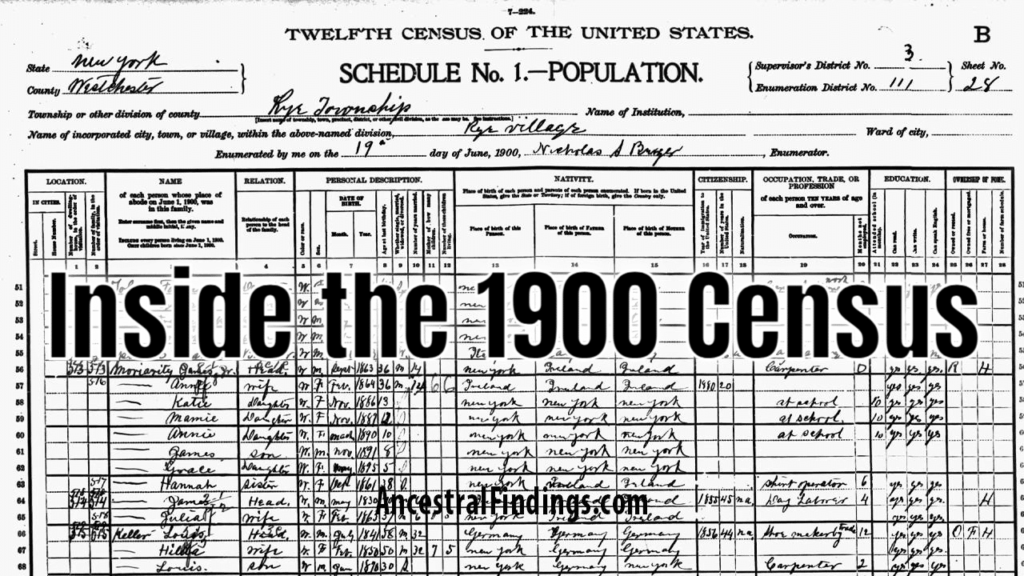
The Twelfth Census of the United States had a reference date of June 1, 1900. Enumerators were appointed for each enumeration district, which was a subdivision of a larger supervisor’s district. The official form, titled “Schedule No. I—Population,” was printed by the government and carried by the enumerator to every household.
The census form was organized around the household. The enumerator recorded the location of each dwelling, including the street and house number in cities, and the number of the dwelling and family in the order of visitation. The form’s instructions were explicit: “Include every person living on June 1, 1900. Omit children born since June 1, 1900.” This made the census a snapshot of a single day, not an ongoing record.
For each person, the enumerator recorded:
- The name, with surname first, followed by the given name and middle initial, if any
- Relationship to the head of the family
- Color or race
- Sex
- Date of birth (month and year)
- Age at last birthday
- Whether single, married, widowed, or divorced
- Number of years married
When the results were compiled, Volume II of the Census Reports—published in 1902—provided statistics on ages by sex, nativity, and color; persons of school age; males of militia age; males of voting age; marital status; school attendance; illiteracy; ability to speak English; occupations; dwellings and families; and proprietorship of homes. The census also covered the territories of Alaska and Hawaii.
How It Was Seen at the Time
The census was understood as a civic and legal obligation. Each enumerator signed the form, certifying that the enumeration had been conducted “on the day of June, 1900,” and the forms were official government documents stamped with the authority of the United States.
Contemporaries saw the census as a matter of national importance. The data collected would determine representation in Congress and inform government policy on matters of military readiness, education, and public welfare. The categories on the form—”color or race,” “single, married, widowed, or divorced”—reflected the social conventions that mattered to the era’s policymakers and to the public.
The census was also a moment of personal obligation between the government and every American household. The enumerator’s arrival at the door was a rare moment when the federal government reached into the private life of a family. The instructions were unambiguous about the scope of the count:
“Include every person living on June 1, 1900. Omit children born since June 1, 1900.”
Historical Snapshot
| Aspect | Detail |
|---|---|
| Date | June 1, 1900 |
| Place | The United States, including the territories of Alaska and Hawaii |
| People | Every person residing in the United States |
| What Happened | The Twelfth Census was conducted, with enumerators visiting every household |
| Why It Mattered | The census determined representation and provided a comprehensive portrait of the nation’s social and economic character |
What People Knew at the Time
| What People Knew Then | What We Know Now |
|---|---|
| The census was a government count for representation and policy | The census is a primary source for historians, genealogists, and social scientists |
| The census captured a basic demographic snapshot of the population | The census records are preserved at the National Archives and indexed using the Soundex system |
| The census collected data about age, occupation, and marital status | The census reveals the structure of American households and the social categories of the era |
Numbers at the Time
Volume II of the 1900 Census Reports, published in 1902, presented the following categories of statistical data:
| Statistic | Source |
|---|---|
| Ages, by sex, nativity, and color | Volume II, 1902 |
| Persons of school age | Volume II, 1902 |
| Males of militia age | Volume II, 1902 |
| Males of voting age | Volume II, 1902 |
| Marital status | Volume II, 1902 |
| School attendance | Volume II, 1902 |
| Illiteracy | Volume II, 1902 |
| Ability to speak English | Volume II, 1902 |
| Occupations | Volume II, 1902 |
| Dwellings and families | Volume II, 1902 |
| Proprietorship of homes | Volume II, 1902 |
| Territories of Alaska and Hawaii | Volume II, 1902 |
Daily Life
The census form reveals a great deal about the daily life of American households in 1900. The form was organized around the dwelling and the family, reflecting a society in which the household was the fundamental unit of social organization. The enumerator moved from door to door, recording the number of each dwelling and family in the order of visitation, which meant that the census captured the physical layout of neighborhoods as well as the demographic character of their residents.
The questions on the census reflect the concerns of the era. The question about “color or race” reflected the racial categories that structured American society. The question about “ability to speak English” reflected the anxieties of a nation absorbing millions of immigrants. The question about “proprietorship of homes”—whether a family owned or rented its dwelling—revealed the economic importance of homeownership as a marker of stability and respectability.
The census also documented the centrality of the family. The relationship of each person to the head of the family was recorded, revealing the structure of the household: husband, wife, children, extended relatives, and sometimes servants or boarders. The question about “number of years married” was a record of family history and stability, and the census’s attention to marital status—”single, married, widowed, or divorced”—shows how central marriage was to the social identity of Americans at the turn of the century.
How Historians See It Today
Modern historians and genealogists regard the 1900 census as one of the most valuable primary sources for understanding American life at the turn of the century. The National Archives preserves the census schedules, and the Soundex index allows researchers to locate records by surname. As the National Archives notes, the records “document the history of the United States government from the First Continental Congress” and “contain information of importance for understanding various aspects of American life, both past and present.”
Scholars today use the 1900 census to study household structure, family size, migration patterns, occupations, and social conditions. The census is also an essential tool for genealogists tracing family histories. The categories used in the census—”color or race,” “single, married, widowed, or divorced”—are understood by modern scholars as historical artifacts that reflect the social assumptions of the era. The census is read not as a neutral record but as a document that reveals the categories and concerns of its time.
The inclusion of Alaska and Hawaii in the 1900 census was a landmark in the expansion of the United States. The census was one of the first systematic attempts to count the population of the newly incorporated territories, and it provided a baseline for understanding the demographic and social character of the nation’s expanding borders.
The 1900 census stands as a testament to the scale and ambition of the American government at the turn of the century. It was a moment when the federal government reached into every household in the nation, and in doing so, created a record that would shape the understanding of American life for generations to come.
The Twelfth Census of 1900 remains a powerful document of American history. The primary sources it produced—the enumeration schedules, the Soundex indexes, and the compiled volumes—offer an unrivalled portrait of American households at the dawn of the twentieth century. They show us a nation of families and migrants, of workers and farmers, of city dwellers and frontier settlers. The census captured them all in a single moment on a single day, and in doing so, it created a record that continues to illuminate the past.
FAQ
When was the 1900 census taken?
The 1900 census had a reference date of June 1, 1900. Enumerators were appointed to visit every household, and the enumeration was conducted during June 1900. The form instructed enumerators to include every person living on June 1, 1900, and to omit children born after that date.
What information was collected in the 1900 census?
The 1900 census collected each person's name, relationship to the head of the family, color or race, sex, date of birth (month and year), age at last birthday, marital status (single, married, widowed, or divorced), and number of years married. It also recorded the location of the household, dwelling and family numbers, and data on education, occupation, and home ownership.
Are the 1900 census records available today?
Yes, the 1900 census records are preserved at the National Archives and are indexed using the Soundex system, which allows researchers to locate records by surname. The records are a primary source for genealogists and historians.









Leave a Reply