
Short Answer
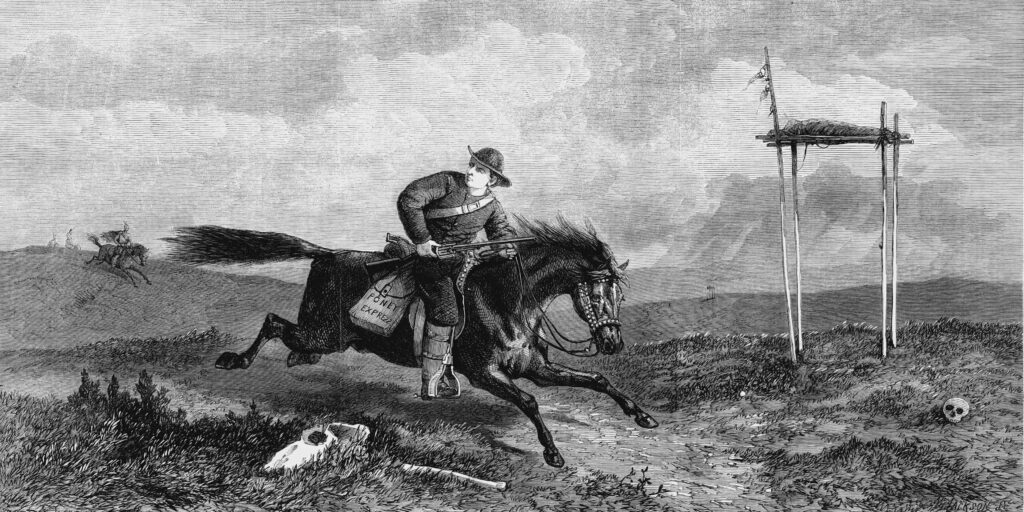
In March 1860, American transportation pioneer William H. Russell placed advertisements in newspapers seeking “hostlers and riders” for a daring enterprise: a relay of horse-mounted couriers to carry mail between Missouri and California across nearly 2,000 miles of prairie, desert, and mountain. The nation had been electrified by the discovery of gold in California and the promise of a Pacific railroad, but in 1860, overland mail took weeks or months. Russell, along with partners Alexander Majors and William Waddell, aimed to cut that time dramatically. The first rider left St. Joseph, Missouri, on April 3, 1860, and ten days later, a rider arrived in Sacramento, California—an astonishing feat that captured the imagination of a country obsessed with speed and progress. Yet this celebrated relay would last barely eighteen months, a burst of innovation that ended in bankruptcy and was soon replaced by the telegraph. But the Pony Express left a permanent mark on the American imagination, symbolizing the daring and endurance of the frontier.
What Happened?
In March 1860, Russell, Majors, and Waddell established the Central Overland California & Pike’s Peak Express Company, a separate corporation created for liability purposes. They acquired equipment, facilities, and experienced personnel from the Chorpenning Stage Company and bought smaller passenger, freight, and mail businesses outright, including the Leavenworth & Pike’s Peak Express Company and the Hockaday Stage Line. Each partner had a specific role: Russell handled finances and promotion, Majors managed the freighting and logistics, and Waddell oversaw the accounting.
The Pony Express began operations on April 3, 1860, with a relay of riders on fast horses stationed every 10 to 15 miles along the route. The system used a relay of riders and horses to carry mail from St. Joseph, Missouri, to Sacramento, California, a distance of about 1,800 miles. The service reduced the time for messages to travel between the east and west coasts to about 10 days. The first westbound mail arrived in Sacramento on April 14, 1860, and the first eastbound mail reached St. Joseph on April 13, 1860.
The Pony Express operated continuously for 18 months, from April 1860 to October 1861. It was a vital link for the new state of California, providing a faster connection to the rest of the United States than any previous overland service. However, despite a heavy subsidy from the U.S. government, the service was not a financial success. The costs of maintaining stations, buying horses, and paying riders far exceeded revenues. When the first transcontinental telegraph was completed on October 24, 1861, the Pony Express became obsolete and ceased operations.
How It Was Seen at the Time
At its inception, the Pony Express was celebrated as a marvel of speed and organization. Newspapers across the country reported on the enterprise with a mix of awe and skepticism. The St. Joseph Gazette announced the departure of the first rider with dramatic prose, and the Sacramento Union eagerly awaited the arrival of the mail. The service was seen as a bold experiment that would prove whether a unified transcontinental communication system could operate year-round.
“A black speck appears against the sky, and it is plain that it moves. . . . Another instant . . . and man and horse burst past our excited faces and go winging away like the belated fragment of a storm.” – Mark Twain, Roughing It, 1872
Twain’s description, written a decade later, captures the romantic excitement that the Pony Express had already begun to generate. Contemporaries understood the service as a daring race against time and nature, and the riders were often portrayed as heroes. Yet the prevailing mood was also practical: the Pony was a business venture, and its financial losses were known to its owners and investors.
Historical Snapshot
| Aspect | Detail |
|---|---|
| Date | April 3, 1860 – October 24, 1861 |
| Place | Route from St. Joseph, Missouri, to Sacramento, California, via Salt Lake City |
| People | William H. Russell, Alexander Majors, William Waddell; riders such as Johnny Fry, Buffalo Bill Cody (later) |
| What Happened | A relay of horse-mounted riders carried mail across the frontier in about 10 days. |
| Why It Mattered | Demonstrated the feasibility of year-round transcontinental communication; tied California to the Union; later replaced by telegraph. |
Eyewitness Accounts
Mark Twain’s Roughing It (1872) provides one of the most vivid contemporary descriptions of the Pony Express in action. Twain, traveling through the West in the early 1860s, saw a rider pass his stagecoach and later wrote:
“The rider was usually a little bit of a man, brimful of spirit and energy. The horse was the fleetest of the fleet. The mail was carried in a saddlebag, and the rider carried a revolver and a knife. He was not allowed to carry any other arms, and was forbidden to carry any letters or papers except the mail.”
Other accounts from station keepers and riders describe the grueling pace: riders changed horses every 10 to 15 miles, and each rider covered 75 to 100 miles before handing off the mail to the next rider. The riders were often young, light, and experienced horsemen, sometimes no more than 18 years old. They faced harsh weather, hostile terrain, and occasional attacks, but the service maintained a remarkable record of delivering mail on time.
Timeline
- March 1860: William H. Russell advertises for hostlers and riders for the central overland express route via Salt Lake City.
- April 3, 1860: First Pony Express rider departs St. Joseph, Missouri.
- April 13, 1860: First eastbound mail arrives in St. Joseph from Sacramento.
- April 14, 1860: First westbound mail arrives in Sacramento, California.
- October 24, 1861: First transcontinental telegraph line completed; Pony Express ceases operations.
Aftermath
The Pony Express operated for only 18 months, ending in October 1861 when the telegraph made it obsolete. The company, already in financial distress, went bankrupt. The owners lost their investment, but the service had demonstrated that a unified transcontinental communication system could be built and operated year-round. In the years that followed, the Pony Express became romanticized in dime novels, Wild West shows, and popular literature, transforming from a failed business venture into a symbol of the American frontier’s spirit of speed, courage, and endurance.
How Historians See It Today
Modern historians view the Pony Express as a brief but significant experiment in overland communication. It was not the first express service, nor was it the only one, but it was the most dramatic and well-publicized. Historians note that it was financially unsuccessful and that its impact was largely symbolic. The service proved that a route could be maintained year-round, but the telegraph quickly superseded it. Today, the Pony Express is understood as a romanticized episode that illustrates the technological and economic challenges of connecting the American continent in the mid-19th century.
Common Misconceptions
The Pony Express lasted for many years.
It operated for only 18 months, from April 1860 to October 1861.
The Pony Express was a government mail service.
It was a private enterprise operated by the Central Overland California and Pikes Peak Express Company, though it received a government subsidy.
The Pony Express was profitable.
It was not financially successful; it went bankrupt in 18 months.
The Pony Express carried mail from coast to coast.
It carried mail only from St. Joseph, Missouri, to Sacramento, California, leaving the eastern and western ends to be completed by other carriers.
The Pony Express, though short-lived and financially disastrous, left an enduring legacy. It proved that a unified transcontinental communication system could be operated year-round, and it captured the imagination of a nation. The primary sources—the advertisements, the newspaper reports, and the memoirs—reveal a venture that was both a practical experiment and a dramatic adventure. The riders who raced across the frontier embodied the spirit of a nation that was expanding westward at a breathtaking pace. The Pony Express reminds us that even the most romanticized elements of American history often rest on a foundation of hard work, sacrifice, and the relentless pursuit of speed.
FAQ
How did the Pony Express work?
The Pony Express used a relay of riders on horseback to carry mail from St. Joseph, Missouri, to Sacramento, California. Riders changed horses every 15 miles or so, and each rider covered about 75-100 miles before handing the mail to the next rider. The service took about 10 days, compared to weeks for other methods.
Why did the Pony Express end?
The Pony Express ended because the first transcontinental telegraph line was completed on October 24, 1861, making telegraph communication faster and more reliable. The company also was losing money and went bankrupt.









Leave a Reply