
Short Answer
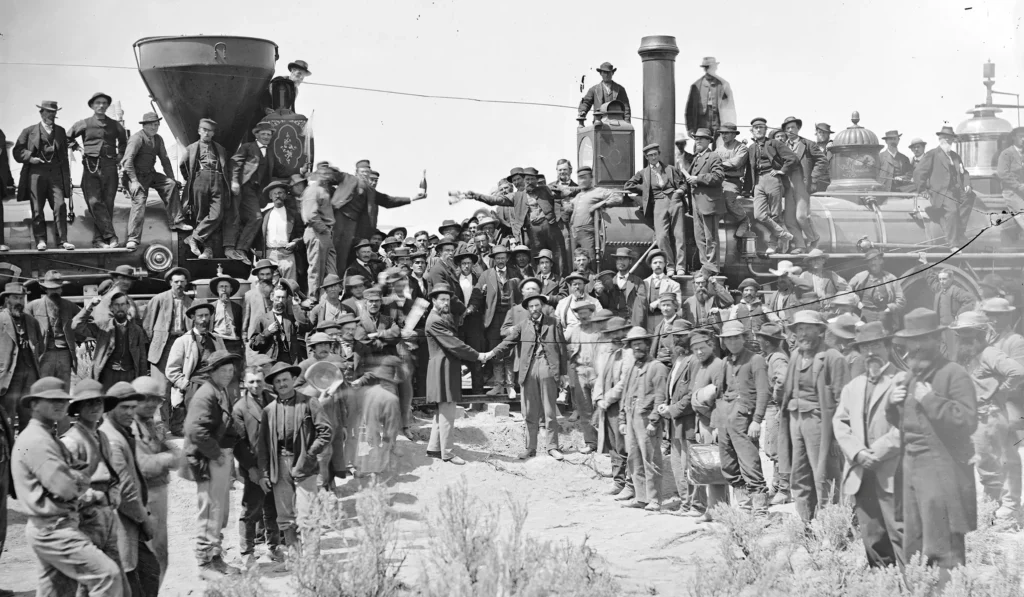
On May 10, 1869, a crowd of laborers, officials, and onlookers gathered on the dusty plateau of Promontory Summit, Utah Territory, to witness the driving of a golden spike that would complete the first transcontinental railroad. The telegraph operator tapped out a single word—DONE—and within seconds, the news flashed across the nation. The race that had begun six years earlier, pitting the Central Pacific Railroad against the Union Pacific Railroad in a frantic contest for land, bonds, and national glory, was over. The iron rails now bound the Atlantic and Pacific coasts, and Americans who had endured the Civil War and the expansion westward watched with a mixture of awe, pride, and anticipation. The scene was a study in contrasts: the gleaming spike, the weathered faces of the workers, the locomotives breathing steam on the tracks—and the knowledge that this single line would transform a continent.
What Happened?
The first transcontinental railroad, originally known as the Pacific Railroad, was built under the Pacific Railroad Acts of 1862 and 1864, which granted land and government bonds to the Central Pacific Railroad Company of California (CPRR) and the Union Pacific Railroad (UPRR) based on the number of miles of track they laid. The Central Pacific, starting from Sacramento, California, pushed eastward through the formidable Sierra Nevada, while the Union Pacific, starting from Omaha, Nebraska, built rapidly across Nebraska and Wyoming. The two companies were locked in a bitter contest, each determined to claim as much land and as many government subsidies as possible.
The Central Pacific, led by the “Associates” (including Leland Stanford, Collis P. Huntington, and Charles Crocker), labored through the mountains, while the Union Pacific, under the direction of Thomas C. Durant, advanced across the plains. The race intensified as both companies approached Utah, knowing that the line that first reached Salt Lake City would secure the Mormon trade and the valuable coal mines in Weber Canyon. After years of construction, the two lines met at Promontory Summit, Utah Territory, on May 10, 1869.
At the ceremony, the final spike was driven—a ceremonial golden spike—and the telegraph flashed the message “DONE” to a waiting nation. The completion of the railroad connected the existing eastern rail network at Council Bluffs, Iowa, with the Pacific coast at Oakland Long Wharf on San Francisco Bay, a total of 1,911 miles of continuous track. The Union Pacific had built 1,085 miles, the Central Pacific 690 miles, and the Western Pacific Railroad had constructed 132 miles from Alameda/Oakland to Sacramento.
How It Was Seen at the Time
Contemporaries saw the completion of the transcontinental railroad as a triumph of American enterprise and a fulfillment of a dream that had been voiced for decades. As early as 1832, Samuel Dexter, editor of the Western Emigrant, wrote: “It is in our power to open an immense interior country to market, to unite our eastern and western states, and to give to the world the greatest thoroughfare that has ever been constructed.” This vision became a reality in 1869.
The prevailing mood was one of euphoria and pride. The telegraphic message “DONE” was broadcast across the nation, and cities held parades and speeches. The railroad was seen as a symbol of progress, a binding force for a nation still healing from civil war. But the enthusiasm was not without its darker undercurrents. The race had been driven by greed and the promise of land grants, and the construction had come at a heavy cost, including the displacement of Native American peoples and the exploitation of thousands of immigrant laborers.
Historical Snapshot
| Aspect | Detail |
|---|---|
| Date | May 10, 1869 |
| Place | Promontory Summit, Utah Territory |
| People | Central Pacific Railroad (CPRR) and Union Pacific Railroad (UPRR); leaders such as Leland Stanford, Collis P. Huntington, and Thomas C. Durant; thousands of Chinese and Irish laborers |
| What Happened | The two railroads met and the final spike was driven, completing the first transcontinental railroad |
| Why It Mattered | It connected the East and West coasts of the United States, opening the West to settlement and commerce, and transformed the nation’s economy and identity. |
Contemporary Newspaper Coverage
Newspapers across the country followed the race with intense interest. The Western Emigrant had already in 1832 championed the idea of a railroad to the Pacific, and by the 1860s, the press regularly reported on the progress of the two companies. The telegraphic message “DONE” was transmitted to the nation, and the press celebrated the completion with headlines of “The Great Railroad Completed” and “The Continent United.”
“It is in our power to open an immense interior country to market, to unite our eastern and western states, and to give to the world the greatest measure of progress that has ever been achieved.” — Western Emigrant, 1832
The coverage was not uniformly celebratory; some papers noted the dangers of the race, including the risky financial schemes and the mistreatment of laborers. But the overall tone was one of national pride and optimism.
Eyewitness Accounts
One of the most direct eyewitness accounts is the telegraphic message sent from Promontory Summit. The telegrapher, who stood at the ceremony, sent the single word “DONE” to the waiting nation. This terse but powerful message became the symbol of the completion. In the words of the telegrapher, the event was “a simple, yet thrilling, message to the waiting nation.”
“DONE.” — Telegraph message from Promontory Summit, May 10, 1869
Other eyewitnesses described the scene: the crowd of workers, the engines facing each other, the golden spike, and the sudden silence as the last blow was struck. The ceremony was attended by officials, laborers, and journalists, many of whom left written accounts. The official reports of the event, though brief, confirm the central fact of the day.
What People Expected Would Happen Next
Contemporaries expected the railroad to bring a new era of prosperity and expansion. They predicted that the West would be rapidly settled, that trade with Asia would flourish, and that the nation would become more tightly unified. The railroad was seen as a means to bind the nation together after the Civil War. Many also feared that the railroad would bring conflict with Native American tribes, whose lands were being crossed, and that the rapid construction would lead to financial scandals and the exploitation of laborers. These expectations were largely realized: the railroad did spur settlement and commerce, but it also brought displacement and violence.
How Historians See It Today
Modern historians have deepened our understanding of the transcontinental railroad beyond the celebratory narratives of the 19th century. They emphasize the role of Chinese and Irish immigrants, who made up the majority of the labor force and worked under dangerous conditions. They also highlight the financial corruption and the “unscrupulous financing” that marked the construction, as noted in the PBS documentary The Transcontinental Railroad. Historians also examine the impact on Native Americans, whose lives and lands were devastated by the railroad. The railroad is now seen not only as a feat of engineering but also as a force that reshaped the environment and the social fabric of the American West.
How Historians See It Today (continued)
While contemporaries saw the railroad as a symbol of progress, modern scholars often stress the costs: the displacement of indigenous peoples, the exploitation of workers, and the creation of a national economy that benefited some at the expense of others. The “Golden Spike” ceremony, once celebrated as a unifying moment, is now also interpreted as the beginning of a new era of corporate power and environmental transformation.
The transcontinental railroad stands as one of the most significant engineering achievements of the 19th century. Its completion on May 10, 1869, at Promontory Summit, marked the end of a race and the beginning of a new era. The primary sources—the telegraphic message, the newspaper editorials, and the accounts of the ceremony—reveal the excitement and the anxieties of the time. They show us a nation that was both proud of its achievements and aware of the sacrifices they demanded. The railroad not only connected two coasts but also changed the way Americans saw their country and themselves.
FAQ
When was the first transcontinental railroad completed?
The railroad was completed on May 10, 1869, when the Central Pacific and Union Pacific railroads met at Promontory Summit, Utah Territory. The final spike was driven, and the telegraph sent the message 'DONE'.
What was the significance of the golden spike?
The golden spike was a ceremonial spike used to mark the completion of the railroad. It symbolized the unity of the East and West coasts of the United States and the achievement of a transcontinental connection.
How did the railroad affect Native Americans?
The railroad disrupted Native American lands and ways of life, leading to displacement, loss of resources, and violent conflicts. The construction and operation of the railroad brought settlers and military forces that encroached on tribal territories.











Leave a Reply