
Short Answer
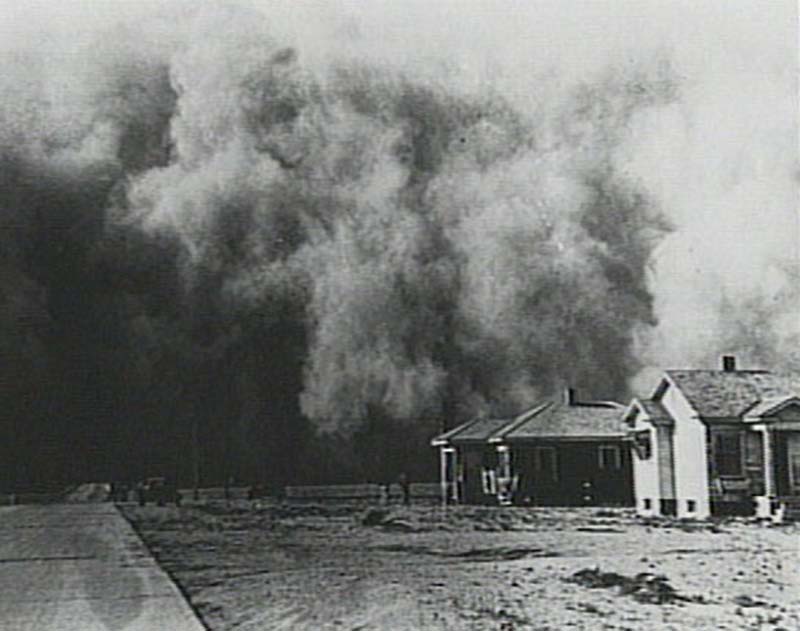
On Sunday, April 14, 1935, a wall of black dust rolled across the Southern Plains, turning day into night and suffocating the region in grit and despair. Pauline Winkler Grey, a resident of Meade County, Kansas, later recalled how she and her neighbors prepared for the onslaught, hanging wet sheets over windows and stuffing rags under doors, yet the dust still seeped through every crack. When the storm hit, she wrote, it was as if the world itself had turned to powder. The day became known as Black Sunday, and it would come to symbolize the worst of the Dust Bowl—a decade of drought, wind, and human suffering that uprooted families, buried farms, and reshaped the Great Plains. Yet behind the statistics and the headlines were real people—wheat farmers like Lawrence Svobida, homesteaders like Imogene Glover, and countless others whose letters, diaries, and recollections preserve the raw texture of survival in a land turned against itself.
What Happened?
The Dust Bowl of the 1930s was a catastrophic environmental and economic event that struck the southern Great Plains, including western Kansas, the Oklahoma Panhandle, the Texas Panhandle, and parts of Colorado and New Mexico. Years of over-plowing and overgrazing, combined with a severe drought that began in the early 1930s, stripped the topsoil of its protective cover. When the winds came—and they came with terrifying force—they lifted the dry, loose soil into massive dust storms that could last for days. The most famous of these, Black Sunday, occurred on April 14, 1935. According to the Kansas Historical Society, Pauline Winkler Grey of Meade County described the storm as a “raging dust storm” that hit western Kansas. That same day, a wall of dust estimated to be 1,000 feet high and 200 miles wide swept across the region, smothering towns and farms under a suffocating blanket of grit.
The storms were not isolated. Lawrence Svobida, a wheat farmer from Kansas, wrote in his memoir Farming the Dust Bowl that “with the gales came the dust. Sometimes it was so thick that it completely hid the sun. Visibility ranged from nothing to fifty feet.” He described the experience of watching his crop fail: “When I knew that my crop was irrevocably gone I experienced a deathly feeling which, I hope, can affect a man only once in a lifetime.” The drought and wind persisted through the mid-1930s, forcing thousands of families to abandon their farms and head west, as John Steinbeck would later chronicle in The Grapes of Wrath. The Dust Bowl was not a single event but a prolonged crisis that lasted from roughly 1931 to 1939, with Black Sunday as its most dramatic and memorable episode.
How It Was Seen at the Time
For those who lived through it, the Dust Bowl was a terrifying, almost apocalyptic experience. The language they used was one of darkness, suffocation, and loss. Pauline Grey described how she prepared for an impending storm: “We would close all windows and doors, and hang wet sheets over the windows to keep the dust out, but it was impossible.” Her account, written in a 1950 reminiscence for the Pioneer Stories of Meade County, captures the ferocity of the storms and the powerlessness of the people.
“With the gales came the dust. Sometimes it was so thick that it completely hid the sun. Visibility ranged from nothing to fifty feet, the former when the eyes were filled with dirt which could not be avoided, even with goggles.” — Lawrence Svobida, Farming the Dust Bowl
“When I knew that my crop was irrevocably gone I experienced a deathly feeling which, I hope, can affect a man only once in a lifetime. My dreams and ambitions had been flouted by nature, and my shattered ideals seemed gone forever. The very desire to make a success of my life was gone.” — Lawrence Svobida
Grey’s description of Black Sunday itself is equally vivid: “The storm came with such fury that it was like a black wall of dirt.” She recalled that the dust was so thick that people could not see their own hands in front of their faces. The prevailing mood among farmers was one of desperation and resignation. Many believed the land was permanently ruined, and the future looked bleak. Yet some, like Imogene Glover, who grew up in the Oklahoma Panhandle, remembered the homesteading spirit and the determination to stay. “We feel like we’re the original people out here,” she said in an interview for the PBS series Surviving the Dust Bowl. This mix of despair and stubborn resilience defined the era.
Historical Snapshot
| Aspect | Detail |
|---|---|
| Date | April 14, 1935 (Black Sunday); the broader Dust Bowl lasted from ~1931 to 1939 |
| Place | Southern Great Plains: western Kansas, Oklahoma Panhandle, Texas Panhandle, parts of Colorado and New Mexico |
| People | Lawrence Svobida (Kansas wheat farmer), Pauline Winkler Grey (Meade County resident), Imogene Glover (Oklahoma homesteader) |
| What Happened | A series of severe dust storms, culminating in Black Sunday, buried farms, destroyed crops, and forced mass migration |
| Why It Mattered | The Dust Bowl revealed the consequences of unsustainable farming and drought, prompting federal conservation programs and reshaping the American West |
Eyewitness Accounts
Eyewitness accounts are the heart of understanding the Dust Bowl. Lawrence Svobida’s memoir, Farming the Dust Bowl, published in 1940, provides a farmer’s detailed narrative of the storms and their personal cost. He described the beauty of the land before the disaster: “I believe any man must see beauty in mile upon mile of level land where the wheat, waist high, sways to the slightest breeze and is turning a golden yellow under a flaming July sun. To me it is breathtaking, the most beautiful scene in all the world.” But he also recorded the relentless destruction: “With the gales came the dust. Sometimes it was so thick that it completely hid the sun.”
Pauline Grey’s reminiscence, written in 1950 for the Pioneer Stories of Meade County, is a rare woman’s perspective. She described the preparations for the storm: “We would put a wet cloth over our noses and mouths, but the dust still got through.” She recalled that after Black Sunday, “the fields were covered with drifts of dust like snow, and the fences were buried.” Imogene Glover, interviewed for PBS’s Surviving the Dust Bowl, offered the perspective of a child who grew up on a homestead in the Oklahoma Panhandle. She remembered her grandfather coming from Alabama to claim land, and the family’s struggle to build a life in a dugout before the dust storms. “We had to haul water and we had to endure the dust, but we stayed,” she said. These accounts together show a range of experience—from the despair of a farmer who lost his crop to the resilience of a family that remained on the land.
Letters & Diaries
Lawrence Svobida’s memoir is not a diary, but it functions as a personal chronicle of the Dust Bowl. His writing is filled with the intimate details of daily struggle—the constant battle to keep dust out of the house, the feeling of helplessness as the wind stripped the fields. He wrote, “I have seen the land literally rise up and move away, and I have seen the crops buried in the drifting soil.” His words are a testament to the psychological toll of the disaster. In one passage, he described the moment he realized his crop was gone: “The very desire to make a success of my life was gone.”
Pauline Grey’s reminiscence, though written later, draws on her memories and those of her neighbors. She included details of how the community prepared for storms—piling up wet hay, sealing windows, and even placing a wet cloth over the face. Her diary-like entries reveal the constant anxiety and the small rituals that people used to cope.
Daily Life
Daily life during the Dust Bowl was dominated by the need to manage the dust. Pauline Grey described the routine: “We had to keep the house closed, and we would put a wet cloth over the cracks around the doors and windows. We would also put a wet towel over our faces when we went outside.” The dust got into everything—food, clothing, beds—and it caused respiratory problems and a constant gritty feeling. People wore goggles and masks, and they often had to clear the dust from their homes with shovels. Imogene Glover recalled that her family had to haul water and that the dust would drift against the house like snow. Children had to walk to school with wet cloths over their faces, and many schools were closed during the worst storms. The struggle for survival also meant dealing with the economic collapse; many farmers had no income because their crops failed. The daily routine was one of constant vigilance and improvisation.
What People Feared
At the time, people feared that the Dust Bowl would never end. Lawrence Svobida’s “deathly feeling” reflects the loss of hope that many felt. He wrote, “My dreams and ambitions had been flouted by nature, and my shattered ideals seemed gone forever.” People feared that the land was permanently destroyed and that they would never be able to farm again. They also feared for their health, as dust pneumonia became a deadly threat. There was also a fear of the unknown—the storms seemed to come without warning, and the darkness was terrifying. Pauline Grey said, “It was like the end of the world.” Many people feared that the Dust Bowl would spread to the rest of the country, and some even thought it might be a sign of divine punishment. The fear was not irrational; the storms were real and devastating. But there was also a sense of despair that made some people give up and leave.
What People Expected Would Happen Next
Many contemporaries expected that the Dust Bowl would never end. They saw the land as permanently ruined. Lawrence Svobida wrote, “The land is dead, and the water is gone, and I know that I can never farm here again.” He and others thought that the southern Plains would become a desert. The migration to California was driven by the belief that the region was no longer habitable. Yet, some, like Imogene Glover’s family, remained, hoping that the rains would return. They did not expect the federal government to step in with soil conservation programs, which eventually helped stabilize the land. The expectation of permanent ruin was common, but it was not entirely accurate. The Dust Bowl did eventually end, though the scars remained.
How Historians See It Today
Modern historians view the Dust Bowl as a complex interaction of natural drought and human-induced ecological degradation. At the time, many people blamed the weather, but later research has emphasized the role of over-plowing and the failure to use conservation techniques. The federal government’s response, including the Soil Conservation Service and the shelterbelt project, helped to restore some of the land. Historians also see the Dust Bowl as a turning point in American environmental consciousness, leading to a greater awareness of soil conservation and sustainable farming. The eyewitness accounts, such as those of Svobida and Grey, are now valued not only as personal memories but also as crucial evidence for understanding the social and emotional impact of the disaster. While contemporaries saw the Dust Bowl as a natural catastrophe, modern scholarship highlights the human factors that made it worse. The difference is not that the drought was not real, but that the human response to the drought was what turned it into a disaster.
In conclusion, the Dust Bowl was a multi-layered catastrophe, and the eyewitness accounts bring us closer to the raw experience of those who lived through it. They show us the beauty of the land before it turned to dust, the terror of the storms, and the resilience of the people who stayed. These primary sources remind us that history is not just a list of dates, but a story of human endurance and vulnerability.
FAQ
What was Black Sunday?
Black Sunday was the dust storm that hit the southern Great Plains on April 14, 1935. It was the most severe of the Dust Bowl storms, creating a wall of dust that darkened the sky and caused widespread damage and fear. Eyewitnesses like Pauline Winkler Grey described it as a raging black wall of dirt.
How did people survive the dust storms?
People used wet sheets over windows and doors, wore goggles and cloth masks, and kept the house closed. They also had to clear dust from rooms and food, and many children stayed home from school. Despite these measures, the dust still got in, and many people suffered from respiratory problems.




Leave a Reply