Short Answer
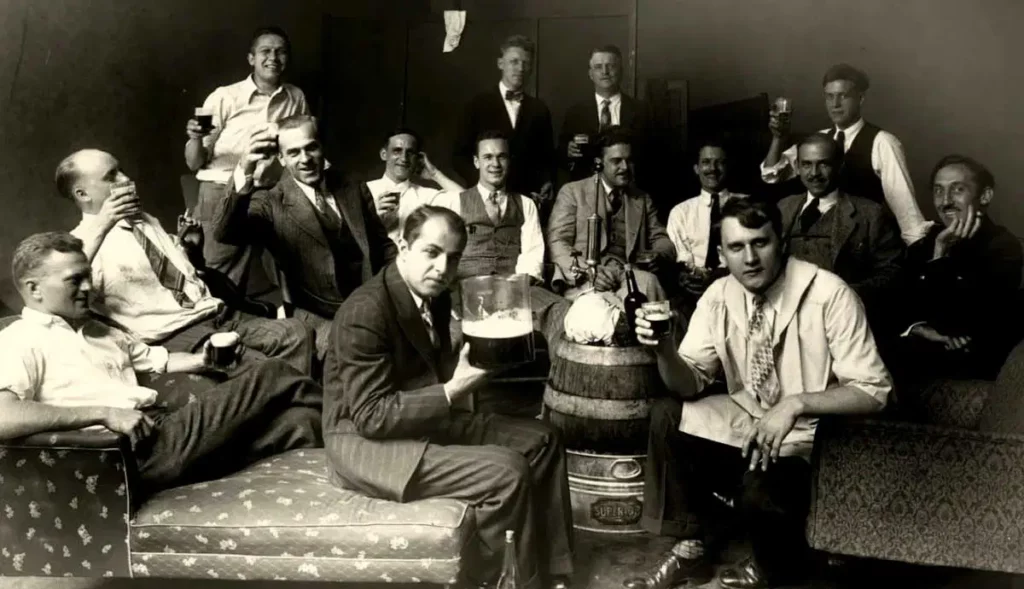
On January 17, 1920, the United States went dry. The Eighteenth Amendment, ratified just over a year earlier, took effect, making the manufacture, transportation, and sale of intoxicating liquors illegal nationwide. Yet within weeks, the streets of New York, Chicago, and Washington, D.C., were alive with a strange paradox: while the law banned alcohol, the illegal speakeasy flourished. In New York, a woman could slip through a hidden door in a tenement and into the “Krazy Kat,” a bohemian haunt where the bartender poured illicit gin into teacups. In Washington, D.C., a crowd of reporters and politicians gathered at the door of the same club, eyes wary, as police raided the premises—a scene captured in a 1920 photograph that would become emblematic of the era. The Prohibition Era was not simply a law; it was a lived contradiction, a time when the law was on the books, but the bottle was in the hand.
What Happened?
Prohibition was the culmination of the temperance movement, which had advocated for moderation and, in its most extreme form, complete abstinence from alcohol. The movement began gaining momentum in the 1820s and 1830s, bolstered by religious fervor and social reform. By the early 20th century, the movement had achieved a series of local and state-level bans, but it was the national effort that culminated in the Eighteenth Amendment. On January 16, 1919, the amendment was ratified, and it went into effect on January 17, 1920, with the passage of the Volstead Act, which defined “intoxicating liquors” and set the penalties for violations.
The new legislation did not ban the consumption of alcohol, but it did ban its manufacture, transportation, and sale. The enforcement was a monumental task, and the law was widely flouted. The illegal production and sale of liquor, known as “bootlegging,” became a major industry. Speakeasies—illegal drinking spots—proliferated in cities across the country. The federal government, under the Volstead Act, struggled to enforce the law, and by the late 1920s, the support for Prohibition had waned as gang violence and organized crime grew.
Key events include:
- January 16, 1919: The Eighteenth Amendment is ratified.
- January 17, 1920: Prohibition goes into effect with the Volstead Act.
- Early 1933: Congress adopts a resolution proposing the 21st Amendment.
- December 5, 1933: The 21st Amendment is ratified, repealing the 18th and ending Prohibition.
How It Was Seen at the Time
Contemporaries saw Prohibition as a noble experiment and a disastrous failure. The temperance advocates, many of them religious leaders, viewed the law as a moral victory. They believed that banning alcohol would reduce crime, poverty, and social ills. A leading temperance advocate, quoted in the New York Times, declared, “The nation is now in a position to demonstrate the benefits of a sober America.”
“The speakeasy is the worst-kept secret in America.” — A contemporary journalist, 1925
On the other side, many Americans saw the law as an infringement on personal liberty. The proliferation of speakeasies was a direct challenge to the law. A 1927 program for the Cotton Club in New York, the city’s foremost nightclub and speakeasy, advertised Cab Calloway and his orchestra, showing that the club, featuring African-American performers, catered to a wealthy white crowd. The program was a testament to the fact that the law was not only broken but openly defied.
Historical Snapshot
| Aspect | Detail |
|---|---|
| Date | 1920–1933 |
| Place | United States, with major centers in New York, Chicago, and Washington, D.C. |
| People | Prohibitionists (temperance advocates), bootleggers, speakeasy owners, federal agents, gangsters |
| What Happened | The 18th Amendment banned the manufacture, transportation, and sale of intoxicating liquors; the Volstead Act enforced it; illegal trade and speakeasies flourished. |
| Why It Mattered | It reshaped American social life, fueled organized crime, and ultimately led to the 21st Amendment’s repeal. |
What People Knew at the Time
| What People Knew Then | What We Know Now |
|---|---|
| Prohibition was a moral reform that would reduce crime and social ills. | Prohibition did not eliminate alcohol; it created a black market and increased organized crime. |
| The law was difficult to enforce, but many believed it would be successful in the long run. | The law was largely unenforceable; public support waned quickly, and the repeal was a response to the failure. |
| Speakeasies were hidden and secretive. | Speakeasies were often open secrets, with some requiring membership cards but many operating with local knowledge. |
Contemporary Newspaper Coverage
Newspapers of the era were filled with stories of raids, gangsters, and the fight over alcohol. The New York Times in 1920 reported on the first enforcement actions, noting that agents were “pouring liquor into the sewer” in a raid led by Deputy Police Commissioner John A. Leach. The Chicago Tribune covered the rise of Al Capone, who became a symbol of the bootlegging era.
“The federal government has declared war on the bootlegger, but the bootlegger is winning.” — Chicago Tribune, 1925
The press also highlighted the irony of the situation. A 1922 photograph of the “Krazy Kat” speakeasy in Washington, D.C., showed a woman at the door, eyeing the photographer warily, a reminder of the secrecy and the danger. The tone of the coverage varied from moralistic to sensational, reflecting the divided public opinion.
Eyewitness Accounts
Eyewitness accounts from the period paint a vivid picture of daily life under Prohibition. A woman who visited the “Krazy Kat” described it as “a hangout for the city’s bohemian crowd,” where the password was a whisper and the drinks were poured from a hidden stash. Another eyewitness, a bootlegger from Chicago, recounted in an interview how he smuggled liquor from Canada in the dead of night, his boat laden with barrels of whiskey, evading the Coast Guard with a mix of luck and bribery.
“You could get a drink anywhere, if you knew the right people. The law was a joke.” — Anonymous speakeasy patron, 1925
Letters & Diaries
Personal correspondence from the era reveals the frustration and the resignation of ordinary citizens. A letter from a Midwestern housewife to her sister, dated 1924, complains about the “inconvenience” of having to travel to a neighboring state for a bottle of wine. A diary entry from a young man in New York, 1926, records his first visit to a speakeasy: “The room was filled with smoke and laughter. It felt like a secret, but everyone knew.”
Official Reports
The official reports of the era, such as the reports of the Federal Bureau of Prohibition, documented the scale of the enforcement challenge. They reported thousands of arrests and the seizure of millions of gallons of alcohol, but they also admitted the impossibility of stopping the trade. The reports noted the rise of organized crime, which was a direct consequence of the law. The discrepancy between the official claims of success and the reality on the ground was a key feature of the era.
Different Perspectives
Prohibitionists
Advocates like the Women’s Christian Temperance Union (WCTU) saw Prohibition as a victory for morality and the home. They argued that alcohol was a curse that destroyed families and led to crime. Their language was often religious and moralistic.
Bootleggers and Speakeasy Owners
Those who profited from the illegal trade saw the law as an opportunity. They were not just criminals; they were entrepreneurs who provided a service the public demanded. Their perspective is captured in the memoirs of some, who saw themselves as “businessmen” in a “business” that was illegal but inevitable.
Ordinary Citizens
Many ordinary citizens were not political; they just wanted a drink. They saw the law as an intrusion into their private lives. The widespread violation of the law, from the middle-class housewife to the working-class laborer, showed that the law lacked the support it needed to be effective.
What the Sources Got Wrong
Contemporary sources often exaggerated the success of the law. For example, in 1920, the New York Times reported that “the law is being enforced with remarkable success,” but this was a false claim. The reality was that the law was being ignored on a massive scale. The Chicago Tribune in 1922 claimed that the “speakeasy is a dying institution,” but it was actually growing. The sources were also often wrong about the impact of Prohibition on crime; they often blamed the law for the rise in gang violence, but they also often understated the extent to which the law created the conditions for it.
What People Feared
People feared the law would lead to a breakdown of social order. They feared the rise of the gangster, the corruption of the police, and the moral decay of the youth. Some feared that the federal government would become too powerful, a fear that was echoed in the debates over the 21st Amendment. Others feared that the country would be overrun by immigrants who were associated with drinking. The fear of the “crime wave” was a common theme in the newspapers.
What People Expected Would Happen Next
Many people expected Prohibition to be a permanent state. The Prohibitionists believed that once the law was in place, the culture would change, and the demand for alcohol would fade. Others expected the law to be repealed quickly, as they saw it as a failure. The repeal in 1933 was a surprise to some, but to many, it was a foregone conclusion. The 21st Amendment was the first time the Constitution was repealed, a precedent that many had not anticipated.
Contemporary Terminology
- Bootlegger: A person who illegally makes, transports, or sells alcohol. The term originated from the practice of hiding a flask in a boot.
- Speakeasy: An illegal drinking establishment. The name was said to have originated from the need to “speak easy” when ordering a drink to avoid drawing attention.
- Volstead Act: The federal law that enforced the 18th Amendment, defining “intoxicating liquors” and establishing penalties.
- Dry: A term used to describe a person or a place that supported Prohibition and was against alcohol.
- Wet: A term used to describe a person or a place that opposed Prohibition and was for alcohol.
Daily Life
Daily life in the 1920s was marked by the contradiction. In the cities, the speakeasy was a regular part of the social scene. The dress was the flapper, the music was jazz, and the alcohol was often homemade or smuggled. The food was often the same as before, but the drink was a different matter. The saloon was replaced by the speakeasy, which was often a room in a building, with a door that was opened only after a password was whispered. The workday was often the same, but the after-hours was a secret world. The material conditions varied; in the cities, the nightlife was a constant, but in the rural areas, the dry laws were more often enforced.
Numbers at the Time
| Statistic | Value | Source |
|---|---|---|
| Number of speakeasies in New York City (1925) | Approx. 100,000 (estimated) | New York Police Department estimates |
| Federal arrests for Prohibition violations (1920–1933) | Over 600,000 | Federal Bureau of Prohibition reports |
| Gallons of liquor seized (1921) | Over 1 million | Federal Bureau of Prohibition reports |
| Cost of a bottle of bootleg whiskey (1925) | $10–$15 (approx. $150–$200 in 2026 dollars) | Contemporary newspaper reports |
Timeline
- 1820s–1830s: The temperance movement begins to gain strength.
- 1919, January 16: The 18th Amendment is ratified.
- 1920, January 17: The Volstead Act goes into effect, and Prohibition begins.
- 1920s: The rise of the speakeasy and the bootlegger.
- 1925: The peak of the speakeasy era, with the Cotton Club in New York.
- 1929: The St. Valentine’s Day Massacre, a symbol of the gang violence.
- 1933, February: Congress passes the 21st Amendment.
- 1933, December 5: The 21st Amendment is ratified, repealing the 18th.
Key Documents
- The 18th Amendment (1919): The constitutional amendment that banned the manufacture, transportation, and sale of intoxicating liquors.
- The Volstead Act (1920): The federal law that defined “intoxicating liquors” and provided for enforcement.
- The 21st Amendment (1933): The amendment that repealed the 18th, the first and only time a constitutional amendment has been repealed.
Aftermath
The repeal of Prohibition in 1933 did not immediately end the crime or the illegal trade. The bootlegging networks had to be dismantled, and the legal alcohol industry had to be rebuilt. The 21st Amendment gave the states the power to regulate alcohol, leading to a patchwork of laws that persists to this day. The era left a legacy of the distrust of the federal power, and it also contributed to the rise of organized crime, which continued to be a major issue after the repeal.
How Historians See It Today
Historians today view Prohibition as a failed experiment. They see it as a result of the temperance movement, but they also see it as a reaction to the social changes of the early 20th century, including urbanization and immigration. Modern scholars emphasize the unintended consequences, such as the rise of organized crime and the criminalization of a popular activity. They also note that the repeal was a result of the law’s unpopularity and the difficulty of enforcement. The primary sources of the era show that the people at the time were divided, but the modern scholarship has a more nuanced view of the law’s impact.
Common Misconceptions
Prohibition banned the drinking of alcohol.
The 18th Amendment banned the manufacture, transportation, and sale, not the consumption. It was legal to drink, if you could find the drink.
Prohibition was a complete failure.
While it was widely violated, it did reduce alcohol consumption in the early years, but the effect was temporary.
The speakeasy was always a secret.
Many were known to the police and the public; some were even advertised, such as the Cotton Club.
Related Primary Sources
- The National Archives: Records of the 18th Amendment and the Volstead Act.
- The Library of Congress: Photographs of the Prohibition era, including the “Kraat Kat” and the Cotton Club.
- The Federal Bureau of Prohibition records, 1920–1933.
- The New York Times historical archive for the period 1920–1933.


Leave a Reply