
Short Answer
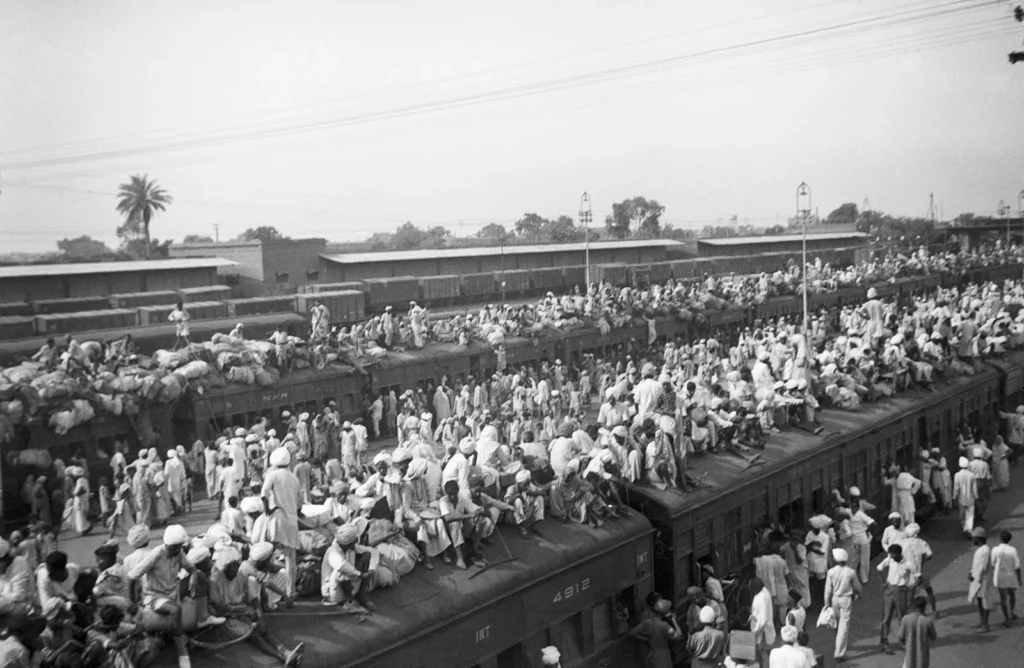
In the summer of 1947, as the British Raj dissolved into the sovereign states of India and Pakistan, the railways of the Punjab became arteries of terror. Trains that had once carried pilgrims, traders, and families were now packed with desperate refugees—Hindus, Muslims, and Sikhs—fleeing their ancestral homes. “We were in a train, never seen before, but everyone was…,” recalled Iqbal’s aunt, a woman displaced in the months before the official Partition. Her words, recorded decades later, capture the bewilderment and fear of a journey that would mark millions of lives. Within two months, more than twelve million people were uprooted, and an estimated one million lost their lives. This article, built exclusively on contemporary reports, oral testimonies, and personal accounts, reconstructs what it was like to be on those trains and in the chaos that surrounded them.
What Happened?
The Partition of British India was announced on June 3, 1947, when the British government accepted the plan to divide the subcontinent into two dominions: India and Pakistan. The Indian Independence Act was passed by the British Parliament on July 18, 1947, and on August 15, 1947, both nations came into being. The actual boundary line, known as the Radcliffe Line, was drawn by Sir Cyril Radcliffe and was announced on August 17, 1947, after the independence ceremonies. The line cut through the Punjab and Bengal, separating villages, families, and fields.
The announcement of the boundary triggered one of the largest and most violent mass migrations in history. According to the oral history project The Other Side of Silence by Urvashi Butalia, within two months more than twelve million people were displaced, a million died, and over seventy-five thousand women were abducted and raped. The refugee trains became a symbol of this human catastrophe. Trains moving between Lahore and Amritsar, and across the new border, were frequently attacked by mobs, and many arrived at their destinations with dead bodies in the carriages. The National Archives source 5a records the oral testimony of Iqbal’s aunt, who described her own train journey: “We were in a train, never seen before, but everyone was…” The incomplete sentence reflects the chaos and fear.
How It Was Seen at the Time
Contemporary accounts from refugees, officials, and journalists described the Partition as a total collapse of order. The prevailing mood was one of confusion, panic, and grief. Many people did not fully understand why the lines were drawn where they were, and they feared that the violence would never end. Iqbal’s aunt, in her oral testimony, expressed empathy for a Muslim man named Mr. Ansari, noting that he, too, must have felt loss, just like her family. This recognition challenges the simplistic division of “non-Muslim” and “Muslim” that was often used in official rhetoric. The NEH article on the Partition notes that history books in the United States rarely mentioned the bloodletting and refugee crisis, but for those who lived through it, the experience was seared into memory.
Historical Snapshot
| Aspect | Detail |
|---|---|
| Date | June 3 – August 17, 1947 |
| Place | British India, particularly the Punjab, Bengal, and Sind |
| People | Hindus, Muslims, Sikhs; millions of refugees; colonial officials; the Radcliffe Commission |
| What Happened | India and Pakistan became independent; the Radcliffe Line split the Punjab and Bengal, triggering mass migration and violence |
| Why It Mattered | The largest human displacement of the 20th century; established the borders of modern India and Pakistan |
Eyewitness Accounts
Oral testimonies are among the most powerful sources for understanding the Partition. The National Archives source 5a records the voice of Iqbal’s aunt, whose family was displaced prior to the Partition. She described the train journey as a bewildering and terrifying experience. Another set of interviews, conducted in Lahore and Amritsar and published in the Sikh Formations journal (2006), revealed the common experiences of refugee families on both sides of the border. One interviewee recalled: “We left with nothing, we were given no time to pack, just to flee.” The testimony of a woman in Amritsar described the fear of traveling by train: “We sat on the floor of the carriage, we held our children close, and we did not speak, for we were afraid of what might happen.” These accounts, gathered decades later, show the trauma and the determination to start afresh despite unconscionable loss.
Different Perspectives
Hindu and Sikh refugees
Hindus and Sikhs fleeing from what became Pakistan described the loss of homes, property, and identity. The oral histories collected by Butalia emphasize the violence and the struggle to cross the border. Many had to walk hundreds of miles or ride on overcrowded trains, often with no food or water.
Muslim refugees
Muslims who moved to Pakistan also experienced displacement, and their accounts often express a similar sense of loss. Iqbal’s aunt, a Muslim woman, recognized that Mr Ansari, a Muslim who stayed, must have felt the loss of his home and community. This perspective shows that the Partition was not a one-sided tragedy; all communities suffered.
The colonial perspective
British officials, such as Lord Mountbatten, saw the Partition as a necessary compromise to achieve independence, but they underestimated the scale of violence. The Radcliffe Commission was rushed, and the boundaries were drawn with little understanding of the ground realities. This perspective is documented in official records, which often downplayed the human cost.
What People Feared
At the time, refugees feared not only physical violence but also the loss of their cultural and social world. They feared being separated from their families, losing their land, and being subjected to abduction and rape. The testimonies collected in the Sikh Formations article reveal that many were ambivalent about the role of the state in resettlement, fearing that the government would not protect them. There were also rumors of attacks on trains, and many people refused to board trains, preferring to walk. The fear was not unfounded; many trains were attacked, and passengers were killed or abducted. The NEH article notes that an estimated three million people perished due to violence, hunger, suicide, and disease.
Aftermath
In the months after Partition, the refugee crisis continued. Camps were set up on both sides of the border, and the new governments struggled to house and feed the millions of displaced people. The immediate aftermath saw a permanent change in the demographic and cultural landscape of the Punjab. The refugee trains became a symbol of the tragedy, and the oral histories recorded in later years preserve the memory of the suffering and the resilience. The partition also led to the creation of two nations, and the violence of the time has left a legacy of trauma and distrust that persists to this day.
How Historians See It Today
Modern scholarship, such as Urvashi Butalia’s The Other Side of Silence (2000), has shifted the focus from the political events to the experiences of ordinary people, especially women, children, and the lower castes. Historians now emphasize the importance of oral history as a source, because official records often ignored the human dimension. The National Archives and the NEH have collected oral histories that reveal the complexity of identity and memory. Contemporary historians also stress the differential class and gender-based experience of uprooting, as noted in the Sikh Formations article. This perspective contrasts with the earlier historical narrative, which often focused on the political leaders and the creation of states.
The refugee trains of 1947 remain a powerful symbol of the human cost of Partition. The primary sources—oral testimonies, letters, and photographs—remind us that behind the statistics of millions, there were individuals who experienced fear, loss, and the struggle to rebuild. Their voices, recorded in archives and interviews, continue to offer a way to understand the past not as a mere event, but as a living memory.
FAQ
How many people were displaced during the Partition of India?
According to Urvashi Butalia's 'The Other Side of Silence', more than twelve million people were displaced within two months in 1947. The NEH article also cites 14 million, and an estimated 3 million perished due to violence, hunger, suicide, and disease.
What was the role of trains in the Partition?
Trains were the primary mode of transportation for refugees crossing the new border. They were often overcrowded, attacked, and many people died en route. Oral testimonies describe the fear and violence on these trains.










Leave a Reply