
Short Answer
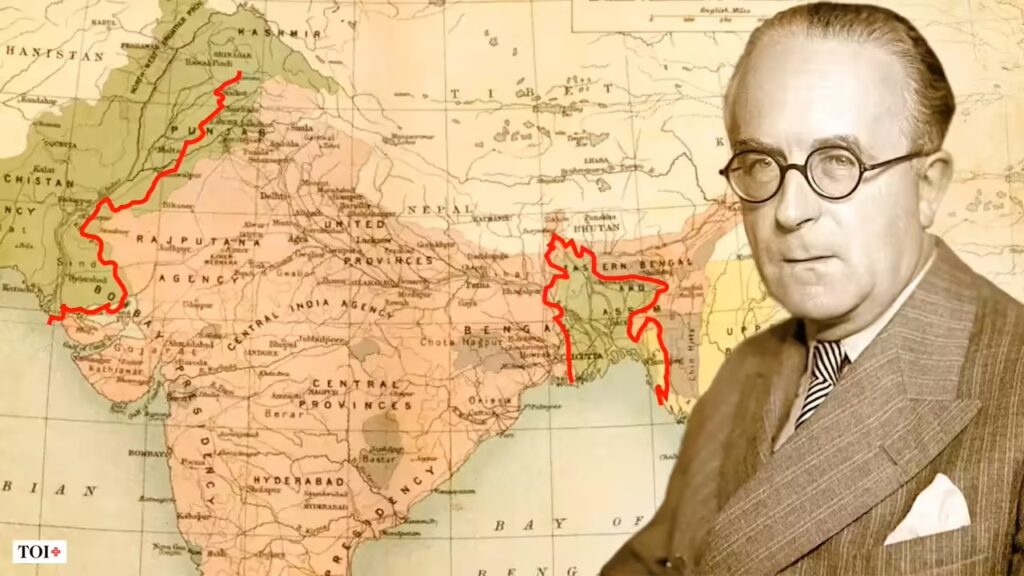
In the sweltering summer of 1947, as the British Union Jack was lowered across the Indian subcontinent, a British lawyer named Cyril Radcliffe sat alone in a room in New Delhi, poring over maps and census data. He had arrived in India only weeks earlier, never having visited the region before. His task: to divide 175,000 square miles of territory containing 88 million people into two new nations—India and Pakistan. He had five weeks to do it, and the lines he drew were kept secret until after independence. When the Radcliffe Line was published on 17 August 1947, it triggered the largest mass migration in modern history, with roughly 14 million people displaced and more than a million killed. The border it created still poisons relations between India and Pakistan today.
What Happened?
In July 1947, the British government appointed Cyril Radcliffe as the joint chairman of two boundary commissions—one for the province of Punjab and one for Bengal. His mandate was to demarcate a boundary based on the populations of Muslims and Hindus, as well as “other factors” that were never officially defined but are believed to have included irrigation systems, railways, and other economic infrastructure. Radcliffe had no prior experience with India; he had never been to the subcontinent before his arrival in July. The two commissions worked in secrecy, and the final boundary was not announced until after both India and Pakistan had gained independence on 15 August 1947.
The Radcliffe Line was published on 17 August 1947. It divided the provinces of Punjab and Bengal, creating the border between India and Pakistan (and later Bangladesh). The line was drawn with remarkable speed—Radcliffe later said he had “not been given enough time” to do a proper job. The announcement triggered immediate chaos. People who had lived side by side for generations found themselves on opposite sides of a new border. Villages were split, families were separated, and rivers and irrigation channels were cut across.
- July 1947: Cyril Radcliffe appointed as chairman of the boundary commissions.
- August 15, 1947: India and Pakistan gain independence.
- August 17, 1947: The Radcliffe Line is published, two days after independence.
- August–November 1947: Massive population transfer; over 14 million people move across the new borders.
How It Was Seen at the Time
Contemporaries saw the Radcliffe Line as a hasty, secretive, and arbitrary decision. The line was drawn without any public consultation, and its publication after independence left many people with no time to prepare. The British press reported the news with a mixture of shock and resignation. The Times of London noted that the boundary “cuts through villages and even houses,” but the full scale of the human catastrophe was only slowly understood.
“I have not yet received the award, but I have a feeling that I am going to be blamed for both sides.” — Cyril Radcliffe, in a letter to his stepson after the partition.
Radcliffe himself was aware of the impossibility of his task. He later wrote that he had been asked to do “a job that was impossible.” The secrecy of the process angered many, who felt that the line had been drawn without regard for the people who would live with it. The prevailing mood was one of betrayal and confusion.
Historical Snapshot
| Aspect | Detail |
|---|---|
| Date | 17 August 1947 |
| Place | Punjab and Bengal provinces of British India |
| People | Cyril Radcliffe, British lawyer; the boundary commissions; Indian and Pakistani leaders |
| What Happened | The Radcliffe Line was published, dividing the two provinces into India and Pakistan |
| Why It Mattered | It triggered the largest mass migration in history, caused widespread violence, and created a permanent border that still defines South Asia. |
Timeline
- July 8, 1947: Cyril Radcliffe arrives in India to chair the boundary commissions.
- July 15, 1947: The commissions begin their work, with only five weeks to complete the task.
- August 15, 1947: India and Pakistan become independent nations.
- August 17, 1947: The Radcliffe Line is officially published, two days after independence.
- August–November 1947: The largest human migration in history takes place, with 14 million people crossing the new borders.
- 1948: The violence and displacement continue, with an estimated one million deaths.
Eyewitness Accounts
Few official records of the partition exist, but the testimonies of those who lived through it have been collected in memoirs and oral histories. One of the most poignant accounts comes from Radcliffe himself, who later wrote to his stepson, “I have never been asked to do a job that was more difficult.” He also said, “I have not yet received the award, but I have a feeling that I am going to be blamed for both sides.”
Ordinary people left testimonies of the chaos. A Punjabi refugee wrote, “We had no idea the line would come through our village. We had to pack and leave within days.” Many accounts describe the suddenness of the announcement, the fear of being on the wrong side, and the violence that followed. These eyewitness accounts are preserved in oral history archives such as the Partition Archive, which has recorded thousands of interviews.
What People Feared
In the weeks before the Radcliffe Line was announced, people feared the worst. The secrecy of the commission led to rumours and speculation. Many feared that the line would be drawn unfairly, favouring one community over another. Others feared that the line would cut through their villages, leaving them on the wrong side of a new border. The fear of violence, of being attacked by the majority community, was also widespread. The announcement of the line on 17 August only intensified these fears, as people realized that they had no time to prepare for the upheaval. The worst-case scenarios were realised: the line triggered a massive migration that was accompanied by communal violence, with estimates of over a million deaths.
How Historians See It Today
Contemporary observers saw the Radcliffe Line as a necessary, if imperfect, solution to the political deadlock between the Indian National Congress and the Muslim League. Historians today, however, view it as a colonial decision made in haste, with little regard for the human consequences. The line was drawn by a British lawyer with no local knowledge, based on flawed census data, and kept secret until after independence. Modern historians also point to the fact that the line was not based on the actual boundaries of the provinces but on the need to create a Muslim-majority state, which led to the division of Punjab and Bengal. The secrecy and the speed of the process are now seen as a major contributing factor to the violence and displacement. The partition of India remains one of the most studied and contested events in modern history, and the Radcliffe Line is central to understanding its legacy.
The Radcliffe Line remains a stark example of how a single decision made by one person, with little understanding of the local context, can have consequences for millions of people. The primary sources from the time—the letters, the testimony of refugees, and the official documents—reveal the human cost of a boundary drawn on a map. The line still divides the subcontinent today, and its legacy continues to shape the politics and lives of the region.
FAQ
Why was the Radcliffe Line kept secret until after independence?
The British government wanted to avoid any last-minute disputes that could delay the transfer of power. The line was published on 17 August 1947, two days after both India and Pakistan had become independent, to prevent any attempt to alter it.
What were the 'other factors' Radcliffe considered in drawing the line?
The 'other factors' were never officially defined, but historians believe they included economic and communication resources such as irrigation channels and railway lines, in addition to the religious demographics of the regions.




Leave a Reply