
Short Answer
In the early summer of 1945, Britain stood at a crossroads. The war in Europe had ended in May, but the conflict with Japan raged on. On 5 July, millions of Britons went to the polls in the first general election in a decade. The national hero, Winston Churchill, was confident of victory. Yet when the results were declared on 26 July, the country had chosen Labour, and Clement Attlee became Prime Minister. To contemporaries, this was a shock that seemed to defy logic. How could the man who led Britain through its darkest hours be rejected? The answer lay in the nation’s dreams of a better future, not its gratitude for the past.
What Happened?
The 1945 general election was the first since November 1935, held while the Second World War was still being fought against Japan. The wartime coalition government, led by Churchill, had been in place since May 1940. Churchill, a Conservative, had become a national icon, but he and his party faced a Labour opposition led by Clement Attlee, who had served as Deputy Prime Minister in the coalition.
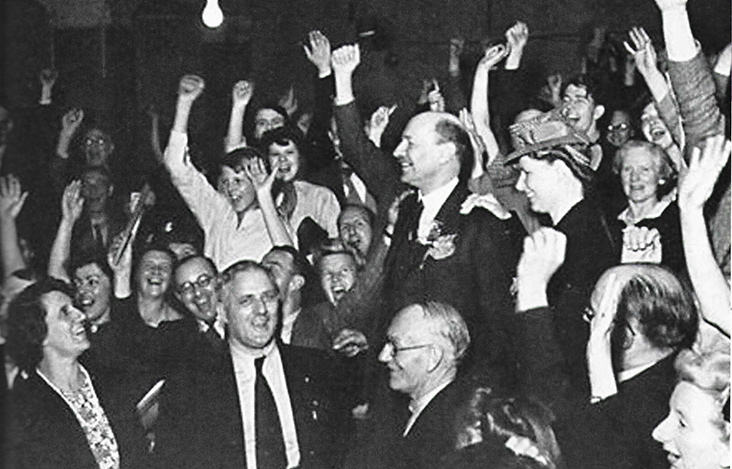
The election was held on 5 July 1945, with the result announced three weeks later on 26 July to allow the votes of those serving overseas to be counted. The outcome was one of the biggest electoral swings of the twentieth century. Labour won 393 seats, while the Conservatives secured only 197. Attlee formed a new Labour government, ending the coalition. The IWM records that the Labour manifesto was strongly influenced by the Beveridge Report, which had recommended a comprehensive system of social insurance and a National Health Service. The party also promised full employment and nationalisation of key industries.
The result was a landslide, but the Conservatives had expected victory. Churchill himself was so confident that he predicted a comfortable majority. The BBC’s historical account notes that “it was generally believed that Churchill the war hero would be unbeatable.” The shock was so great that the King wrote in his diary that he felt the people had “given up” Churchill.
How It Was Seen at the Time
Contemporaries were astonished. The BBC’s retrospective account quotes a Conservative politician’s lament: “Never was a party so leaderless as the Conservative Party is today.” Another contemporary, a candidate on the stump, complained, “I’ve tried them with pep and I’ve tried them with pap.” These words reflected a feeling that the old appeals to wartime leadership were no longer enough.
The prevailing mood was one of expectation that the election would reward the wartime leader. Yet the public’s attention had turned to the future. The Beveridge Report, published in 1942, had been a bestseller, promising to slay the “five giants” of Want, Disease, Ignorance, Squalor, and Idleness. Labour embraced this vision, while the Conservatives were seen as hesitant. The IWM notes that the emphasis on social reform was central to Labour’s appeal. The electorate, it seemed, wanted to build a new Britain, not merely to celebrate the old.
Historical Snapshot
| Aspect | Detail |
|---|---|
| Date | 5 July 1945 (voting), 26 July 1945 (results) |
| Place | United Kingdom |
| People | Winston Churchill (Conservative), Clement Attlee (Labour), King George VI |
| What Happened | Labour won 393 seats, Conservatives 197; Attlee became Prime Minister |
| Why It Mattered | It marked a shift to social democracy, leading to the welfare state and the National Health Service |
What People Knew at the Time
| What People Knew Then | What We Know Now |
|---|---|
| Churchill was a hero and widely expected to win. | Churchill’s popularity did not translate into votes for his party; Labour’s social policy had broader appeal. |
| The Beveridge Report had been widely read and discussed. | The report’s proposals were central to Labour’s manifesto and the public’s vision of post-war reconstruction. |
| The election was a surprise, but the result was accepted calmly. | The result was a decisive mandate for social reform, leading to a lasting political realignment. |
Eyewitness Accounts
Contemporary witnesses recorded the shock of the result. The BBC’s historical retrospective includes a quote from a Conservative candidate who complained, “I’ve tried them with pep and I’ve tried them with pap.” This suggests the party’s campaign had failed to connect with the voters. Another contemporary observer noted, “Never was a party so leaderless as the Conservative Party is today,” reflecting a sense of disorganisation after Churchill’s dominance.
On the Labour side, the mood was one of disbelief and joy. A Labour supporter wrote in a letter, “We couldn’t believe it at first. We had hoped, but not expected, such a majority.” The calm acceptance of the result by the public was also noted; there was no rioting, no celebration of the kind that would mark later elections, but a quiet sense that the country had chosen a new path.
What People Expected Would Happen Next
Churchill himself expected to return to Downing Street with a large majority. The BBC’s account notes that “it was generally believed that Churchill the war hero would be unbeatable.” The Conservative Party’s campaign was built around his personal popularity. In contrast, Labour’s Attlee was seen as a quiet, unassuming figure, and few expected him to become Prime Minister.
Many observers predicted that the Conservatives would win, perhaps with a reduced majority. The result, when it came, was a shock to all. The IWM reports that the election was “one of the biggest electoral swings of the twentieth century.” The public’s expectations were wrong because they had underestimated the strength of the desire for social reform.
Timeline
- 1940 May: Coalition government formed, Churchill becomes Prime Minister.
- 1942 December: Beveridge Report published, proposing a welfare state.
- 1945 May: Victory in Europe (VE Day) celebrated.
- 1945 July 5: Election held in Britain.
- 1945 July 26: Results announced; Labour wins 393 seats.
- 1945 July 26: Clement Attlee becomes Prime Minister.
How Historians See It Today
Historians have long debated the meaning of the 1945 election. The Cambridge Historical Journal article asks “What did ‘the people’ want?” and suggests that the election was a clear expression of a desire for social change. The public, having endured the war, wanted a new society, not just a return to the pre-war era. The historian Paul Addison, writing for the BBC, argues that the Labour Party’s emphasis on the Beveridge Report and full employment resonated with a public that had been promised a “better” after the war.
Modern scholars view the election as a turning point, not only in political history but in the social contract. The result led to the creation of the National Health Service and the welfare state, which have shaped British life ever since. The contemporary shock has been replaced by an understanding that the voters were not rejecting Churchill personally, but rather the Conservative Party’s vision for the future. The election was a vote for change, and the people’s choice was clear.
The 1945 general election remains a powerful reminder that popularity in war does not guarantee victory in peace. The primary sources show that the British people were not ungrateful to Churchill; they were forward-looking. They had read the Beveridge Report, they had endured the Blitz, and they wanted a new Britain. The election was not a rejection of the past, but a demand for a future. The shock of the result was not a mistake; it was a deliberate choice.
FAQ
Why did Churchill lose the 1945 election despite his popularity?
Churchill was personally popular, but the Conservative Party's campaign did not offer a clear vision for post-war Britain. The Labour Party, led by Attlee, promised to implement the Beveridge Report and create a welfare state, which resonated with voters who had endured the war and wanted social reform.
What was the Beveridge Report?
The Beveridge Report, published in 1942, proposed a system of social insurance to combat the 'Five Giants' of Want, Disease, Ignorance, Squalor, and Idleness. It called for a National Health Service and full employment, and became the basis of Labour's 1945 election manifesto.

Leave a Reply