
Short Answer
Quick Snapshot
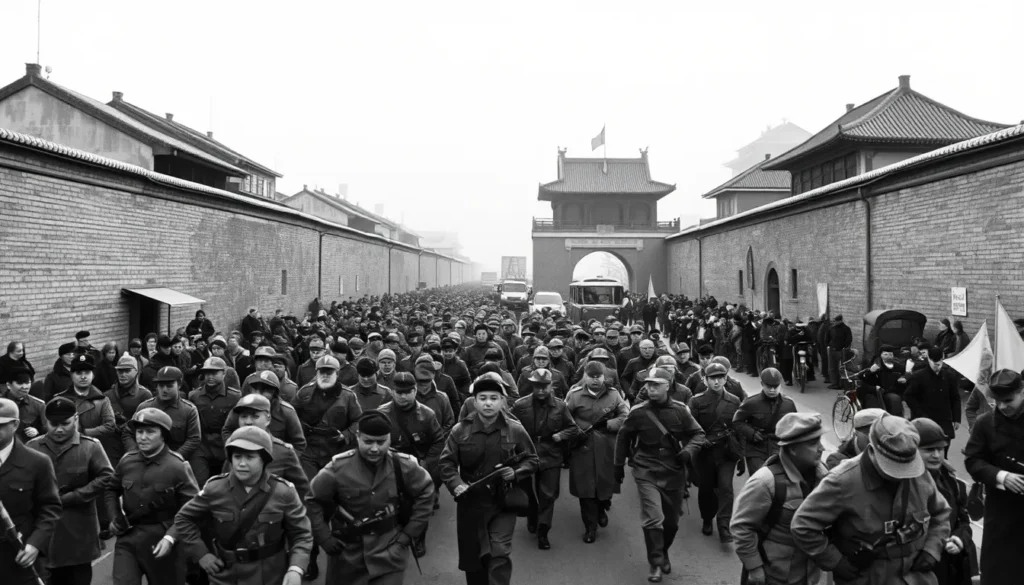
In 1949 Beijing—then still called Beiping—passed through one of the most compressed transformations in its long history. On 31 January, after weeks of encirclement and secret negotiations, Fu Zuoyi’s Nationalist garrison handed the city to the People’s Liberation Army. Within days the city was under military control; on 3 February a formal entry ceremony sent PLA units through the old gates and, symbolically, through the Legation Quarter. On 1 October, from the Tiananmen rostrum, Mao Zedong proclaimed the People’s Republic of China. The year thus combined the end of civil-war siege, the creation of a new municipal order, and the birth of a national capital.
Everyday life was still shaped by scarcity. Paper money had collapsed; food, fuel and transport were unreliable; spies, stragglers and thieves were widely feared. Yet the city also hummed with meetings, takeovers, newspapers, cadre schools and preparations for the Chinese People’s Political Consultative Conference. For residents, 1949 was not simply a sequence of high politics but a year of queueing, rumour, house meetings, changed signs and uncertain expectations.
The scope of this article is the city of Beijing/Beiping within its 1949 municipal boundaries, with attention to both the revolutionary capital story and the daily experience of ordinary residents.
Beijing in 1949
In 1949 the city was still the walled, low-rise capital of the Ming and Qing, though it had not been a national capital since 1928, when it was renamed Beiping. Its inner and outer walls, gates, hutongs and courtyard houses defined movement and social life. The city’s population was roughly two million, swollen by refugees, soldiers and officials from the collapsing Nationalist order. Winter was cold; coal and food were scarce. On 3 February, a dust storm blew through the entry ceremony, a detail recalled in later accounts and photographs. The atmosphere mixed relief, anxiety and political excitement. The old regime’s authority had evaporated, but the new one was not yet fully installed.
Geography mattered. Beiping sat at the northern edge of the North China Plain, linked by rail to Tianjin and the coast and by roads to the north and west. The city walls still framed urban life, and the Legation Quarter remained a symbol of foreign privilege. The surrounding countryside was already under Communist control, while the city itself was an enclave awaiting takeover. This made 1949 a year of gates, checkpoints and symbolic crossings.
Population & Economy
No modern census was taken in 1949, and estimates vary. Contemporary accounts speak of more than two million residents inside the city, including a large transient population of soldiers, refugees and officials. The municipal economy was not industrial in the modern sense. It relied on government administration, education, handicrafts, commerce, food processing, textiles and services. Peking University, Tsinghua, Yenching and other schools gave the city a cultural weight that exceeded its economic power.
Economic conditions were dire. Years of civil war and hyperinflation had destroyed confidence in paper currency. A Beijing Daily retrospective notes that in early 1949 vendors at the Chaoyangmen vegetable market would accept only silver dollars, and that discarded paper notes littered streets and drains. Food prices had risen astronomically. The new authorities prioritised grain supply, currency stabilisation, tax collection and the reopening of markets. Cost-of-living evidence is fragmentary, but memoirs and newspaper notices show that a few silver dollars, a bag of flour or a load of coal mattered more than abstract wage figures.
Employment was divided between old municipal employees, teachers, shop assistants, rickshaw pullers, artisans, factory hands and the huge informal sector. The takeover created new jobs in administration, public security and propaganda, even as old offices were dissolved.
Government & Politics
At the start of 1949 the city was still under the Nationalist North China Bandit Suppression Headquarters commanded by Fu Zuoyi, with municipal authorities in disarray. The military situation forced negotiations. On 19 January, representatives signed the Agreement on the Peaceful Settlement of Beiping, a document revised by Mao Zedong and expanded to eighteen articles plus four annexes. It provided for Nationalist troops to leave the city and be reorganised, for a joint office to manage the transition, and for temporary financial and foreign-affairs arrangements.
On 31 January the PLA’s Fourth Field Army entered through Xizhimen. A Beiping Military Control Commission was established, with Ye Jianying as director and mayor, Peng Zhen as Communist Party secretary, and Tan Zhengwen as public-security chief. The municipal government was rebuilt on Communist lines, but for a time it relied on former lower-level staff and newly trained cadres. Political life was dominated by takeover meetings, mass organisations, denunciations of the old regime and preparations for the CPPCC. The city’s status changed in September, when the CPPCC adopted the Common Program, renamed Beiping as Beijing, and designated it the capital of the new republic.
Industry
Beijing in 1949 was not a great manufacturing centre. Its industrial base included small textile workshops, food processing, printing, metalwork, furniture, brick and tile yards, and utilities such as water and electricity. The old city had craft workshops in the hutongs and larger enterprises near the railway lines. The new government regarded industry as backward and began surveying factories, registering capital and organising workers. Printing and newspaper production expanded rapidly because propaganda and administration required them. Military supply, coal distribution and transport repair also grew in importance.
The most important industry of 1949 may have been government itself: the takeover of offices, police stations, schools and hospitals created a vast administrative machine. The city’s future as a political capital would soon reshape its economy more than any single factory could.
Education
Beijing possessed the strongest concentration of higher education in China. Peking University, Tsinghua University, Yenching University, Beijing Normal University and various specialised colleges enrolled a small elite. Literacy among the general population was low, and most children received little or no formal schooling. The new authorities moved quickly to reorganise schools, appoint committees, purge explicitly Nationalist materials and introduce political education. Cadre training classes, workers’ night schools and short courses trained takeover personnel and propagandists. The Yanshan Brigade and public-security training classes mentioned in recollections show how education was tied directly to state-building.
Universities were not immediately merged or Sovietised in 1949; that came later. But the year marked the beginning of a shift from elite liberal education toward mass political education and technical training for the new state.
Transportation
Movement inside Beijing depended on trams, rickshaws, bicycles, carts and walking. The city’s first tram line had opened in 1924, and trams remained important along major arteries. Rickshaws served the narrow hutongs. Private cars were rare. The railway stations linked Beijing to Tianjin, the Manchurian lines and the south, but military operations disrupted schedules. During the siege, South苑 airport was occupied by the PLA, and Fu Zuoyi built temporary airstrips at Dongdan and Tiantan. The city gates served as checkpoints and symbols of authority; the PLA entry through Xizhimen and later through the Legation Quarter was carefully staged.
By year’s end, the new government was restoring rail and road links, organising transport for grain and coal, and using vehicles and horses for official business. Travel remained slow and paper permits mattered.
Everyday Life
Daily life in 1949 was dominated by scarcity and uncertainty. Families stored cabbage, millet, flour and coal when they could. Courtyard houses in the hutongs sheltered extended families and lodgers. Clothing was patched and practical; cadre uniforms of coarse cotton became increasingly visible. Water came from wells or vendors, and heating depended on coal or wood. Public order was fragile: people spoke of the five many—spies, stragglers, robbers, thieves and silver-dollar dealers. Neighbourhood committees and police stations began to register residents and organise watches.
Entertainment was modest: teahouses, opera, storytelling, cinemas and radio broadcasts. Political meetings, street propaganda and newspaper reading became new social rituals. The Lunar New Year fell at the end of January, and the PLA entry coincided with the third day of the new year, giving the transition a festive and improvised quality. For many residents, the most immediate change was not ideology but the sight of new uniforms, new signs and new queues for grain.
Major Events
The year’s central events unfolded in quick succession. In January, the siege tightened, Tianjin fell, Fu Zuoyi’s cannons were placed on Jingshan as a final gesture, and the peace agreement was signed. On 31 January the PLA entered the city. On 3 February a formal entry ceremony drew perhaps half the population despite a dust storm. On 18 February the new Public Security Bureau opened in the former Nationalist police headquarters. In March the Communist Central Committee moved to Beiping, and in September the CPPCC met and renamed the city Beijing. On 1 October Mao proclaimed the People’s Republic from Tiananmen.
What Newspapers Were Reporting
Newspapers and Xinhua dispatches in early 1949 carried reports on the peaceful liberation of Beiping, the entry of the PLA and the formation of the Military Control Commission. A contemporary phrase repeated in later accounts was simple: “北平宣告和平解放” (Beiping is peacefully liberated). After the People’s Daily moved to Beiping in March, its pages reported on price stabilisation, the takeover of schools and factories, the CPPCC and the founding ceremony. Headlines emphasised order, production and the end of Nationalist rule. The press also warned against spies and saboteurs and published regulations on currency, registration and public meetings. On 1 October, Mao’s words from the rostrum—the Central People’s Government of the People’s Republic of China is established today—became the year’s defining headline.
“北平宣告和平解放。”—phrase from liberation-era reports cited in later retrospectives.
Newspapers were not neutral observers; they were instruments of the new state. But they preserve valuable detail about prices, transport, meetings and the language of the transition.
What People Were Talking About
Conversations in courtyards, teahouses and offices turned on food, safety and the future. Would the Nationalists return? Were spies hidden in the neighbourhood? Would paper money be honoured? Would the new government keep old municipal employees? Rumours about the capital decision circulated before the CPPCC formally announced it. Students discussed political study; workers discussed wages and factory committees; shopkeepers discussed taxes and currency. Memoirs by takeover cadres such as Ma Ju and Liu Yong describe sleepless nights, security worries and the improvised style of the first weeks. Ordinary residents, by contrast, often remembered the entry ceremony, the behaviour of soldiers and the sudden change of official signs.
Historical Photographs
The visual record is substantial. Photographs and newsreels show PLA soldiers marching through Xizhimen and along Chang’an Avenue, crowds watching the 3 February ceremony, students climbing onto tanks, and Mao speaking at Tiananmen on 1 October. Images of the old city walls, trams, rickshaws and hutong shops provide context. Official photographers from Xinhua and the military documented the takeover, while foreign journalists and visitors left fewer but valuable images. The photographs are not neutral: they were selected to convey order, popular support and historical legitimacy. Yet details—clothing, shop signs, damaged buildings, the dust in the air—make them indispensable primary sources.
Documents & Primary Sources
Key sources include the Agreement on the Peaceful Settlement of Beiping (1949), with its eighteen articles and annexes; proclamations and notices of the Beiping Military Control Commission; municipal police takeover records; currency and price regulations; and the documents of the CPPCC First Plenary Session. Newspapers such as Renmin Ribao and Xinhua dispatches provide day-by-day reporting. Memoirs and oral histories of cadres, including Ma Ju and Liu Yong, describe the takeover from inside. Photographs, newsreels and maps of the walled city complete the record. Some official archives remain closed or partially catalogued, so historians often triangulate newspapers, memoirs and administrative documents.
1949 Timeline
| Date | Event |
|---|---|
| 15 January | Tianjin falls to the PLA; pressure on Fu Zuoyi intensifies. |
| 18 January | Bomb attack at He Siyuan’s residence kills his daughter and injures family members. |
| 19 January | Peace agreement for Beiping signed. |
| 31 January | PLA enters Xizhimen; Beiping declared peacefully liberated. |
| 3 February | Formal PLA entry ceremony; troops pass through the Legation Quarter. |
| 18 February | New Public Security Bureau begins work in former Nationalist police headquarters. |
| 5 March | Second Plenum of the Seventh Central Committee discusses transfer of focus to cities. |
| 25 March | CPC Central Committee and PLA headquarters arrive in Beiping. |
| 21–30 September | CPPCC First Plenary Session; Beiping renamed Beijing and designated capital. |
| 1 October | Mao proclaims the People’s Republic of China at Tiananmen. |
What Changed Next
After 1949 Beijing became the centre of a new state. The military control commission gave way to regular municipal institutions; the police, schools and neighbourhood organisations were consolidated. Land reform and campaigns against counter-revolutionaries reached the city and countryside. The old walls and gates survived into the 1950s but were later dismantled as traffic and planning changed. Industry expanded, universities were reorganised, and the population grew. The symbolic acts of 1949—the entry through the Legation Quarter, the renaming of the city, the proclamation from Tiananmen—set the template for the capital’s later identity as the political heart of the People’s Republic.
Sources
- Sun Wenye, “定都北京——1949,从围城到人民政府诞生,” 北京日报/人民网党史频道, 12 February 2019, http://dangshi.people.com.cn/n1/2019/0212/c85037-30624234.html.
- “Capital of New China,” China.org.cn/Streetwise Beijing Guide, 23 May 2008, http://beijing.english.china.org.cn/2008-05/23/content_15422554.htm.
- Lillian M. Li, Alison J. Dray-Novey and Haili Kong, Beijing: From Imperial Capital to Olympic City (Palgrave Macmillan, 2007).
- Roderick MacFarquhar and John K. Fairbank, eds., The Cambridge History of China, Vol. 14: The People’s Republic, Part 1 (Cambridge University Press, 1987).
- Selected Works of Mao Zedong, Vol. IV (Foreign Languages Press, 1961), for the 1949 proclamation and CPPCC documents.
FAQ
What was the population of Beijing in 1949?
There was no precise modern census. Contemporary accounts speak of more than two million residents inside Beiping, including soldiers, refugees and officials.
What major events happened in Beijing in 1949?
The peaceful PLA entry on 31 January, the formal entry ceremony on 3 February, the CPPCC session in September that renamed Beiping as Beijing and made it the capital, and the founding of the People's Republic on 1 October.
What primary sources are available for studying Beijing in 1949?
Key sources include the peace agreement, military control commission notices, police takeover records, Renmin Ribao and Xinhua reports, memoirs of takeover cadres, photographs, newsreels and CPPCC documents.
How did daily life in Beijing in 1949 differ from today?
Daily life was marked by food and fuel scarcity, collapsed paper currency, limited transport, courtyard housing, low mass literacy and intense political mobilisation, with none of the modern infrastructure or consumer economy of contemporary Beijing.










Leave a Reply