
Short Answer
Quick Snapshot
Chicago in 1871 was a city of roughly 300,000 people, the railroad and packing capital of the American interior, and — by the reckoning of its own boosters — the fastest-growing metropolis on earth. It was also, in the dry autumn of that year, a tinderbox of pine, tar paper, and raised wooden sidewalks. On the evening of Sunday, October 8, a small fire in a barn on DeKoven Street, on the West Side, grew into a gale-driven inferno that burned for thirty-six hours, crossed both branches of the Chicago River, and erased three and a half square miles of the city’s heart.
When the flames died down on October 10, more than 17,000 buildings were gone, about 100,000 people — a third of the population — were homeless, and at least 300 were dead. The courthouse, the waterworks, the gasworks, the great hotels, the newspaper offices, and the wholesale warehouses along the river were ash. Yet within days Chicagoans were trading from tents, barns, and undamaged churches, and within a year most of the visible ruin had been cleared and much of it rebuilt.
The Great Chicago Fire is the hinge of the city’s nineteenth-century history. It destroyed a wooden city and, in the rebuilding, produced the masonry city of fire limits, elevators, and eventually the skyscraper. This article reconstructs Chicago as it was in 1871 — before, during, and immediately after the fire — from contemporary newspapers, letters, diaries, and photographs.
Chicago in 1871
The city occupied a low, flat shelf of mud and sand on the southwestern shore of Lake Michigan, straddling the main stem of the Chicago River and its North and South branches. The ground was so wet that the streets were raised on trestles of earth and the sidewalks laid as wooden planking a few feet above the mud; cellars were rare and drainage poor. The river itself was an industrial sewer, thick with sawdust, offal, and oil from the lumber yards and packing houses.
The climate was continental and harsh: hot, humid summers; long, wind-whipped winters; and violent swings in spring and autumn. The autumn of 1871 was exceptionally dry. Contemporary observers noted that scarcely an inch of rain had fallen in three months, that wells and creeks were low, and that a hot southwest wind had been blowing for days. “Fall 1871: Chicago is a tinderbox,” as the fire historians of the American Experience series later summarized the season. Wooden buildings, wooden roofs, wooden sidewalks, lumber yards, and coal yards lay in one continuous field of fuel.
Population & Economy
The federal census of 1870 counted 298,977 residents, up from 112,172 a decade earlier; by the autumn of 1871 the figure was commonly given as about 300,000, and some estimates ran higher. Roughly half the population was foreign-born — Germans and Irish in the greatest numbers, with Scandinavians, Bohemians, Poles, Canadians, and English well represented. The Irish clustered on the West Side near DeKoven Street, in districts such as Conley’s Patch; the Germans on the North Side and along Milwaukee Avenue.
Chicago was a city of work. Laborers on the railroads and in the lumber district earned roughly $1.50 to $2.00 a day; skilled carpenters and machinists rather more. Contemporary price lists put a loaf of bread at five to eight cents, butter at twenty to thirty cents a pound, coal at seven to nine dollars a ton, and a small frame cottage at ten to eighteen dollars a month in rent. Boarding-house board ran four to six dollars a week. Wages were high by European standards, which is why immigrants kept arriving.
The city’s wealth rested on position rather than on minerals: it was the junction where the eastern railroads met the prairie, the lakes, and the cattle country. Grain elevators, lumber yards, packing houses, wholesale dry-goods houses, banks, and insurance offices all clustered within a mile of the river.
Government & Politics
Chicago was governed by a mayor and a Common Council elected by wards, under a city charter granted by the state of Illinois. In 1871 the mayor was Roswell B. Mason, a railroad engineer and former Illinois Central executive elected on a reform “Citizens’ ticket” in 1869. Mason was a quiet, methodical administrator rather than a machine politician; the fire would make him the most conspicuous mayor in America.
Politics in the city turned on the legacy of the Civil War, on taxation and street improvements, on the rivalries of German and Irish wards, and on the perennial question of vice and saloon regulation. Chicago leaned Republican, but its Democratic and immigrant wards were strong and vocal. The city’s police force numbered in the hundreds and was organized on military lines; the fire department, by contrast, counted only 185 men, all professionals, and had spent the preceding week fighting roughly twenty separate fires. Their requests for more men and better apparatus had been refused.
After the fire, authority briefly passed to the army: Mayor Mason declared the burnt district under martial law and asked Lieutenant General Philip H. Sheridan, commanding the Military Division of the Missouri, to take charge of order and relief. A Chicago Relief and Aid Society, presided over by Thomas B. Bryan, was made the funnel for the millions of dollars in charity that arrived from around the world.
Industry
The South Branch of the river was lined with sawmills and lumber yards holding millions of board feet for the prairie trade. The Union Stock Yards, opened in 1865, had made Chicago the beef and pork capital of the country. Cyrus McCormick’s reaper works on the North Side, the Pullman Palace Car shops to the south, iron foundries, stove works, breweries, planing mills, and furniture factories employed thousands.
Downtown, along Lake, State, and Market streets, stood the wholesale houses: Marshall Field and Levi Leiter’s dry-goods store, Potter Palmer’s great Palmer House hotel (opened 1870), the First National Bank, and the offices of the Chicago and North Western, the Rock Island, the Illinois Central, and the Michigan Central railroads. Lake steamers loaded grain and lumber at the river mouth. Almost all of this central commercial fabric — the merchandise, the ledgers, the inventories — was destroyed in a single night.
Education
Chicago maintained a large and expanding system of free public schools, organized by wards under a Board of Education, with tens of thousands of pupils enrolled and dozens of substantial brick schoolhouses. Evening schools served working adults and immigrants. The old University of Chicago, a Baptist institution founded in 1856, stood on the South Side; Northwestern University, Methodist, sat just up the lake at Evanston; Rush Medical College trained physicians in the city.
Literacy was high among the native-born and among German and Scandinavian immigrants, lower among some Irish and Polish newcomers, and the public schools were understood as an instrument of Americanization as much as of instruction. The fire destroyed school buildings as well as churches, but the school term was resumed within weeks in borrowed and rebuilt rooms.
Transportation
Chicago was a walking city stitched together by horse-drawn streetcars. Some twenty street-railway companies operated on the principal thoroughfares, and the cars — unheated in winter, dusty in summer — carried clerks, mill hands, and housewives for a five-cent fare. Omnibuses supplemented the cars, and private carriages and drays crowded the downtown streets.
The river was crossed by a series of timber and iron bridges, many of them swing bridges turned by hand. On the night of the fire these bridges became the only escape routes from the West Side, and eyewitnesses described them as jammed solid: “Drays, wagons, trucks… crowded across in indiscriminate haste. Collisions happened almost every moment,” wrote the reporter Joseph Edgar Chamberlin of the Randolph Street crossing.
For long-distance travel, Chicago was the great rail hub of the interior, with several separate passenger depots and a dense web of lines radiating across the prairie. Lake steamers connected the city with Milwaukee, Michigan ports, and Buffalo.
Everyday Life
Most Chicagoans lived in one- or two-story frame houses, often with a kitchen garden, a cow, and chickens; the reporter Chamberlin described a West Side neighborhood as “every wretched building within four feet of its neighbor, and everything of wood.” Better-off families kept servants in brick or stone houses on the South Side and along the North Side lakefront; single men and working women lodged in boarding houses and hotels.
Meals were heavy and plain: pork, beef, potatoes, cabbage, bread, and beer. Chicago’s German breweries and beer gardens were famous, as were its oyster houses and its ice cream saloons. Clothing followed the fashions of the 1870s — long skirts, bonnets, and, for men, broadcloth coats and tall hats; workingmen wore overalls, wool shirts, and heavy boots.
Entertainment meant the theatre (McVicker’s, Hooley’s, the Academy of Music), lectures, church socials, fraternal lodges, baseball, and excursions on the lake. Sundays were strictly observed in many households. Family life was large and often crowded: five, seven, even ten children were not unusual, and infant mortality was high.
Major Events
The central event of 1871 was, of course, the Great Fire. On Saturday night, October 7, a blaze had destroyed four blocks on the West Side; the firemen were exhausted when, at about nine o’clock on Sunday evening, October 8, fire was discovered in the O’Leary barn at DeKoven and Jefferson streets. A watchman in the courthouse tower misreported the location; a nearby fire-alarm box failed; and the gale carried the flames northeast across the river before midnight. The gasworks exploded shortly after midnight, leaving the city dark.
By dawn on October 9 the fire had swept through the business district and across the North Side, consuming the courthouse, the waterworks, the hotels, and block after block of frame housing. It burned out only at Fullerton Avenue on the northern edge, aided by rain on the night of October 9–10. On the same night, across Lake Michigan, the Peshtigo fire killed an estimated 1,200 to 2,500 people in Wisconsin, a catastrophe largely forgotten amid Chicago’s greater fame.
What Newspapers Were Reporting
The Chicago Tribune, whose own building burned, reported from borrowed offices. Its editor in chief, Horace White, described the scene near La Salle Street: “The dogs of hell were upon the housetops of La Salle and Wells streets, just south of Adams, bounding from one to another.” The Chicago Evening Post’s Chamberlin filed vivid eyewitness copy from the West Side; the Chicago Times, the Journal, and the German-language Staats-Zeitung all lost their plants and resumed publication within days on borrowed presses.
Headlines of October and November alternated between the tally of ruin — 17,450 buildings, $200 million in property, 100,000 homeless — and the announcement of revival. The Tribune and its rivals printed lists of the missing, notices of relief stations, appeals for clothing and bedding, and, very soon, advertisements from merchants announcing that they had reopened in temporary quarters.
What People Were Talking About
Conversation in the streets and in private letters turned first on blame. A popular theory blamed a comet — fragments of Biela’s comet were said to have fallen on the city — and the story was repeated in pulpits and parlors. Others blamed the O’Learys’ cow, and the accusation fed anti-Irish and anti-Catholic sentiment for decades. Practical men argued about water supply, fire-alarm telegraphs, and the folly of wooden cornices.
Clarence Augustus Burley, later president of the Chicago Historical Society, remembered picking up cinders near his home more than two miles from the fire, marveling that they had not started new blazes. Travelers’ letters describe the chaos of the bridges and the kindness of strangers; one Iowa woman, Mrs. Alfred Hebard, recalled “women with babies and bundles, men with kegs of beer — all jostling, scolding, crying, or swearing.” Insurance, credit, and whether to rebuild in wood or brick were the topics of every counting house.
Historical Photographs
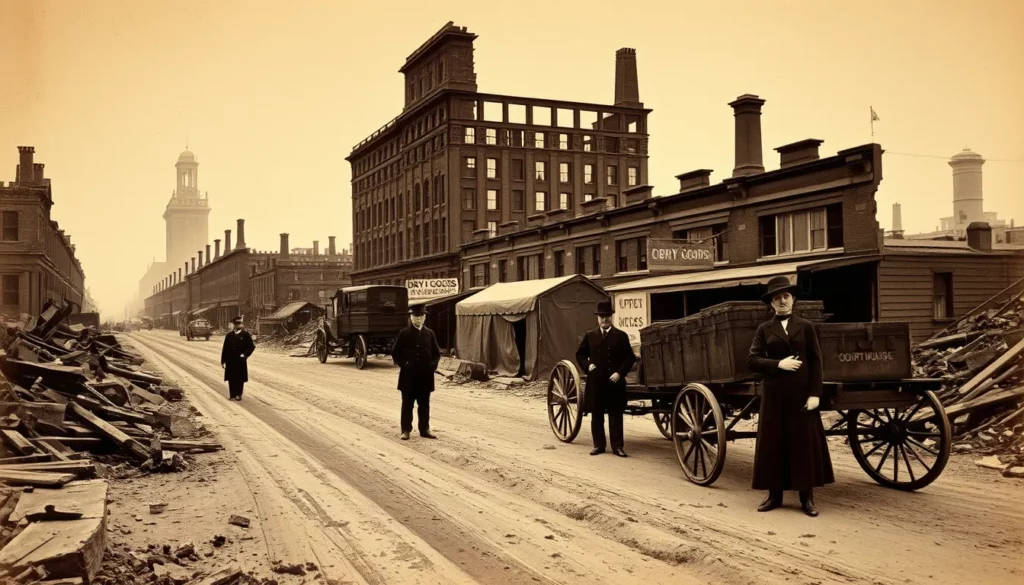
The fire is among the first great American disasters documented photographically. Commercial studios — Chicago had several, including those of Alexander Hesler and John Carbutt before the fire — produced stereographs and albumen prints of the ruins within weeks: miles of chimney stacks standing alone among rubble, the hollow shell of the courthouse, the gutted Palmer House, crowds picking through the burnt district, and temporary sheds and tents erected as shops.
These photographs were sold as souvenirs and stereoviews for the parlor viewer, and they shaped how the disaster was remembered: as spectacle, as proof of total destruction, and as the starting point of a triumphant rebuilding. The originals are today held chiefly by the Chicago History Museum, the Newberry Library, and the Library of Congress.
Documents & Primary Sources
- The 1870 federal census schedules and the city directories (Edwards’ Annual Directory), which list residents, trades, and addresses block by block.
- Runs of the Chicago Tribune, Chicago Times, Chicago Evening Post, and Chicago Journal for October and November 1871.
- The records of the Chicago Relief and Aid Society, which document the distribution of roughly $4.7 million in donations.
- Letters and diaries of survivors, such as the letter of Francis William Test to his mother and the reminiscences of Clarence Augustus Burley, held by the Chicago History Museum.
- Post-fire fire-insurance maps and the ordinances establishing the city’s new fire limits, which reshaped the rebuilt city.
1871 Timeline
| Date | Event |
|---|---|
| October 7–8 | A West Side blaze destroys four blocks; the fire department is exhausted. |
| October 8, ~9 p.m. | Fire breaks out in the O’Leary barn, DeKoven and Jefferson streets; alarm errors delay response. |
| October 8, ~11:30 p.m. | Flames cross the South Branch of the Chicago River into the business district. |
| October 9, after midnight | Gasworks explode; the courthouse and the waterworks burn; prisoners are released. |
| October 9 | Mayor Mason declares martial law; General Sheridan assumes command of order and relief. |
| October 9–10 | The fire burns out on the North Side; rain falls on the night of October 9. |
| October 11 onward | Relief stations open; the Chicago Relief and Aid Society coordinates aid from around the world. |
| November–December 1871 | Temporary structures rise; the Common Council adopts new fire limits for the burnt district. |
What Changed Next
Rebuilding was astonishingly fast. Debris was carted to the lake and used as fill; new brick and stone blocks replaced frame; within a year most of the burnt district was reoccupied, and by the mid-1870s Chicago had a larger and more valuable stock of buildings than before the fire. The new fire limits required masonry construction downtown, and the combination of masonry walls, iron, and passenger elevators set the city on the road to the steel-framed skyscraper of the 1880s.
The fire also changed institutions. Building codes, a paid and better-equipped fire department, and improved waterworks followed. The Panic of 1873 checked the boom, and labor unrest grew through the decade, culminating in the railroad strikes of 1877 and the Haymarket affair of 1886. By 1880 the population had passed 500,000; by 1890 it exceeded a million. The Chicago of the twentieth century — the city of the White City, the stockyards, and the skyscraper — was built on the ashes of 1871.
Sources
- Karen Sawislak, Smoldering City: Chicagoans and the Great Fire, 1871–1874 (University of Chicago Press, 1995).
- Carl Smith, Urban Disorder and the Shape of Belief: The Great Chicago Fire, the Haymarket Bomb, and the Model Town of Pullman (University of Chicago Press, 1995).
- Encyclopedia of Chicago, “Fire of 1871,” Newberry Library, http://www.encyclopedia.chicagohistory.org/pages/1740.html
- American Experience, “Chicago on Fire,” PBS, https://www.pbs.org/wgbh/americanexperience/features/chicago-fire/
- Bessie Louise Pierce, A History of Chicago, vol. 2 (Alfred A. Knopf, 1940).
FAQ
What was the population of Chicago in 1871?
The 1870 federal census counted 298,977 residents; by the time of the fire in October 1871 the population was generally estimated at about 300,000, roughly a third of whom lost their homes.
What major events happened in Chicago in 1871?
The defining event was the Great Chicago Fire of October 8–10, which destroyed more than 17,000 buildings, killed at least 300 people, and left about 100,000 homeless. It was followed immediately by a vast relief effort led by Mayor Roswell B. Mason, General Philip H. Sheridan, and the Chicago Relief and Aid Society, and by the beginnings of reconstruction.
What primary sources are available for studying Chicago in 1871?
Researchers use the 1870 census and city directories, runs of the Chicago Tribune, Times, and Evening Post, the records of the Chicago Relief and Aid Society, survivors' letters and diaries held by the Chicago History Museum, post-fire insurance maps and building ordinances, and the many stereographs and albumen photographs of the ruins held by the Chicago History Museum, the Newberry Library, and the Library of Congress.
How did daily life in Chicago in 1871 differ from today?
Most people lived in wooden houses without electric light, indoor plumbing, or telephone; they traveled by horse-drawn streetcar or on foot; they drew water from wells or the river and lit their homes with gas or kerosene. Work was manual and often seasonal, wages were low by modern standards, and fire, epidemic disease, and the weather were immediate daily hazards rather than abstractions.










Leave a Reply