
Short Answer
Quick Snapshot
This article treats New York as New York City, specifically Manhattan, during 1863. The wider state and national war effort form the necessary backdrop, but the focus is the urban crisis that made the year infamous.
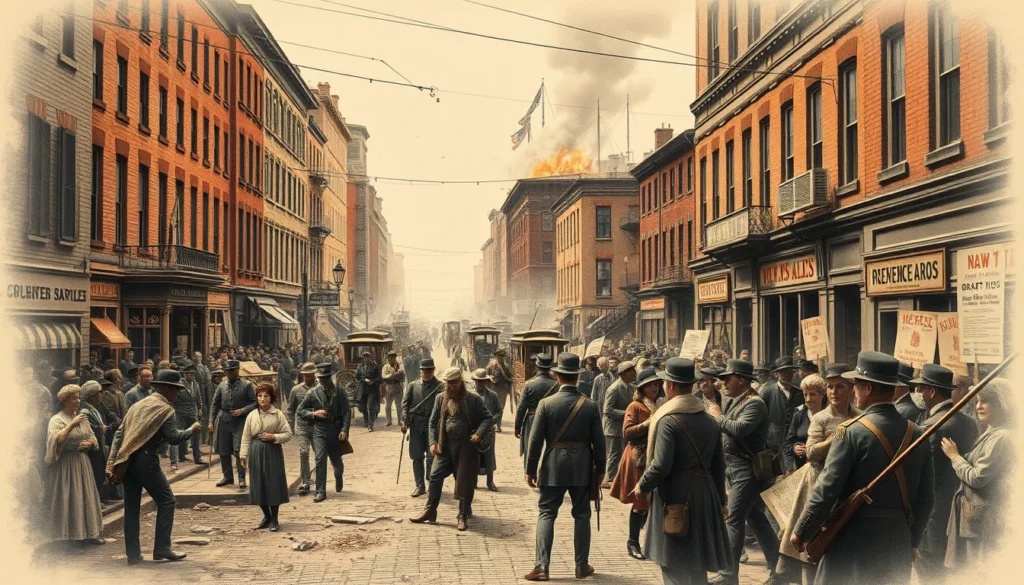
In 1863 New York City was the Union’s largest metropolis, a crowded port of immigrants, bankers, dockworkers, journalists, soldiers, and reformers. The Civil War had enriched some New Yorkers and strained others. On July 13, the first federal draft lottery under the March Enrollment Act triggered four days of violence that became the bloodiest urban riot in American history. At least 105 people died, and possibly many more. Mobs attacked draft offices, Republican symbols, abolitionists, Protestant reform agencies, and the city’s African American community. The Colored Orphan Asylum was burned, Black New Yorkers were beaten and lynched, and telegraph lines, railroads, ferries, and bridges were targeted. Federal troops, including battle-weary regiments from Gettysburg, eventually restored order.
The riots exposed divisions that had been building for years: Republican mayor versus Democratic ward politics, Lincoln administration versus Copperhead peace Democrats, native-born versus immigrant, wealthy draft-exempters versus laboring families, emancipation versus racial prejudice. Yet the city did not stop. Newspapers published, churches held services, shops reopened, and commerce resumed under guard. The year left a memory of a city divided against itself.
New York in 1863
Manhattan in 1863 was a narrow, densely built island shaped by its harbor. The East River and Hudson River carried ships, ferries, and barges; the streets carried omnibuses, horse-drawn streetcars, carts, and pedestrians. Wealth and poverty stood close together. Broadway displayed fine shops and hotels, while Five Points and parts of the Fourth Ward held crowded tenements, saloons, and workshops. German immigrants clustered in Kleindeutschland, Irish immigrants in wards near the docks and in the Five Points area, and African Americans in scattered neighborhoods including parts of Greenwich Village and the Five Points district.
The atmosphere was anxious and noisy. War news arrived by telegraph and newspaper extras. Recruiting posters and draft notices appeared on walls and fences. Gas lamps, muddy streets, horse manure, coal smoke, and harbor breezes mixed with the smells of food markets and factories. The summer of 1863 brought oppressive heat and humidity, which sharpened tempers once the draft lottery began. The city felt at once indispensable to the Union and dangerously divided over what the war should mean.
Population & Economy
The 1860 federal census counted 813,669 residents in New York City, and wartime estimates placed the population near 850,000. Immigrants made up a large share of the population, especially Irish and German newcomers. The city also had a significant free Black community, native-born workers, merchants, professionals, and a growing class of war contractors and financiers. Population pressure, immigration, and wartime migration strained housing and public services.
The economy rested on the port. Shipping, banking, insurance, wholesale trade, and manufacturing gave New York enormous influence over the Union war economy. Shipyards, iron works, sugar refineries, printing houses, garment workshops, and docks employed thousands. War contracts brought profits to some firms, while inflation and disrupted trade hurt wage earners. Common laborers earned roughly $1 to $1.50 a day in many trades, while flour could cost around $7 to $9 a barrel and rents rose amid wartime demand. The $300 draft exemption became a hated symbol of wealth buying safety, because only prosperous men could easily pay it or hire a substitute.
Government & Politics
New York City’s mayor in 1863 was George Opdyke, a Republican elected in 1861 and serving during a period of intense partisan conflict. The state governor was Horatio Seymour, a Democrat who criticized federal draft and emancipation policies while trying to preserve order. City politics ran through the Board of Aldermen, ward bosses, Tammany Hall networks, and a vigorous press. Democrats were strong in the city, and many Irish Catholic voters resented Republican reform campaigns, temperance efforts, and abolitionist activism.
National politics saturated local life. Lincoln’s administration needed New York’s manpower, money, and shipping. Republicans argued that the draft and emancipation were necessary to save the Union. Copperhead or Peace Democrats attacked the war as a Republican crusade that favored abolitionists and African Americans while burdening white laborers. In November 1863, Democrat C. Godfrey Gunther was elected mayor, a sign of the city’s swing away from Opdyke and Republican war policies. Federal provost marshals, police officials, and military commanders struggled to enforce conscription in a politically hostile city.
Industry
New York’s industries were tied to the harbor and the war. Shipbuilders and repair yards worked along the rivers. Iron foundries and machine shops produced tools, engines, and war-related goods. Sugar refineries processed imported raw sugar. Printing and publishing made the city a media center, with Harper & Brothers, Currier & Ives, and many newspaper offices. The garment trades employed thousands of women and men in small shops and tenement workshops. Banks, insurance companies, and commodity traders financed shipping and federal contracts.
The draft riots hit industrial districts hard. Mobs attacked armories, railroad property, and workshops, and fighting spread into the industrial Upper East Side. The violence showed how much the city’s economy depended on transport, communication, and public order. A few days of disorder could stop production, cut telegraph links, and frighten merchants.
Education
New York had a developing public school system, private academies, parochial schools, and charitable institutions. The Free Academy, later the City College of New York, offered advanced education to some working and middle-class students. Columbia College served a more elite constituency. Catholic schools grew with Irish and German immigration, and churches often provided schooling, charity, and community discipline. African American children faced segregation and limited opportunities, though Black churches and benevolent societies supported education.
Literacy was relatively high for the era, but schooling was not universal. Newspapers, pamphlets, sermons, and public lectures shaped opinion for many adults. The war increased demand for evening classes, job training, and moral instruction, while the riots revealed how quickly schools, churches, and reform agencies could become targets of popular anger.
Transportation
New Yorkers moved by foot, horse-drawn omnibus, and street railway. Horse cars clattered along major avenues, while ferries linked Manhattan to Brooklyn, Jersey City, and Staten Island. The Harlem Railroad, Hudson River Railroad, and other lines connected the city to the region. Ships and barges crowded the harbor, and the Erie Canal and railroads tied New York to the interior. Streets were often congested, muddy, and dangerous, and traffic mixed with peddlers, carts, and livestock.
During the riots, transportation became a battleground. Mobs tore up streetcar tracks, cut telegraph wires, attacked railroad depots, and threatened ferries and bridges. The disruption demonstrated how fragile urban movement was in an age before electric transit and instant communication.
Everyday Life
Daily life varied sharply by class and neighborhood. Wealthy families lived in brownstones and hotels, employed servants, and sent children to private schools. Laboring families crowded into tenements, boardinghouses, and rear-yard dwellings. A worker’s dinner might be bread, potatoes, pork, cabbage, or oysters from street vendors. Clothing was practical and often secondhand; washing, cooking, and heating demanded constant labor. Women managed households, took in sewing, or worked in factories and shops. Men sought work on docks, in construction, in factories, or on streetcars.
Entertainment included theaters, minstrel shows, concerts, saloons, lectures, and the Barnum museum. Churches organized charity, worship, and social life. Newspapers were read aloud in saloons and boardinghouses. Police and fire companies were part of neighborhood identity. The war added soldiers, flags, fundraising fairs, and casualty lists to ordinary routines. After July 13, everyday life was shattered by gunfire, arson, and fear.
Major Events
The year opened with the Emancipation Proclamation taking effect on January 1, a measure that energized Black New Yorkers and alarmed many white Democrats. On March 3, Congress passed the Enrollment Act, creating federal conscription. Gettysburg was fought July 1–3, and news of Union victory reached New York just as the draft lottery began on July 11.
On July 13, crowds attacked the Ninth District provost marshal office and destroyed draft records. Violence spread rapidly. The Colored Orphan Asylum on Fifth Avenue was burned; more than 200 children escaped, but the building was destroyed. Black men were hunted, beaten, and lynched, and their homes and businesses attacked. Mobs targeted Republicans, abolitionists, and Protestant charities. Archbishop John Hughes appealed for order, but the crowds grew bolder. Federal troops and militia, some fresh from Gettysburg, retook streets by force. By July 16 the uprising was crushed, leaving at least 105 dead and many more wounded.
One contemporary observer described the underlying tension as a volcano under the city.
What Newspapers Were Reporting
New York’s newspapers covered the riots with passion and partisanship. The New-York Times condemned the mob and defended the draft and the Union cause. The New-York Herald provided detailed accounts of attacks, casualties, and troop movements. Horace Greeley’s New-York Tribune denounced the violence while pressing emancipation and Republican war aims. The New York World and other Democratic papers blamed Republican policies and the draft for provoking working-class anger.
Ethnic and community papers added other perspectives. The Irish-American addressed Irish workers and community leaders, while the Weekly Anglo-African reported the terror faced by Black New Yorkers. Frank Leslie’s Illustrated Newspaper and Harper’s Weekly published engravings of burning buildings, crowds, and soldiers. Headlines described the city as in the hands of the mob, and editors debated whether the violence was treason, protest, or both.
What People Were Talking About
People talked about the $300 exemption, the fear of being drafted, and whether the war had become a war against slavery rather than a war to save the Union. Irish workers debated loyalty to the Union, resentment of abolitionists, and competition for jobs with Black laborers. Republicans worried about Copperhead influence; Democrats accused the government of tyranny. Diarists such as George Templeton Strong recorded shock at the violence and fear for the city. Letters and diaries mention rumors of attacks on draft officials, Republicans, and Black families, and arguments over whether the rioters were criminals, martyrs, or misguided laborers.
Historical Photographs
There are no known action photographs of the Draft Riots themselves, because camera technology still required long exposures and bulky equipment. The visual record is dominated by engravings in illustrated weeklies, maps, lithographs, and studio photographs. Photographers such as Mathew Brady and E. & H.T. Anthony produced portraits and city views, while newspapers and print publishers circulated images of burning buildings, crowds, and soldiers. These images shaped public memory and remain essential evidence, even when they were staged or exaggerated for dramatic effect.
Documents & Primary Sources
Historians study the 1860 federal census, the 1865 New York State census, city directories, tax records, and maps to reconstruct neighborhoods and populations. The Enrollment Act, draft lottery lists, provost marshal records, police reports, coroner’s inquests, and court records document the mechanics and aftermath of conscription. Mayor George Opdyke’s papers, Governor Horatio Seymour’s correspondence, and military reports reveal official responses. Newspapers, pamphlets, sermons, and letters show public opinion. George Templeton Strong’s diary offers a vivid elite perspective, while African American newspapers and church records preserve the experiences of Black New Yorkers.
1863 Timeline
| Date | Event |
|---|---|
| January 1 | The Emancipation Proclamation takes effect, intensifying debates over slavery and the war. |
| March 3 | Congress passes the Enrollment Act, establishing federal conscription and the $300 exemption. |
| July 1–3 | The Battle of Gettysburg is fought; news reaches New York amid rising draft tensions. |
| July 11 | The draft lottery begins in New York City. |
| July 13 | The Draft Riots erupt; draft offices are attacked and the Colored Orphan Asylum is burned. |
| July 14–15 | Violence spreads; Black New Yorkers are attacked, and troops are rushed to the city. |
| July 16 | Federal troops and militia restore order after four days of violence. |
| November | Democrat C. Godfrey Gunther is elected mayor of New York City. |
What Changed Next
In the immediate aftermath, troops occupied neighborhoods, arrests were made, and the city counted its dead. Many African American residents fled Manhattan, and the Black population declined in the following years. Irish New Yorkers remained politically powerful, and the Democratic Party gained strength. The draft continued, though enforcement remained contentious. The riots became a warning about the fragility of urban order and the depth of racial and class conflict in the North. In later years, the Colored Orphan Asylum was rebuilt, and the city’s wartime divisions shaped debates over emancipation, civil rights, and memory.
Sources
- Iver Bernstein, The New York City Draft Riots: Their Significance for American Society and Politics in the Age of the Civil War (Oxford University Press, 1990).
- Harold Holzer, ed., State of the Union: New York and the Civil War (Fordham University Press, 2002).
- Historical Society of the New York Courts, New York City and the Civil War in 1863, https://history.nycourts.gov/garfinkel_resources/new-york-city-1863/
- George Templeton Strong, Diary, edited by Allan Nevins and Milton Halsey Thomas (Macmillan, 1952).
- Kenneth T. Jackson, ed., The Encyclopedia of New York City (Yale University Press, 1995).
FAQ
What was the population of New York City in 1863?
The 1860 census counted 813,669 residents in New York City, and wartime estimates placed the population near 850,000.
What major events happened in New York City in 1863?
The Emancipation Proclamation took effect, the federal draft began, Gettysburg was fought, and the Draft Riots erupted from July 13 to 16, leaving at least 105 dead.
What primary sources are available for studying New York City in 1863?
Key sources include censuses, city directories, newspapers, maps, draft and provost marshal records, police and coroner reports, letters, diaries such as George Templeton Strong’s, and African American church and newspaper records.
How did daily life in New York City in 1863 differ from today?
Transport was horse-drawn, communication was by telegraph and newspaper, housing was crowded, and war, draft, and racial violence shaped daily life in ways far removed from modern New York.




Leave a Reply