
Short Answer
In the late summer of 1989, the West German consulate in Vienna became a daily point of arrival for an extraordinary tide of refugees. Each morning, East Germans straggled in, bleary-eyed and often torn from nights spent hiding in woods or fields, after slipping across the border from Hungary into Austria. They came because, as one 24-year-old waiter from Magdeburg explained, “We heard the Hungarians had taken down the barriers. That’s why we came.” (The Washington Post, August 5, 1989). The border they crossed was a relatively lightly protected stretch of the Iron Curtain, where three months earlier barbed wire had been removed—the only such gap along the entire divide. The world watched as a trickle became a flood, and newspapers across the West scrambled to document a drama that would ultimately reshape Europe.
What Happened?
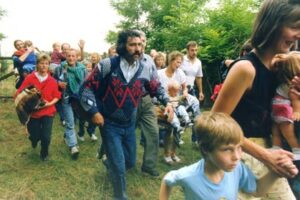
In the spring of 1989, Hungary began dismantling the physical border with Austria, a move that made it the only Warsaw Pact country to open a gap in the Iron Curtain. By early August, East Germans on vacation in Hungary discovered that they could simply walk across the frontier. On August 19, a symbolic “Pan-European Picnic” was held at the border gate near Sopron, organized to celebrate European unity. When Hungarian frontier guards opened the gate for the ceremony, several hundred East Germans who had been waiting nearby suddenly walked through—and were not stopped. The Austrian Press Agency reported that about 300 East Germans pushed through the normally closed gate during the event. (Los Angeles Times, August 20, 1989).
The exodus accelerated. By August 22, The New York Times reported that the tide of East Germans was a “popular no-confidence vote” against the Communist regime. (The New York Times, August 22, 1989). Hungary initially treated the fleeing citizens as “humanitarian” cases, granting more than 100 exit permits by August 25. (Los Angeles Times, August 25, 1989). Then, on August 31, Hungarian Foreign Minister Gyula Horn flew to East Berlin to renounce a bilateral treaty that had blocked Budapest from recognizing West German travel documents for would-be emigrants. Austria’s state railway prepared to assemble passenger trains at the border to accommodate the expected surge. (The Washington Post, September 1, 1989).
How It Was Seen at the Time
Contemporary observers understood the exodus as a profound crisis for East Germany. The Washington Post’s headline called it “The New Route to Freedom” (August 5, 1989), while The New York Times declared it a “Westward Tide of East Germans Is a Popular No-Confidence Vote” (August 22, 1989). The language was dramatic, but the underlying interpretation was clear: the flight of thousands of citizens was a rejection of the East German state. As one Bonn official put it, the incident “is sure to exacerbate relations between West Germany and the East German Communist regime: East Germany has accused Bonn of fomenting an exodus from the country.” (Los Angeles Times, August 20, 1989).
The mood among the refugees was one of desperate hope. The Washington Post quoted a young East German who had crossed after hiding in a poppy field: “It’s easy to get across as long as you don’t get caught.” (August 5, 1989). The press also noted that the exodus was a direct challenge to the legitimacy of the East German state, and that the Hungarian government’s cooperation was a visible crack in the Soviet bloc.
Historical Snapshot
| Aspect | Detail |
|---|---|
| Date | Summer 1989, particularly August–September |
| Place | Hungary–Austria border, Vienna, West German consulate |
| People | East German refugees, Hungarian border guards, West German diplomats |
| What Happened | East Germans fled through Hungary after the border opened; Hungary granted humanitarian permits and eventually renounced its treaty with East Germany |
| Why It Mattered | It exposed the fragility of the East German regime and set the stage for the fall of the Berlin Wall later that year |
Contemporary Newspaper Coverage
The Western press covered the story with a mix of urgency and wonder. The Washington Post’s August 5 report described the refugees’ arrival in Vienna: “Each weekday morning they straggle into the West German consulate here. Bleary-eyed from lack of sleep, many with scratches or torn clothing after a night hiding in woods or fields, they arrive after slipping surreptitiously into Austria from Hungary.” (The Washington Post, August 5, 1989). The New York Times, on August 22, focused on the political implications, writing that the exodus was “a popular no-confidence vote” in the East German government. (The New York Times, August 22, 1989).
The Los Angeles Times reported on the August 19 picnic with a sense of drama: “The gate was opened to mark the greater access across the Austro-Hungarian frontier as a symbol of the reduction in East-West tensions, with Hungarian frontier guards present to stamp passports of European participants. But East German citizens, who had been vacationing in Hungary, suddenly began walking through the gate. They were not stopped by Hungarian frontier police.” (Los Angeles Times, August 20, 1989).
“We heard the Hungarians had taken down the barriers. That’s why we came.” — Guido Hoffmann, 24, a waiter from Magdeburg, East Germany, quoted in The Washington Post, August 5, 1989.
Eyewitness Accounts
Guido Hoffmann’s account, published in The Washington Post on August 5, 1989, is a vivid first-person record of the escape. He and a friend hid in a poppy field outside Sopron, dodged border patrols, and walked 30 miles in darkness. At the border, they had only to climb a 6-foot wire mesh fence. “It’s easy to get across as long as you’re careful,” he said. His testimony captured the mix of fear and relief that characterized the refugees’ experience.
Another account came from the Los Angeles Times’ report on the picnic: “The gate was opened to mark a symbolic picnic celebrating European unity. But East German citizens, who had been vacationing in Hungary, suddenly began walking through the gate. They were not stopped by Hungarian frontier police.” (August 20, 1989). The refugees were not quoted directly, but the action spoke volumes.
What People Expected Would Happen Next
Contemporary observers expected the exodus to continue and intensify. The Washington Post, on September 1, 1989, reported that Hungary was moving to clear a legal path for tens of thousands of East Germans now in that country. The report noted that “Austria’s state railway prepared to assemble passenger trains at the border to accommodate them.” It also quoted Hungarian Foreign Minister Gyula Horn, who had flown to East Berlin to renounce the treaty that had blocked Budapest from recognizing West German travel documents. The paper predicted a “climax this weekend as the customary summer holiday period ends with 150,000 to 200,000 East Germans vacationing in Hungary.” (The Washington Post, September 1, 1989).
Most observers believed the pressure would force East Germany to reform or collapse. The New York Times, on August 22, wrote that the tide was a “popular no-confidence vote,” implying that the regime’s legitimacy was fatally wounded. Yet no one predicted the speed with which the Berlin Wall would fall—that was still months away, but the seeds were clearly being sown.
Timeline
- May 1989: Hungary begins dismantling barbed wire on its border with Austria.
- August 2, 1989: Guido Hoffmann and others cross the border; the Washington Post reports on the new route.
- August 5, 1989: The Washington Post publishes “The New Route to Freedom.”
- August 19, 1989: Pan-European Picnic at Sopron; several hundred East Germans walk through the opened gate.
- August 20, 1989: Los Angeles Times reports on the picnic and the ensuing crisis.
- August 22, 1989: New York Times calls it a “popular no-confidence vote.”
- August 25, 1989: Hungary grants more than 100 “humanitarian” exit permits to East Germans.
- August 31, 1989: Hungary renounces its treaty with East Germany; Austria prepares trains.
Aftermath
The immediate aftermath was a continued acceleration of the exodus. By September, tens of thousands of East Germans were crossing into Austria, and the Hungarian government officially opened its border on September 11, 1989. This made it impossible for East Germany to prevent its citizens from leaving. The flood of refugees contributed to the political crisis that led to the fall of the Berlin Wall on November 9, 1989. The events of the summer were a direct precursor to the end of Communist rule in East Germany and the reunification of Germany in 1990.
The primary sources from the summer of 1989 capture a moment when ordinary people, with little more than hope and a wire fence, changed the course of history. The newspaper reports, written in real time, show the uncertainty and the human cost—the hiding, the fear, the relief—and the way that a seemingly small act of border opening became a world-changing event. They remind us that history is often made not by leaders, but by the decisions of individuals who choose to walk through an open gate.
FAQ
Why did Hungary open the border in 1989?
Hungary began dismantling its barbed wire border with Austria in May 1989 as part of a broader effort to improve relations with the West and to show a commitment to reform. The border was initially opened for a symbolic picnic, but the large number of East Germans who walked through led Hungary to formally open the border on September 11, 1989, after renouncing its treaty with East Germany.
How many East Germans fled through Hungary in the summer of 1989?
Exact numbers vary, but by the end of August 1989, the Washington Post reported that up to 6,000 East Germans had already fled, and an estimated 150,000 to 200,000 were still in Hungary, with about 10 percent intending to flee. The total exodus through Hungary continued to grow throughout September.
What did the Western newspapers say about the exodus at the time?
Western newspapers such as The Washington Post, The New York Times, and the Los Angeles Times covered the exodus extensively, using language that emphasized the human drama and the political significance. They called it a 'new route to freedom' and a 'popular no-confidence vote' against the East German regime, and they highlighted the courage of the refugees and the diplomatic tensions within the Soviet bloc.



Leave a Reply