
Short Answer
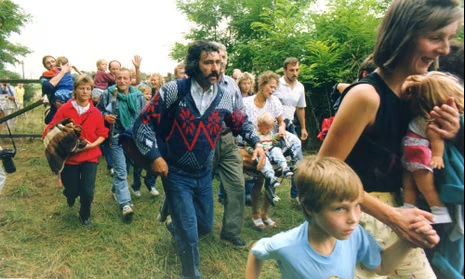
On the warm afternoon of 19 August 1989, a few thousand Hungarians and Austrians gathered at a border gate near Sopron, Hungary, carrying picnic baskets and flags. They had come for a “Pan-European Picnic,” a demonstration for open borders and a united Europe. The atmosphere was festive, but the stakes were enormous. Only a few hundred metres away, the iron curtain—barbed wire and electronic surveillance—still separated the communist bloc from the West. As the day wore on, a rumour spread: the gate was open. Hundreds of East Germans, who had been waiting in Hungary for a chance to escape, surged forward. Hungarian border guards, taken by surprise, stood aside. By evening, more than six hundred refugees had crossed into Austria. The picnic, intended as a symbol, had become the first real breach of the Iron Curtain.
What Happened?
The idea for the picnic emerged from a meeting between Ferenc Mészáros, a member of the Hungarian Democratic Forum (MDF), and Otto von Habsburg, the former Crown Prince of Austria-Hungary and President of the Paneuropean Union. They proposed a symbolic opening of the border to test Soviet tolerance and to push for a united Europe. The Hungarian Prime Minister Miklós Németh supported the plan, and the event was publicly announced as a “peace demonstration.”
On the morning of 19 August, organizers and ordinary citizens gathered at the border crossing near Sopron. The Hungarian border guards had been instructed not to fire, but no one expected a mass exodus. As the afternoon wore on, news of the open gate spread among the East German refugees who had been camping in Hungary, hoping for a route to the West. According to the BBC, “more than 600 East Germans surged through the open Hungary-Austria border.” The Guardian reported that “East Germans surprise Hungarian border guards and rush through a gate into Moerbisch, Austria.”
The event unfolded as follows:
- May 1989: Hungary begins dismantling the electronic surveillance equipment and barbed wire along its western border (Bundesregierung).
- August 1989: The Hungarian Democratic Forum and the Paneuropean Union issue invitations to a “Pan-European Picnic.”
- August 19, 1989: The picnic takes place near Sopron; around 600–700 East Germans cross the border into Austria.
- August 25, 1989: Hungary formally opens its border to East Germans (Bundesregierung).
The picnic itself was a peaceful demonstration. The German Federal Government later described it as “a symbolic border opening with consequences.”
How It Was Seen at the Time
Contemporary observers understood the picnic as a deliberate challenge to Soviet control. The organizers, including Otto von Habsburg, framed it as a step toward European reunification. The Hungarian government, though officially still communist, had already begun dismantling the border. The mood was one of cautious hope mixed with fear of Soviet reaction. The BBC later noted that the picnic “was the signal for an exodus to the West which became a flood.”
At the time, the Western press reported the event with astonishment. The Guardian, in its 2019 retrospective, described the scene: “Thousands of Hungarians and Austrians gathered at the border fence between the two countries, which also marked the dividing line between the Communist bloc and the west.” The East Germans who crossed were not officially part of the picnic, but their sudden rush became the defining image. As the German Chancellor Angela Merkel later said, “The picnic turned into a major world event.”
Historical Snapshot
| Aspect | Detail |
|---|---|
| Date | 19 August 1989 |
| Place | Border crossing near Sopron, Hungary, on the Austro-Hungarian border |
| People | Hungarian Democratic Forum, Paneuropean Union, Otto von Habsburg, Ferenc Mészáros, Miklós Németh, Hungarian border guards, East German refugees |
| What Happened | A peaceful picnic turned into a border opening; over 600 East Germans crossed into Austria. |
| Why It Mattered | It was the first real breach of the Iron Curtain, leading to the fall of the Berlin Wall and German reunification. |
What People Knew at the Time
| What People Knew Then | What We Know Now |
|---|---|
| That Hungary was slowly opening its border; that the picnic was a symbolic gesture. | That the picnic was a planned test of Soviet resolve and that it directly triggered the mass exodus. |
| That hundreds of East Germans had crossed; the exact number was uncertain. | That about 600–700 people crossed on that day, according to later official counts. |
| That the event was a significant step, but no one predicted the rapid collapse of the Eastern Bloc. | Historians now see the picnic as the turning point that led to the fall of the Berlin Wall in November 1989. |
What People Feared
At the time, the greatest fear was that the Soviet Union would intervene militarily, as it had done in Hungary in 1956 and Czechoslovakia in 1968. The Hungarian government was wary of provoking Moscow. The organizers, including Otto von Habsburg, hoped that a peaceful demonstration would avoid a crackdown. The East German refugees feared being turned back; they had already been living in Hungarian camps for months. The border guards feared orders to shoot, but they were instructed to show restraint. As the BBC reported, the guards’ restraint was later praised by Angela Merkel.
What People Expected Would Happen Next
Most contemporaries expected a gradual, managed opening of the border, not a sudden collapse. The Hungarian government had already begun dismantling the border in May, and the picnic was seen as a step toward normalization. Many believed that the Soviet Union would tolerate limited emigration but not a full rupture. The East German refugees expected to be allowed to leave, but they did not expect the border to stay open. In the weeks after the picnic, Hungary formally opened its border on 25 August, and the exodus grew. By November, the Berlin Wall fell. Contemporaries were caught by surprise; the speed of events exceeded all expectations.
Timeline
- 2 May 1989: Hungary begins dismantling the electronic surveillance equipment and barbed wire along its western border.
- August 1989: The Hungarian Democratic Forum and Paneuropean Union announce the “Pan-European Picnic.”
- 19 August 1989: The picnic takes place near Sopron; over 600 East Germans cross into Austria.
- 25 August 1989: Hungary officially opens its border to East Germans.
- September 1989: Mass exodus of East Germans through Hungary and Austria.
- 9 November 1989: Fall of the Berlin Wall.
- 1990: German reunification.
Aftermath
The immediate aftermath was a flood of East Germans. By the end of August, Hungary had opened its entire border, and by September thousands were crossing. The East German government, unable to stop the exodus, began to lose control. The picnic was the catalyst. In the following months, pro-Soviet regimes across Eastern Europe collapsed. The Hungarian government later acknowledged that the picnic was a deliberate act to test the Soviet Union and to push for reform. The event is now commemorated in Hungary and Germany as a pivotal moment in the end of the Cold War.
How Historians See It Today
Modern historians view the Pan-European Picnic as a turning point in the history of the Cold War. At the time, it was seen as a symbolic gesture; today, it is recognized as the first concrete breach of the Iron Curtain. The German Federal Government’s official archive notes that “Hungary lifted the Iron Curtain” and that the picnic was “a symbolic border opening with consequences.” The BBC described it as “the first rip in the Iron Curtain.” Historians now emphasize the role of Hungarian decision-makers and the peaceful nature of the protest. They also note the importance of Otto von Habsburg’s and the Paneuropean Union’s leadership. The event is often compared to the fall of the Berlin Wall, but historians argue that the picnic made the Wall’s fall possible by demonstrating that the East could not hold.
In conclusion, the Pan-European Picnic of 1989 was a peaceful protest that unexpectedly opened a door. The primary sources—contemporary news reports, official statements, and later recollections—show that the people involved were both hopeful and fearful. They did not know that they were witnessing the beginning of the end of the Cold War. The picnic teaches us that ordinary acts, when courageously carried out, can change history.
FAQ
What was the Pan-European Picnic?
The Pan-European Picnic was a peace demonstration held on 19 August 1989 at the Austro-Hungarian border near Sopron, Hungary. It was organized by the Hungarian Democratic Forum and the Paneuropean Union to promote open borders and a united Europe. During the event, about 600–700 East Germans crossed into Austria, marking the first real breach of the Iron Curtain.
Who organized the Pan-European Picnic?
The idea came from Ferenc Mészáros of the Hungarian Democratic Forum and Otto von Habsburg, President of the Paneuropean Union and former Crown Prince of Austria-Hungary. They proposed it to Hungarian Prime Minister Miklós Németh, who supported the plan.
Why did the picnic lead to the fall of the Berlin Wall?
The picnic demonstrated that Hungary would not stop East Germans from escaping to the West. This encouraged thousands more to flee, and the exodus became a flood, leading to the opening of the Berlin Wall in November 1989. The picnic is seen as the first decisive step in the collapse of the Eastern Bloc.










Leave a Reply