
Short Answer
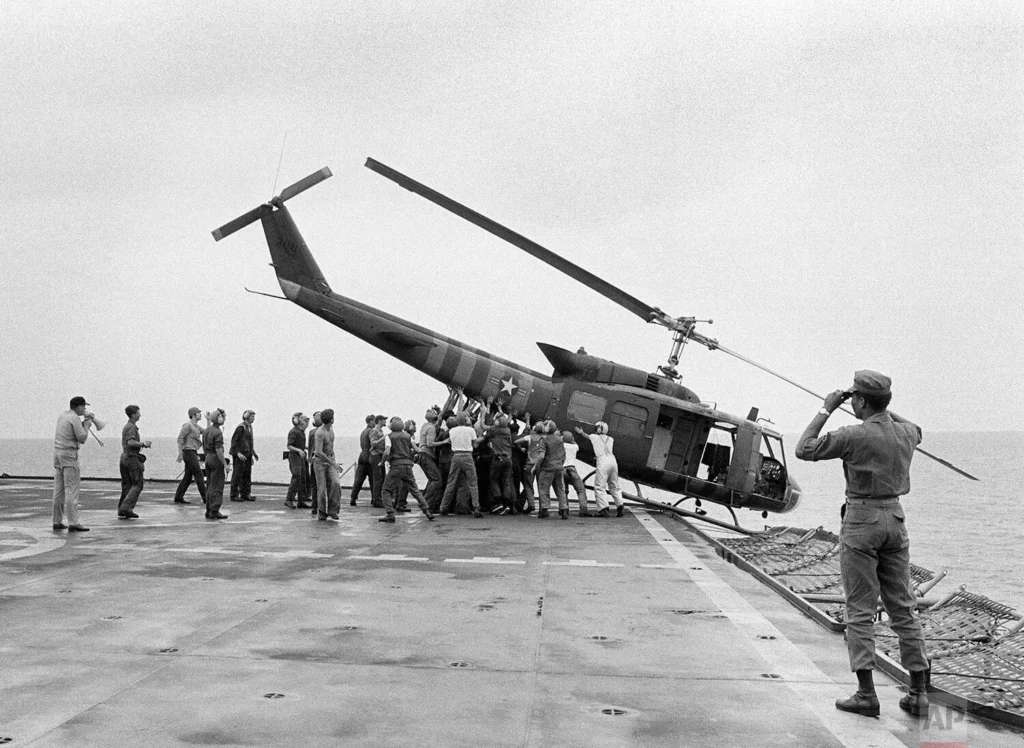
April 29, 1975. A thick gray overcast and misting rain blurred the view from the cockpits as nine U.S. Air Force helicopters flew in loose formation northwest from the sea toward the besieged capital of South Vietnam. Below, the Republic of Vietnam was collapsing in its final hours. The aircrews—many of whom had thought the war over since 1973—were ordered to evacuate the last Americans and as many “critical” Vietnamese nationals as possible. They were also bringing in several hundred Marines to secure the landing zones. This was their second sortie from the carrier USS Midway into Saigon, and it would be their most dangerous. The radio crackled with the airborne commander’s voice: “Okay, let’s pick it up here. It looks like things are about to close up and we want to be able to give them the support they need.” This was the beginning of Operation Frequent Wind—the largest helicopter evacuation in history.
What Happened?
Operation Frequent Wind was the U.S. military’s emergency evacuation of American citizens and at-risk Vietnamese nationals from Saigon as North Vietnamese forces closed in. The operation began on April 29, 1975, and lasted less than 24 hours, yet it lifted more than 7,000 people out of the city.
- April 29, 1975, early morning: The U.S. Navy and Marine forces—including 44 naval vessels, 6,000 Marines, 120 Air Force combat and tanker planes, and 150 Navy planes—were already in position off the coast. The signal to start was the radio broadcast of Bing Crosby’s “White Christmas,” followed by a coded message to the helicopters.
- First sorties: Marine Heavy Helicopter Squadron 463 (HMH-463) launched eight CH-53D Sea Stallions from the USS Hancock. The squadron’s CO, LtCol. Herbert Fix, lifted off to the command “Gentlemen, start your engines.” They flew through blustery winds and dark rain clouds to the evacuation points.
- Evacuation points: The primary landing zone was Tan Son Nhut Airport (call sign “Alamo”), but when the North Vietnamese began shelling the base, the operation shifted to the U.S. Embassy compound and other designated rooftops. Pilots and crews shuttled back and forth, often without rest, in a continuous cycle of flights.
- Radio traffic: The airborne commander coordinated multiple helicopters into both the embassy and Tan Son Nhut. “Roger, find out for sure how many aircraft Alamo needs at this time,” one transmission said. “Okay, they’re on their way. Their feet wet at this time and we’ll have them there as soon…”
- Numbers: By the end of the operation, more than 1,000 Americans and 5,500 Vietnamese had been flown out. The total, including all U.S. and Vietnamese personnel, exceeded 7,000. The last helicopter left the roof of the U.S. Embassy at 7:53 a.m. on April 30, just hours before the city fell.
How It Was Seen at the Time
For the pilots and crews, the operation was a chaotic, desperate, and often terrifying experience. Many had believed the war was over. Iowa native John Morgan, a helicopter pilot, recalled that when he received orders to assist with the evacuation, it was a “tremendous surprise.” He said, “I’m not happy about being subjected to possibly being killed when I thought a war was already over.” Yet he also felt a deep sense of purpose: “But now, I feel proud that I served my country in the way that I did, that my missions, my actual combat missions, had to do with saving people and not hurting anyone.”
The radio transmissions captured the urgency. The airborne commander’s words—“Okay, let’s pick it up here”—were broadcast to the world, later preserved in Marine Corps archives. The mood was a mix of professional discipline and raw emotion. A crew chief on a CH-53D, Chris Woods, described the moment of launch: “Gentlemen, start your engines.” That laconic command, copied from the Indianapolis 500, echoed from the USS Hancock’s 1MC. The eight helicopters then “fluttered off in a tight formation through blustery winds and dark, ominous rain clouds.”
Historical Snapshot
| Aspect | Detail |
|---|---|
| Date | April 29–30, 1975 |
| Place | Saigon, South Vietnam; offshore U.S. naval carriers |
| People | U.S. Air Force and Marine helicopter pilots and crew; U.S. Navy personnel; U.S. Embassy staff; Vietnamese nationals |
| What Happened | Emergency helicopter evacuation of Americans and at-risk Vietnamese as North Vietnamese forces captured Saigon |
| Why It Mattered | Marked the final U.S. withdrawal from Vietnam; the largest helicopter evacuation in history |
Eyewitness Accounts
The most vivid details come from the pilots and crew members themselves.
“Gentlemen, start your engines.” — Command from the USS Hancock’s 1MC, as recalled by Chris Woods, crew chief of “Swift 2-2,” in his account for the USMC Combat Helicopter & Tiltrotor Association.
Woods described the launch: “The laconic command copied from the Indianapolis 500 auto races echoed from the 1MC. Moments later, the Commanding Officer of Marine Heavy Helicopter Squadron 463, LtCol. Herbert Fix, lifted his CH-53D Sea Stallion off the deck of the aging carrier. When the other eight choppers had left the deck, they fluttered off in a tight formation through blustery winds and dark, ominous rain clouds that hovered over the South China Sea.”
Pilot John Morgan, speaking to Iowa Public Radio in 2025, recalled the personal stakes: “I’m not happy about being subjected to possibly being killed when I thought a war was already over.” Yet he added, “But now, I feel proud that I served my country in the way that I did, that my missions, my actual combat missions, had to do with saving people and not hurting anyone.”
What People Feared
For the pilots and crews, the primary fear was death—both from enemy fire and from the sheer danger of flying in dense traffic and hostile conditions. The North Vietnamese army was shelling Tan Son Nhut Airport, and the city was in chaos. Many feared they might not make it out. John Morgan’s comment about “possibly being killed” captured that anxiety. There was also the fear that the evacuation would be overrun, that the helicopters would be overwhelmed by the desperate crowds. The radio transmissions show the tension: “All right – max it out,” the airborne commander ordered, meaning load as many as possible. The fear of being left behind was real for the Vietnamese, who knew they would face prison or execution under the communist rule. The operation was delayed as long as possible—too long, in the view of many Pentagon officials—which only increased the risk.
Numbers at the Time
| Statistic | Figure | Source |
|---|---|---|
| Total evacuated | More than 7,000 people | Iowa Public Radio, 2025 |
| Americans evacuated | More than 1,000 | Iowa Public Radio, 2025 |
| At-risk Vietnamese evacuated | 5,500 | Iowa Public Radio, 2025 |
| U.S. Navy vessels in area | 44 | Popasmoke (USMC Association) |
| Marines ashore | 6,000 | Popasmoke |
| Air Force combat and tanker planes | 120 | Popasmoke |
| Navy planes | 150 | Popasmoke |
| Helicopters in first wave (HMH-463) | 9 CH-53D Sea Stallions | Popasmoke |
Contemporary Terminology
The pilots and crew used a specific jargon that is now part of military history. “Alamo” was the call sign for Tan Son Nhut Airport. “Feet wet” meant the aircraft had left land and was flying over water—a term that signaled a safe phase of the flight. The phrase “max it out” meant to load as many people as possible, regardless of normal limits. The operation itself was named “Frequent Wind,” a code phrase used to signal the evacuation. The helicopters were mostly CH-53D Sea Stallions, a heavy-lift transport helicopter. The command “Gentlemen, start your engines” was borrowed from the Indianapolis 500 auto race, giving the launch a moment of levity.
How Historians See It Today
Modern historians view Operation Frequent Wind as the definitive end of U.S. involvement in the Vietnam War. It was the largest helicopter evacuation in history, and it symbolized the failure of U.S. policy in Southeast Asia. At the time, many Americans saw it as a humiliating retreat, but the courage of the pilots and crew is now widely recognized. The operation was a logistical marvel—the rapid coordination of dozens of aircraft, carriers, and Marines in a chaotic environment. Historians also note the human cost: thousands of Vietnamese who had worked with the Americans were left behind, and the evacuation was a race against time. The primary sources—the radio transmissions, the crew accounts, and the photographs—remain a powerful testament to the bravery and the tragedy of the final days of the Vietnam War.
In the end, the pilots and crew of Operation Frequent Wind did not just fly helicopters; they carried out an act of mercy in the midst of defeat. Their voices, captured on radio and in later interviews, remind us that the fall of Saigon was not a single event but a human one—filled with fear, courage, and the desperate hope of thousands seeking freedom.
FAQ
What was Operation Frequent Wind?
Operation Frequent Wind was the U.S. military's emergency helicopter evacuation of American citizens and at-risk Vietnamese nationals from Saigon on April 29–30, 1975, as North Vietnamese forces captured the city. It was the largest helicopter evacuation in history, lifting over 7,000 people to U.S. Navy carriers in the South China Sea.
Who were the pilots and crew involved?
The operation involved U.S. Air Force and Marine helicopter pilots and crew, including Marine Heavy Helicopter Squadron 463 (HMH-463) flying CH-53D Sea Stallions. They were supported by Navy personnel and air controllers. Their personal accounts and radio transmissions are preserved in archives like the Marine Corps and Naval History.










Leave a Reply