
Short Answer
In the final days of October 1962, the world held its breath. For thirteen days, the United States and the Soviet Union stood on the brink of nuclear war over the discovery of Soviet missiles in Cuba. Yet for most people—in Washington, London, Moscow, and beyond—the crisis unfolded not through direct experience but through the crackle of radio broadcasts, the hurried exchange of telegrams, and the tense words of diplomats. Communication was agonizingly slow: there was no hotline between the White House and the Kremlin, and ciphered telegrams could take hours to deliver. The time difference between Moscow and Washington, seven to eight hours, compounded the confusion. As the crisis reached its peak, Soviet Premier Nikita Khrushchev turned to the airwaves, broadcasting messages over Radio Moscow that were monitored, translated, and rushed to leaders within minutes. This is the story of how the world learned of the brink—through the voices, wires, and paper trails of October 1962.
What Happened?
The Cuban Missile Crisis began on October 16, 1962, when U.S. reconnaissance photographs revealed Soviet nuclear missiles under construction in Cuba. President John F. Kennedy announced a naval blockade on October 22, and the world entered a tense standoff. Over the next thirteen days, the crisis escalated and nearly spiraled into war.
Key events unfolded with dizzying speed:
- October 22, 1962: Kennedy addressed the nation, revealing the missiles and announcing a quarantine of Cuba.
- October 26, 1962: Soviet Premier Nikita Khrushchev sent a long, emotional letter to Kennedy proposing to remove missiles if the U.S. pledged not to invade Cuba. That same day, ABC News diplomatic correspondent John Scali received a lunch invitation from Alexander Fomin, a Soviet embassy official who was actually KGB station chief. Fomin hinted at a possible deal—an approach that would become a critical channel of unofficial diplomacy.
- October 27, 1962: A U.S. U-2 spy plane was shot down over Cuba, killing the pilot, and Khrushchev sent a second, harder letter demanding the removal of U.S. missiles from Turkey in exchange. Washington and Moscow reached a secret agreement that night: the U.S. would publicly pledge not to invade Cuba and privately remove its missiles from Turkey.
- October 28, 1962: Khrushchev announced over Radio Moscow that the Soviet Union would dismantle the missiles in Cuba, ending the immediate crisis.
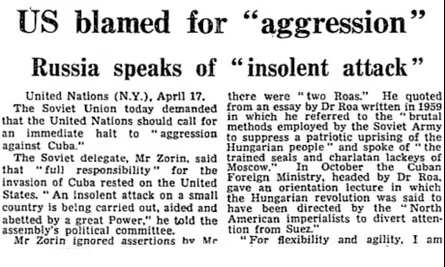
Throughout, speed of communication was vital. As the Imperial War Museum notes, Khrushchev used the radio “primarily for speed,” because diplomatic channels dependent on ciphered telegrams were “extremely slow and cumbersome.” The time difference between Moscow and Washington, between seven and eight hours, only worsened the tension.
How It Was Seen at the Time
Contemporaries understood the crisis as an existential threat. The language of the time was stark—leaders spoke of “the brink of war” and “the gravest issue.” In Washington, officials worried that a single miscalculation could trigger a nuclear exchange. In London, the BBC Monitoring Service became a crucial lifeline, translating Khrushchev’s broadcasts and transmitting them to the White House and British government within minutes.
“The Cuban Missile Crisis in October 1962 was the most dangerous moment of the Cold War.” — Rosaleen Hughes, BBC Monitoring and the Cuban Missile Crisis
The mood was one of controlled fear. The shooting down of the U-2 on October 27 inflamed tensions, and diplomats on all sides struggled to interpret Soviet motives. As Canadian diplomats reported on October 27, officials were aware of Khrushchev’s demand for removal of missiles from Turkey, but they did not yet know of the secret agreement being reached that night. The non-aligned states, meanwhile, hoped for peace, but their voices were largely drowned out by the superpowers’ confrontation.
Historical Snapshot
| Aspect | Detail |
|---|---|
| Date | October 16–28, 1962 |
| Place | Washington, D.C.; Moscow; Havana; the Caribbean Sea; and the airwaves of Radio Moscow |
| People | President John F. Kennedy; Premier Nikita Khrushchev; Fidel Castro; John Scali (ABC News); Alexander Fomin (Soviet KGB station chief) |
| What Happened | The U.S. discovered Soviet nuclear missiles in Cuba, blockaded the island, and negotiated a withdrawal after a tense standoff. |
| Why It Mattered | The closest the world came to nuclear war; it reshaped Cold War diplomacy and led to the creation of a direct hotline. |
What People Knew at the Time
| What People Knew Then | What We Know Now |
|---|---|
| Khrushchev’s messages were broadcast on Radio Moscow and read by BBC monitors in near real-time. | These broadcasts were the primary channel for the crisis’s resolution, but the secret agreement on Turkey missiles was unknown to the public. |
| Officials knew the U-2 had been shot down over Cuba on October 27, but the full details of the secret back-channel deal were not public. | We now know that the secret agreement to remove U.S. missiles from Turkey in exchange for Soviet withdrawal was reached that night. |
| The public saw the crisis as a direct U.S.–Soviet confrontation, with Cuba as a pawn. | Historians emphasize the role of local actors, especially Fidel Castro, and the fragile nature of the communication channels. |
Eyewitness Accounts
One of the most extraordinary eyewitness accounts comes from John Scali, the ABC News diplomatic correspondent who became a participant in the crisis. On October 26, 1962, Scali received a phone call from Alexander Fomin, the Soviet embassy’s diplomatic counselor—who was in fact the KGB station chief. Fomin insisted on lunch, and Scali agreed.
“Scali was just finishing a baloney sandwich and was not inclined to eat more. But the urgency he detected in Fomin’s voice persuaded him that food wasn’t the point of the phone call. So he agreed to meet.”
During that lunch, Fomin hinted at a Soviet willingness to remove the missiles in exchange for a U.S. promise not to invade Cuba. Scali reported this to the State Department, and the exchange became a critical backchannel of the crisis. Scali later described his role as “a messenger boy” between the two superpowers—a unique and uncomfortable position for a journalist.
Official Reports
The official record of the crisis includes the diplomatic cables and the work of the BBC Monitoring Service. The BBC Monitoring Service at Caversham, with its American counterpart FBIS, played an absolutely vital role. As Rosaleen Hughes writes, “Key developments in the crisis, including its final resolution, turned on messages from the Soviet President Khrushchev to the American President JFK, which were broadcast directly and publicly over Radio Moscow. These were translated immediately by the monitors at Caversham and transmitted by teleprinter not just to the British government departments in London but to the White House and US government agencies in Washington.”
On October 27, 1962, Canadian diplomats in Washington sent cables to Ottawa describing the tension. They reported the special mention Canada received in American newspapers, and the thanks offered by Secretary of State Dean Rusk and Attorney General Robert Kennedy for Prime Minister Diefenbaker’s speech of October 25. The Washington Post argued that “Mr. Khrushchev’s blatant move has brought…” the world to the brink. These official reports show how closely allied nations were monitoring the crisis and the importance of reliable communication.
What People Feared
At the time, the dominant fear was of an immediate nuclear war. The U-2 shootdown on October 27 was widely seen as a potential trigger for a U.S. military response. The public feared a blockade could lead to a shooting war with Soviet ships. In Washington, officials worried about the Soviet demand for the removal of U.S. missiles from Turkey—a demand that seemed a potential public humiliation for the U.S. The time difference between Moscow and Washington meant that a message sent in the evening would arrive in the early morning, and the exhaustion of leaders was a real concern, as historian Rosaleen Hughes noted. People feared that a single miscommunication or an unauthorized military action could ignite a war that would end in nuclear winter.
Timeline
- October 14, 1962: U.S. U-2 flight takes photographs of Soviet missile sites in Cuba.
- October 16: Kennedy is briefed; the crisis begins.
- October 22: Kennedy addresses the nation, announcing a naval quarantine of Cuba.
- October 26: Khrushchev sends a private letter proposing a deal; John Scali’s lunch with Fomin takes place.
- October 27: A U-2 is shot down over Cuba; Khrushchev sends a second letter demanding removal of missiles from Turkey; secret agreement reached that night.
- October 28: Khrushchev announces over Radio Moscow that the missiles will be removed, ending the crisis.
- November 20, 1962: The U.S. ends the blockade.
Key Documents
- Khrushchev to Kennedy, October 26, 1962 – A private letter proposing to remove missiles in exchange for a pledge not to invade Cuba.
- Khrushchev to Kennedy, October 27, 1962 – A public letter demanding the removal of U.S. missiles from Turkey.
- Kennedy’s reply, October 28, 1962 – Accepted the Soviet terms and pledged not to invade Cuba.
- BBC Monitoring logs, October 1962 – Translations of Khrushchev’s Radio Moscow broadcasts that were sent to Washington and London.
Aftermath
The immediate aftermath was relief. The U.S. and the Soviet Union had stepped back from the brink. The crisis led directly to the establishment of a direct telephone hotline between Washington and Moscow in 1963, designed to prevent such miscommunication in the future. The removal of Soviet missiles from Cuba was confirmed, and the U.S. quietly removed its missiles from Turkey. The world had learned the importance of speed and clarity in communication.
How Historians See It Today
Contemporary observers saw the crisis as a triumph of firm diplomacy by President Kennedy. Modern historians, however, emphasize the role of miscommunication and the near-accidents that could have triggered war. They also highlight the importance of backchannels like the Scali–Fomin lunch and the BBC monitoring as crucial to resolution. The crisis is now seen as a turning point in the Cold War, leading to a period of dente and the first arms control agreements. The primary sources—the cables, the broadcasts, the personal accounts—reveal how fragile the world was and how much depended on human interpretation and speed of transmission.
In the end, the Cuban Missile Crisis was a story of communication—its speed, its limits, and its consequences. The world learned of the brink through the voices of radio, the urgency of telegrams, and the whispered negotiations of a journalist and a spy. These contemporary reports remind us that history is not just a series of decisions, but a web of messages, fears, and human hopes.












Leave a Reply