
Short Answer
On the morning of May 8, 1945, Americans awoke to a reality that had seemed impossibly distant for nearly six years: the war in Europe was over. The previous day, at a red-brick schoolhouse in Reims, France, the German High Command had signed an unconditional surrender, and by the time the sun rose over New York, the news was already splashed across front pages from coast to coast. Church bells rang, crowds gathered in Times Square and Trafalgar Square, and the streets echoed with singing and cheering. But for all the jubilation, the victory was incomplete—the war in the Pacific still raged, and the American public knew it. This is the story of how the press captured that moment of triumph and uncertainty, as seen through the newspapers Americans read on the day the guns fell silent in Europe.
What Happened?
The end of the war in Europe unfolded in a sequence of rapid events that newspapers tracked with breathless precision. Adolf Hitler committed suicide on April 30, 1945, during the Battle of Berlin, and his successor, Karl Dönitz, authorized the surrender of Germany. On May 7, 1945, at 2:41 a.m., German representatives signed the unconditional surrender document at General Dwight D. Eisenhower’s headquarters in a red brick schoolhouse in Reims, France. The surrender was ratified on May 8, which became known as Victory in Europe Day (VE Day).
The news reached American newspapers on May 7, even before the official announcement. According to the Readex blog, many American papers published the story that same day, with headlines such as “Germany Quits!” and “Victory! Germany Gives Up.” The New York Times, in its May 7, 1945 issue, proclaimed: “The War in Europe is Ended! Surrender Is Unconditional; V-E Will Be Proclaimed Today; Our Troops on Okinawa Gain.” The official announcement came on May 8, when the surrender document was ratified, and the Los Angeles Times led its front page with “FULL VICTORY IN EUROPE.”
The surrender ended a six-year conflict that had claimed over sixty million lives. In the United States, more than 100,000 American troops had been killed in Europe. The Allies, now free to focus entirely on Japan, turned their attention to the Pacific. The war in Europe was over, but the world war was not.
How It Was Seen at the Time
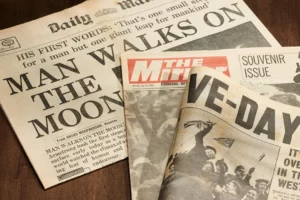
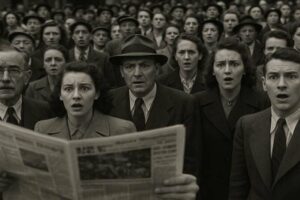
For Americans, the news of Germany’s surrender was met with an outpouring of relief and joy, tempered by the knowledge that the war was not yet won. The front pages of May 7 and 8, 1945, captured the mood with bold, exultant headlines. The Readex blog quotes headlines like “Germany Quits!” and “Victory! Germany Gives Up” from American papers on May 7. The Los Angeles Times lead story read: “Germany surrendered unconditionally, completing the victory in the European phase of the second World War – the most devastating in history.”
“Germany surrendered unconditionally, completing the victory in the European phase of the second World War – the most devastating in history.” — Los Angeles Times, May 8, 1945
The celebrations were immediate and widespread. As described in the Readex article, “Church bells rang and the streets resounded with singing and cheering. People flooded to places like Trafalgar Square in London and Times Square in New York City to celebrate.” The press emphasized the historic nature of the moment, while also reminding readers that the war in the Pacific continued. The New York Times headline on May 7, for example, included “Our Troops on Okinawa Gain,” a reminder that the fight was not yet over.
Historical Snapshot
| Aspect | Detail |
|---|---|
| Date | May 8, 1945 (official VE Day; news reported May 7) |
| Place | Reims, France (surrender signed); celebrations across the United States |
| People | Karl Dönitz (German successor), General Dwight D. Eisenhower, Allied commanders, American press correspondents |
| What Happened | Germany surrendered unconditionally, ending the war in Europe | Why It Mattered | It marked the defeat of Nazi Germany and allowed the Allies to focus on Japan |
Contemporary Newspaper Coverage
American newspapers covered the surrender with a mix of euphoria and sobriety. The May 7, 1945 issue of the New York Times led with the headline: “The War in Europe is Ended! Surrender Is Unconditional; V-E Will Be Proclaimed Today; Our Troops on Okinawa Gain.” The story, by Associated Press correspondent Edward Kennedy, was one of the first to break the news—and it was not without controversy. As described in The Conversation, the Supreme Headquarters of the Allied Expeditionary Forces (SHAEF) had selected 17 correspondents to witness the surrender in Reims, but not a single reporter from a US newspaper was among them. The correspondents were supposed to hold the news until the official announcement, but Kennedy broke the embargo, and the story was published on May 7, a day before the official proclamation. This “scoop” caused a rift between the military and the press, but it also meant that American readers learned of the surrender almost immediately.
The Los Angeles Times on May 8 ran the banner “FULL VICTORY IN EUROPE” above its lead story, which began: “Germany surrendered unconditionally, completing the victory in the European phase of the second World War – the most devastating in history.” The paper also noted that the war had lasted six years and claimed over sixty million lives, and that the Allies would now turn their full attention to Japan.
What People Knew at the Time
| What People Knew Then | What We Know Now |
|---|---|
| Germany had surrendered unconditionally; the war in Europe was over. | Details of the surrender negotiations, the role of the Soviet Union, and the full extent of the Holocaust were not fully known. |
| The war in the Pacific continued; Japan was still fighting. | The atomic bombings of Hiroshima and Nagasaki were still months away; the final end of the war would come in August 1945. |
| The surrender was signed at Reims on May 7 and ratified on May 8. | Later historians have emphasized the political and military complexities of the surrender, including the separate Soviet signing in Berlin. |
What People Expected Would Happen Next
Most Americans understood that the defeat of Germany was only half the battle. The war in the Pacific was still ongoing, and the newspapers made this clear. The New York Times headline on May 7 included “Our Troops on Okinawa Gain,” reminding readers that the fight against Japan continued. The Los Angeles Times noted that the Allies could now turn their full focus toward Japan, but also that supply shortages and rationing would continue. There was a widespread expectation that the war against Japan would be long and bloody, possibly lasting another year or more. The possibility of an atomic bomb was unknown to the public; the expectation was for a prolonged amphibious invasion of the Japanese home islands. In the end, the war would end just three months later, in August 1945, but on VE Day that outcome was not yet foreseeable.
What the Sources Got Wrong
The most notable error in contemporary reporting was the premature publication of the surrender story. The Associated Press correspondent Edward Kennedy broke the embargo set by SHAEF, and his report appeared in newspapers on May 7, a full day before the official announcement. This violation of the embargo caused a serious conflict between the military and the press. The military had intended to make the announcement simultaneously on May 8, but Kennedy’s scoop forced their hand. Many newspapers, however, had already printed the news on May 7, as the Readex article notes. The error was not in the facts—the surrender was real—but in the timing, and it led to a debate about the freedom of the press versus military secrecy. Later historians have also pointed out that the surrender at Reims was not the final surrender; a second signing took place in Berlin on May 8, but that detail was not emphasized in the initial American reports.
Aftermath
In the immediate aftermath of VE Day, the United States shifted its focus to the Pacific. The war in Europe had ended, but the war in Asia continued. Rationing remained in place, and the nation braced for what many expected to be a long and bloody campaign against Japan. The celebrations of May 8 were a moment of relief, but not of final victory. The American press, having covered the surrender with such intensity, turned its attention to the Pacific war and to the challenges of the peace. The end of the war in Europe also brought the beginning of a new era in international relations, with the United Nations charter being drafted in San Francisco that same spring. The newspapers would soon report the final victory in Japan in August 1945, but the VE Day headlines remain a testament to the moment when the first great conflict of the twentieth century came to a close.
FAQ
Why did some American newspapers report VE Day on May 7 instead of May 8?
The surrender document was signed on May 7, but the official announcement was set for May 8. However, Associated Press correspondent Edward Kennedy broke the story early, and many newspapers published the news on May 7, leading to the official announcement being moved up. This caused a controversy over the military embargo.
What did Americans know about the war in the Pacific on VE Day?
They knew that the war against Japan was still ongoing, and that the focus would now turn to the Pacific. The expectation was that the war might last another year or more, with a potential invasion of Japan.



Leave a Reply