Short Answer
In late September 1918, as American troops fought in the trenches of France, Philadelphia prepared for a grand spectacle: a parade to promote the Fourth Liberty Loan drive. The city was crowded with war workers and soldiers from the nearby Navy Yard, and the air buzzed with patriotic fervor. But an invisible enemy had already slipped ashore. On September 28, 1918, more than 200,000 people packed the parade route along Broad Street, unaware that the Spanish influenza had already begun to spread through the city. Within weeks, Philadelphia would become one of the deadliest cities in the United States, with hospitals overflowing, corpses piling up in morgues, and a death toll that would ultimately exceed 13,000. The City of Brotherly Love, as it was called, had become a pandemic epicenter.
What Happened?
The first handful of influenza cases appeared in Philadelphia in late August 1918, but they attracted little attention. Dr. Wilmer Krusen, the city’s Director of Public Health and Charities, was more concerned with the growing epidemic at the Naval Hospital in the Fourth Naval District. On September 18, he reserved 150 beds at the Municipal Hospital for Contagious Diseases for the Navy’s use. The city’s first influenza death was an 89-year-old banker, but Krusen and other officials still believed the outbreak was under control.
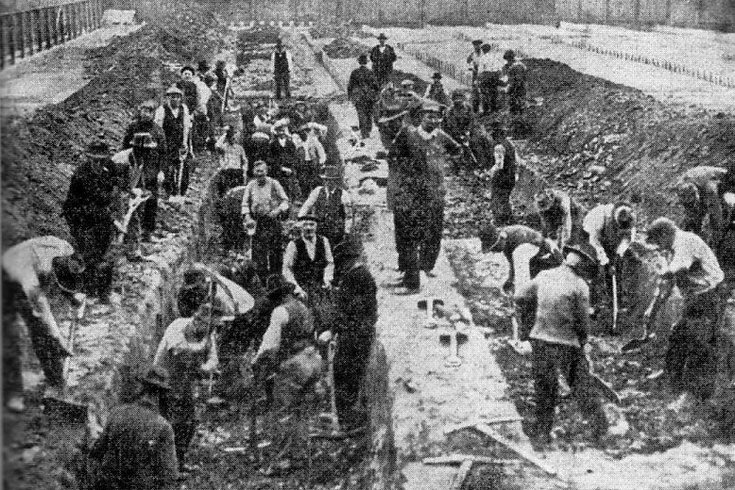
On September 28, the city held the Fourth Liberty Loan parade to boost war bond sales. Over 200,000 people jammed the parade route, many of them soldiers and sailors from the Navy Yard. Within days, the virus exploded in the civilian population. The disease spread rapidly, overwhelming hospitals and funeral homes. Schools, churches, saloons, and theaters were closed. Thirty-two emergency hospitals were opened to handle the sick. The death toll climbed so quickly that burying the dead became almost impossible. By the end of the epidemic, over 13,000 Philadelphians had died.
How It Was Seen at the Time
At the outset, city officials and the public alike underestimated the threat. The Philadelphia Inquirer and other newspapers initially downplayed the severity, focusing on the war effort and the Liberty Loan drive. As the epidemic exploded, a sense of panic and helplessness spread. The city’s health director, Dr. Krusen, continued to insist that the outbreak was under control even as the numbers climbed. The prevailing mood was one of confusion and fear, as citizens struggled to understand why so many young, healthy adults were dying. The language of the time reflected a military mindset: the city was “under siege” by an “enemy” that could not be seen. The Public Ledger called it a “plague,” and doctors reported that patients died within hours of the first symptoms. One doctor described the scene as “a battlefield” with bodies “stacked like cordwood” in the morgues.
Historical Snapshot
| Aspect | Detail |
|---|---|
| Date | Late August 1918 – November 1918 (and sporadic cases into spring 1919) |
| Place | Philadelphia, Pennsylvania, United States |
| People | City officials, including Dr. Wilmer Krusen, Director of Public Health; residents; soldiers and sailors at Philadelphia Navy Yard |
| What Happened | Influenza outbreak spread from the Navy Yard to the civilian population after a Liberty Loan parade, leading to over 13,000 deaths in three months |
| Why It Mattered | Philadelphia became one of the hardest-hit American cities, prompting emergency measures and revealing the dangers of mass gatherings during an epidemic |
Timeline
- Late August 1918 – First handful of influenza cases appear in Philadelphia, but officials pay little attention.
- September 18, 1918 – Dr. Krusen reserves 150 beds at the Municipal Hospital for Contagious Diseases for the Navy.
- September 18, 1918 – The city’s first influenza death is recorded (an 89-year-old banker).
- September 28, 1918 – The Fourth Liberty Loan parade takes place; over 200,000 people line the streets.
- October 1918 – The epidemic explodes; hospitals fill, schools and theaters close, and thirty-two emergency hospitals open.
- November 1918 – The disease recedes, but influenza continues into the spring with decreased virulence.
- Ultimately – Over 13,000 deaths in Philadelphia, the second-highest death toll among major U.S. cities.
What People Knew at the Time
| What People Knew Then | What We Know Now |
|---|---|
| Influenza was caused by a “germ” and spread through contact, but the specific virus was unknown. | The pandemic was caused by an H1N1 influenza A virus, not fully understood until the 20th century. |
| Mass gatherings were risky, but officials allowed the Liberty parade to proceed. | Mass gatherings are a major vector for respiratory disease spread; the parade catalyzed the outbreak. |
| People believed the outbreak was under control until the parade. | The virus had already seeded in the Navy Yard and was likely spreading before the parade. |
| The death toll was reported as “high” but not fully comprehended. | Philadelphia had one of the highest death rates in the U.S., second only to Pittsburgh. |
Contemporary Newspaper Coverage
Philadelphia’s newspapers initially downplayed the influenza, focusing on the war and the Liberty Loan drive. The Philadelphia Inquirer and Public Ledger reported on the parade as a patriotic success, but within days, they were filled with stories of the “Spanish Influenza” and its devastating impact. Headlines shifted from “Great Liberty Parade” to “Influenza Epidemic Sweeps City” and “Hospitals Overwhelmed.” The press published daily death tolls, often exceeding 500 per day in October. The coverage reflected a mixture of denial and alarm. An article in the Public Ledger on October 3, 1918, quoted a health officer: “We are fighting a war, but this enemy is more deadly than any German.” Newspapers also printed advice on prevention, often repeating the erroneous claims that the flu was spread by “germs” and that “fresh air” and “cleanliness” were the best protection. Despite the severity, the press continued to encourage citizens to buy Liberty Bonds, even as the parade’s role in spreading the disease became apparent.
Aftermath
By November 1918, the influenza epidemic in Philadelphia began to recede. The emergency hospitals closed, and schools and theaters reopened. The disease continued into the spring of 1919, but with decreasing severity. The city’s health department, which had been overwhelmed, faced criticism for its handling of the crisis. The Liberty Loan parade was later seen as a catastrophic mistake. In the months that followed, the city began to establish more robust public health protocols, including better surveillance of infectious diseases and restrictions on public gatherings during outbreaks. The pandemic also left a permanent mark on the city’s population, with an estimated 13,000 dead—many of them young adults. The experience of Philadelphia would become a case study in the dangers of ignoring early warning signs and the necessity of evidence-based public health measures.
How Historians See It Today
Historians today view the Philadelphia epidemic as a critical example of how civic boosterism and wartime urgency can exacerbate a pandemic. Modern scholarship emphasizes the role of the Liberty parade in creating a “super-spreader” event, and the failure of officials to heed early warning signs. The death toll of 13,000 in a city of about 1.7 million people (at the time) represents a mortality rate of roughly 0.8%, far higher than the national average. Historians also point out that the city’s health department was underfunded and understaffed, and that the Navy Yard served as an early reservoir. The pandemic’s impact on Philadelphia is now studied as a cautionary tale about the dangers of dismissing early cases and the importance of social distancing. While contemporaries saw the pandemic as a temporary wartime inconvenience, modern historians recognize it as a global catastrophe that killed more than 50 million people worldwide, and that Philadelphia’s experience was a microcosm of the failure of public health infrastructure to respond to a novel virus.
The 1918 influenza pandemic in Philadelphia remains a stark reminder of how quickly a virus can transform a thriving city into a scene of desperation and death. The primary sources—newspaper reports, official records, and personal accounts—reveal a city caught between the demands of war and the threat of an invisible enemy. The Liberty Loan parade, once a symbol of patriotism, became a symbol of deadly complacency. The experience of Philadelphia in 1918 teaches us that the cost of ignoring a pandemic is measured in human lives, and that the decisions made by leaders in times of crisis have lasting consequences.
FAQ
What was the Liberty Loan parade and how did it contribute to the flu epidemic in Philadelphia?
The Liberty Loan parade was a patriotic event on September 28, 1918, to promote war bond sales. Over 200,000 people crowded the streets, which likely spread the influenza virus rapidly. The parade is considered a major factor in the explosion of the epidemic in the civilian population, leading to thousands of deaths.
How many people died in Philadelphia during the 1918 flu pandemic?
Philadelphia recorded over 13,000 deaths from influenza and pneumonia during the 1918-1919 pandemic, making it one of the hardest-hit American cities, second only to Pittsburgh in mortality rate.



Leave a Reply