
Short Answer
On the night of July 20, 1969, a cold rain fell on Manhattan, but the streets were far from empty. In bars, living rooms, and even a few impromptu sidewalk gatherings, New Yorkers huddled around televisions, their faces lit by the ghostly glow of a black-and-white signal from 240,000 miles away. The New Yorker’s reporters, dispatched across the city, found a mood of quiet awe. “The moon, it turns out, is a great place for men,” they wrote, “One-sixth gravity must be a lot of fun, and when Armstrong and Aldrin went into their bouncy little dance, like two happy children, it was a moment not only of triumph but of gaiety.” At mission control in Houston, the tension had broken into smiles. The world was watching, and for two hours, humanity forgot its divisions and stared upward. This article reconstructs that night as it was experienced—through the dispatches of the Associated Press, Agence France-Presse, and The New Yorker—showing what people knew, felt, and expected as history was made.
What Happened?
The Apollo 11 mission began on July 16, 1969, when a Saturn V rocket lifted off from Kennedy Space Center. After a four-day journey, the Lunar Module—named Eagle—separated from the command module Columbia, with astronauts Neil A. Armstrong and Buzz Aldrin aboard, while Michael Collins remained in orbit. On July 20, at 4:17 p.m. EDT, the Eagle touched down on the Moon’s Sea of Tranquility. According to the AFP report, mission commander Armstrong had announced earlier that he would exit the lunar module five hours earlier than planned. At 10:56 p.m. EDT (02:56 GMT on July 21), Armstrong stepped onto the lunar surface, uttering the famous words, “That’s one small step for [a] man, one giant leap for mankind.” The AP dispatch described the scene: “Two Americans landed on the moon and explored its surface for some two hours Sunday, planting the first human footprints in its dusty soil. They raised their nation’s flag and talked to their President on earth 240,000 miles away.” After setting up scientific experiments and collecting rock samples, the astronauts returned to their spacecraft. At 1:11 a.m. EDT Monday, Armstrong reported, “The hatch is closed and locked.” They then rejoined Collins in the command module and began their journey back to Earth, splashing down on July 24.
How It Was Seen at the Time
Contemporary reporting emphasized the triumph of technology and the unity of the world. The AP story, written by John Barbour, captured the solemnity: “Two Americans landed on the Moon and explored its surface for some two hours Sunday, planting the first human footprints in its dusty soil.” The tone was one of achievement, with a hint of awe. The New Yorker’s “The Moon Hours” piece, published just days after the landing, noted a strange paradox: “The moon, on the other hand, is a poor place for flags. Ours looked stiff and awkward, trying to float on the breeze that does not blow. (There must be a lesson here somewhere.)” The magazine observed the public’s reaction: “It was a moment not only of triumph but of gaiety.” The AFP dispatch, written in French and translated, described the suspense: “After seemingly never-ending suspense—the descent for man’s first steps on the Moon gets under way.” The prevailing mood was one of wonder and pride, tempered by a sense of the unprecedented. People were not just watching a mission; they were witnessing the first time in history that a human being stepped onto another world.
Historical Snapshot
| Aspect | Detail |
|---|---|
| Date | July 20, 1969 (landing); July 16, 1969 (launch) |
| Place | Sea of Tranquility, the Moon; Mission Control, Houston, Texas |
| People | Neil Armstrong, Buzz Aldrin, Michael Collins; President Richard Nixon (spoke to astronauts) |
| What Happened | First human footsteps on the Moon; two hours of surface exploration; flag planting; scientific experiments |
| Why It Mattered | Fulfilled the U.S. goal of landing a man on the Moon before the decade’s end; a global milestone in space exploration |
Contemporary Newspaper Coverage
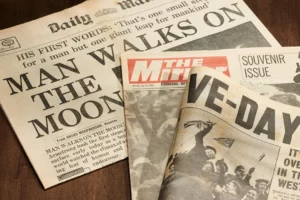
Wire services were the primary source of breaking news. The Associated Press dispatched a detailed story from Houston, written by John Barbour, which was published across the nation. The headline, as seen in many newspapers, read “Two Americans Land on Moon and Explore Its Surface for Two Hours.” The AP article emphasized the physical actions: “They raised their nation’s flag and talked to their President on earth 240,000 miles away.” The tone was factual, but with a sense of drama. The AFP, a French wire service, reported from the Sea of Tranquility itself—a literary device—and described the moment of Armstrong’s step: “On Sunday at 10:56 pm US time (0256 GMT), Armstrong—after seemingly never-ending suspense—steps on the Moon.” The AFP also noted that the astronauts had prepared for the excursion by putting on “double-visor helmets, boots, reinforced gloves and backpack-like life support gear.” The New Yorker’s coverage was more reflective, focusing on the public reaction in Manhattan. The magazine described the rainy night and the crowds: “We’ve added location markers, photographs, videos, and audio from the era to capture what it felt like, on that rainy night in July, to watch history unfold.” These dispatches together gave a comprehensive picture: the world was united in attention, and the press rose to the occasion.
Eyewitness Accounts
The New Yorker’s “Moon Hours” is a treasure trove of eyewitness reactions. The magazine sent reporters to viewing parties across Manhattan, both planned and impromptu. They observed that the moon landing was “a great place for men” and that “when Armstrong and Aldrin went into their bouncy little dance, like two happy children, it was a moment not only of triumph but of gaiety.” This description captures the public’s perception of the astronauts’ joy in the low-gravity environment. The AFP report also gives an eyewitness account from mission control in Houston, where the journalists were present. They described the “seemingly never-ending suspense” as Armstrong descended. The AFP’s summary, crosschecked against NASA transcripts, provides a minute-by-minute account of the astronauts’ preparations, including the 7:42 p.m. start of the excursion. These accounts allow us to see the event not as a distant fact but as a live, tense, and ultimately joyful experience.
What People Expected Would Happen Next
Contemporary commentary suggested that the Moon landing was not an end but a beginning. The New Yorker mused, “One-sixth gravity must be a lot of fun,” implying that future explorers would enjoy the experience. The AP story noted that the astronauts had “talked to their President” and had “scoured the rocky, rugged surface,” indicating the mission’s scientific purpose. Many people expected a continuation of Apollo missions, perhaps a lunar base, and certainly a race to Mars. The Smithsonian article, written forty years later, reflects on how the world stopped for a brief instant, but at the time, the future seemed limitless. The AFP dispatch ended with the astronauts returning to the module, but the tone was forward-looking. While the sources do not explicitly state predictions, the general public and press anticipated a new era of space exploration, with the Moon as a stepping stone. The immediate aftermath—the safe return of the astronauts and the global celebration—reinforced this optimism. In the following years, Apollo 12 through 17 continued, but the expectations of a permanent lunar presence were not met; the Apollo program was canceled after Apollo 17 in 1972.
Aftermath
After the hatch was closed and locked, the astronauts slept and then lifted off from the Moon on July 21, 1969. They docked with the command module and returned to Earth, splashing down in the Pacific Ocean on July 24. The world celebrated the safe return. The AP story, which had been updated, reported the successful conclusion. The New Yorker’s piece, published on July 26, reflected on the event’s meaning. The astronauts were quarantined, then greeted by President Nixon and a worldwide tour. The mission had achieved its goal, and the Cold War space race was effectively won. The immediate aftermath was a surge of national pride in the United States and a global sense of human achievement. The sources from the time do not dwell on the long-term, but the short-term was one of triumph.
How Historians See It Today
Modern historians view the Apollo 11 landing as a pivotal moment in the Cold War, a demonstration of American technological and political superiority over the Soviet Union. The Smithsonian’s retrospective, written in 2009, emphasizes that “the world stopped for a brief instant to witness a remarkable accomplishment, the first instance in which humanity set foot on another body in our solar system.” Historians also note that the event was a global media phenomenon, with an estimated 600 million people watching the live broadcast. While contemporary reports focused on the triumph and the unity of humanity, later scholarship has examined the geopolitical context, the costs, and the subsequent decline of public interest in space exploration. The New Yorker’s contemporary piece, with its ironic comment about the flag, has been seen as a subtle critique of American nationalism, a perspective that has gained traction in later historical analysis. Today, historians see the Moon landing as both a pinnacle of human achievement and a product of a particular historical moment—the Cold War space race—rather than as the start of a continuous expansion into space.
The primary sources from July 1969—the AP, AFP, and New Yorker—offer a window into that extraordinary night. They show us a world united in awe, a press that rose to the occasion, and a people who, for a few hours, set aside their divisions to watch a human being take a step into the unknown. The Moon landing was not just a scientific feat; it was a shared human experience, and these records preserve that experience for all time.
FAQ
What time did Neil Armstrong step on the Moon?
Armstrong stepped onto the Moon at 10:56 p.m. EDT on July 20, 1969 (02:56 GMT on July 21), as reported by AFP and confirmed by NASA.
How long were the astronauts on the Moon's surface?
According to the AP report, they explored the surface for about two hours, from the first step at 10:56 p.m. until they closed the hatch at 1:11 a.m. EDT on July 21.
Who else was on the Apollo 11 mission?
Michael Collins remained in the command module Columbia in lunar orbit while Armstrong and Aldrin descended to the surface. He was not on the Moon.












Leave a Reply