
Short Answer
On the morning of November 20, 1945, the surviving leaders of the Third Reich filed into Courtroom 600 in the Nuremberg Palace of Justice. The world’s press gathered to witness the opening of a trial that Lord Justice Lawrence, the British president of the International Tribunal, called “unique in the history of the jurisprudence of the world.” For the next nine months, the men who had governed Germany under Hitler would sit in the dock, facing charges of conspiracy, crimes against peace, war crimes, and crimes against humanity. The trial was not only a legal event but a global media spectacle, reported daily by newspapers on every continent. As United Press correspondent Dudley Ann Harmon wrote, it was “the greatest trial in history,” and the victors hoped it would begin a new era of international law.
What Happened?
Twenty-four leading Nazis were indicted as chief criminals, along with seven Nazi organizations. Only 21 of the individuals were brought to the bar of justice. Martin Bormann, Hitler’s confidant, was tried in absentia; Gustav Krupp von Bohlen und Halbach, the aged munitions czar, was exempted because of senile insanity; and Robert Ley, the Nazi labor front leader, committed suicide during the proceedings. The trial lasted more than nine months and involved a mass of testimony that disclosed “in its full horror the inhumanities of the Nazi conspiracy against civilization,” as UPI reported on September 30, 1946.
The defendants alternated between blustering, cringing, and whining, according to contemporary press reports. The verdicts were delivered on September 30 and October 1, 1946, with twelve defendants sentenced to death, three to life imprisonment, and four to long prison terms. The trial established the principle that individuals could be held accountable for crimes against humanity under international law.
How It Was Seen at the Time
Contemporary observers understood the trial as a watershed moment. The UPI correspondent wrote that the verdicts marked “the beginning of a new era of international law under which ‘crimes against humanity’ will be punished by humanity itself, sitting in solemn judgment.” The British press, as detailed in academic studies of the era, overwhelmingly agreed that Nazi criminality, including the Final Solution, had to be recorded and punished. The Guardian’s opening-day report noted that Lord Justice Lawrence called the proceedings “unique in the history of the jurisprudence of the world.”
“The Nuremberg verdict marks the end of the greatest trial in history and, it is hoped by the victors in World War II, the beginning of a new era of international law under which ‘crimes against humanity’ will be punished by humanity itself, sitting in solemn judgment.” — United Press, September 30, 1946
Historical Snapshot
| Aspect | Detail |
|---|---|
| Date | November 20, 1945 – October 1, 1946 |
| Place | Courtroom 600, Nuremberg Palace of Justice, Germany |
| People | 21 defendants; Lord Justice Lawrence (president); prosecutors from the U.S., U.K., France, and USSR |
| What Happened | Major Nazi leaders were tried for conspiracy, war crimes, and crimes against humanity |
| Why It Mattered | Established the precedent of individual accountability for crimes against humanity in international law |
Contemporary Newspaper Coverage
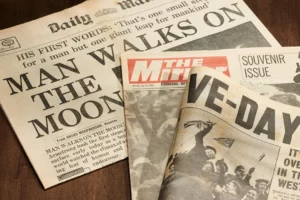
Newspapers around the world gave the trial extensive coverage. The Guardian’s dispatch from the opening day, November 21, 1945, described the scene: “When Lord Justice Lawrence, the British President of the International Tribunal, opened the great Nuremberg war trial this morning he called it unique in the history of the jurisprudence of the world.” The article also noted that Ribbentrop had applied to call prominent British witnesses, including Lord Vansittart and Lord Beaverbrook, reflecting the high-profile nature of the case.
The United Press coverage on September 30, 1946, emphasized the historic significance of the verdict. The British press, as analyzed in scholarly studies of the period, had been primed by the liberation of concentration camps in 1945. A Springer chapter on the British press notes that “ever since the news of the liberated concentration camps had filled the pages of British newspapers, the majority attitude of the press was that Nazi criminality, including the Final Solution, had to be recorded and punished.”
“The trial, which lasted more than nine months, involved the introduction of a mass of testimony which disclosed in its full horror the inhumanities of the Nazi conspiracy against civilization.” — United Press, September 30, 1946
What People Knew at the Time
| What People Knew Then | What We Know Now |
|---|---|
| That the Nazis had committed horrific crimes, including the murder of millions in concentration camps | That the Holocaust was a systematic genocide of six million Jews and millions of others |
| That the trial was a historic first for international law | That the trial established precedents for later war crimes tribunals (e.g., ICC) |
| That the defendants were being tried for crimes against peace, war crimes, and crimes against humanity | That the legal definitions of these crimes were still being formed, and the trial was also criticized as “victor’s justice” |
What People Feared
Contemporary fears centered on whether the trial would be seen as impartial or as a mere act of revenge. The British press, according to Mass Observation studies, worried that the defendants might escape punishment or that the trial would set a dangerous precedent for victor’s justice. There was also anxiety about the fragility of the post-war peace. The UPI report expressed hope that the trial would prevent future atrocities, but the underlying fear was that the world might not heed the lesson.
What People Expected Would Happen Next
Many contemporaries expected that the Nuremberg trials would lead to a new era of international law, where “crimes against humanity” would be punished by humanity itself. The UPI report stated that the verdicts were “hoped by the victors” to be the beginning of such an era. However, there was also expectation that the defendants would be sentenced to death, and that the trial would serve as a deterrent. The press did not foresee the Cold War, which would soon complicate the united front of the Allies.
Aftermath
On October 1, 1946, the International Tribunal delivered its verdicts. Twelve defendants were sentenced to death by hanging, three to life imprisonment, and others to shorter terms. The executions were carried out on October 16, 1946. The trial’s legacy was immediate: it established the Nuremberg Principles, which defined crimes against peace, war crimes, and crimes against humanity. It also led to the subsequent Nuremberg trials of lesser officials. The United Nations later adopted the Genocide Convention in 1948, which drew directly from the Nuremberg Charter.
How Historians See It Today
Modern historians recognize the Nuremberg trials as a turning point in international law, but they also point out its limitations. The trial was conducted by the victorious Allies, and the defendants were only tried for crimes committed by the Axis powers. There was no parallel trial for Allied war crimes. Yet the legal principles established at Nuremberg—particularly the idea that individuals can be held responsible for crimes against humanity—remain foundational. The contemporary press, as shown in the UPI and British newspaper reports, largely saw the trial as a moral triumph, a view that has been nuanced but not fundamentally reversed by modern scholarship.
In conclusion, the primary sources from the era—newspaper dispatches, press analyses, and public opinion surveys—show that the Nuremberg trials were understood as a historic attempt to bring justice to the horrors of the Holocaust and the Second World War. They were reported with a sense of gravity and hope, and the world watched as the principles of international justice were tested for the first time.
FAQ
What was the Nuremberg trial?
The Nuremberg trial was an international military tribunal held in 1945–1946 to prosecute the major Nazi leaders for crimes against peace, war crimes, and crimes against humanity. It was the first such tribunal in history and set a precedent for international justice.
How many defendants were tried?
Twenty-four Nazis were indicted, but only 21 were brought to trial. Martin Bormann was tried in absentia, Gustav Krupp was exempted due to illness, and Robert Ley committed suicide during the trial.
What was the role of the press at Nuremberg?
The press played a crucial role in covering the trial, providing daily reports to the world. Newspapers like The Guardian and UPI shaped public understanding of the trial's significance and the horrors of the Nazi crimes.







Leave a Reply