
Short Answer
In the final days of April 1975, Saigon was a city holding its breath. The North Vietnamese army had swept through the South with a speed that stunned even those who had watched the war for years. Now the capital itself was waiting, and everyone in the city knew what was coming. In those last weeks, people listened to anything they could hear—the Voice of America in Vietnamese, the BBC, the American Radio Service—to track the advance of the forces that would soon take the city. For Tom Glenn, a CIA signals intelligence officer who had operated under cover in Vietnam for 13 years, the broadcasts were a lifeline. For the millions of Vietnamese in the city, they were a countdown. The war that had consumed Vietnam for more than two decades, first involving the French and then the Americans, was ending. The city was about to fall, and the people who were there—journalists, intelligence officers, relief workers, and civilians—would remember the last days of April 1975 for the rest of their lives.
What Happened?
The fall of Saigon was the final act of the Vietnam War. The North Vietnamese offensive of 1975 had moved with extraordinary speed. By late March, the country’s second city, Da Nang, had fallen apart. A relief worker who had been evacuated from the town of Quang Ngai described the scene: “The city was choked with the remnants of divisions of the Army of the Republic of Vietnam—the South Vietnamese forces.” He saw a policeman wander by “still in uniform, carrying an M-16 rifle.”
By the last days of April, the North Vietnamese had reached the gates of Saigon. Peter Arnett, a Pulitzer Prize-winning journalist who had covered the war for more than a decade, wrote in his memoir Saigon Has Fallen: “Artillery explosions sound a fearsome 4 a.m. wake-up call, but I’m already awake. The attackers waiting at the gates of a vanquished Saigon have been warning they would attack.”
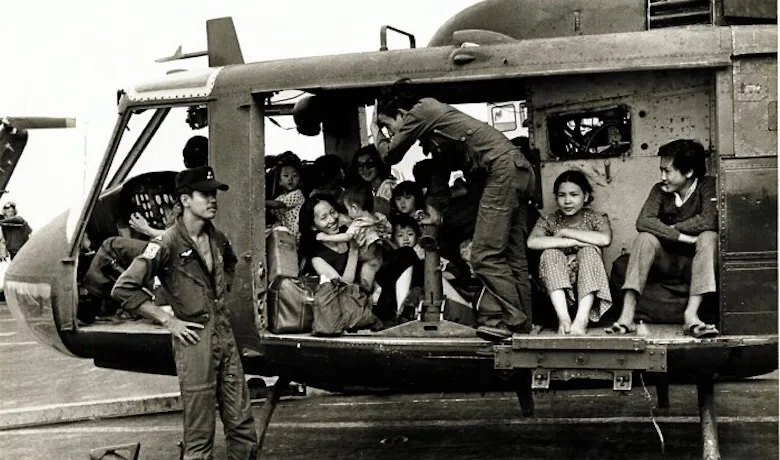
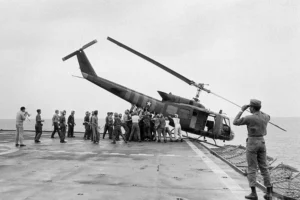
The evacuation of the capital was chaotic and desperate. U.S. officials scrambled aboard helicopters at an apartment building in Saigon, and similar scenes were enacted across the city as people fled Vietnam. Loren Jenkins, a reporter for NPR, was among the last to leave, flying off the roof of the U.S. Embassy on one of the last helicopters out. The city fell on April 30, 1975.
How It Was Seen at the Time
For the people who were in Saigon, the fall was not an abstraction but an imminent event. The language of the time was full of urgency and uncertainty. Peter Arnett’s memoir title—Saigon Has Fallen—captured the finality of the moment, and his phrase “vanquished Saigon” described a city already defeated in speech.
“I listened to anything I could hear to keep track of what was happening. It was April 1975. I was in Saigon waiting for the North Vietnamese to attack.”—Tom Glenn, CIA signals intelligence officer
Tom Glenn described the daily ritual of listening to the Voice of America in Vietnamese, the BBC, and the American Radio Service. “That’s what I heard every day,” he recalled. The prevailing mood was not certainty but anticipation. The Quaker relief worker admitted, “I was slow to realize that the war was ending. In fact, I only began to take the idea seriously after watching the country’s second city, Da Nang, fall apart.” Even in the final days, the people in Saigon did not know exactly when the attack would come or what the aftermath would be.
Historical Snapshot
| Aspect | Detail |
|---|---|
| Date | April 30, 1975 |
| Place | Saigon, Republic of Vietnam (now Ho Chi Minh City) |
| People | U.S. officials, journalists, CIA officers, Vietnamese civilians, North Vietnamese forces |
| What Happened | The North Vietnamese army captured Saigon, ending the Vietnam War |
| Why It Mattered | The fall of the Republic of Vietnam marked the end of the war and the beginning of a new era |
Eyewitness Accounts
The primary sources provide a rich collection of eyewitness accounts from the final days of the war.
Loren Jenkins, NPR Reporter
Thirty years after the event, Jenkins reported on his experience in a 2005 NPR broadcast: “Thirty years after flying off the roof of the U.S. Embassy, on one of the last helicopters out, NPR’s Loren Jenkins recalls the last day of the Vietnam War from downtown Saigon, now Ho Chi Minh City.” His account described the scenes of the final day from the city itself.
Tom Glenn, CIA Signals Intelligence Officer
“I listened to anything I could hear to keep track of what was happening. It was April 1975. I was in Saigon waiting for the North Vietnamese to attack.”
Glenn, a speaker of Chinese, French, and Vietnamese, had been operating in Vietnam under cover on and off for 13 years. His job was signals intelligence (SIGINT)—the intercept and exploitation of the communications of the invading North Vietnamese forces.
The Quaker Relief Worker
A worker for the American Friends Service Committee, a Quaker relief organization, described the fall of Da Nang in late March 1985: “I was slow to realize that the war was ending. In fact, I only began to take the idea seriously after watching the country’s second city, Da Nang, fall apart.” He had been evacuated from the town of Quang Ngai, where he worked at the committee’s rehabilitation center.
Peter Arnett, Journalist
“Artillery explosions sound a fearsome 4 a.m. wake-up call, but I’m already awake. The attackers waiting at the gates of a vanquished Saigon have been warning they would attack.”
Arnett, who won a Pulitzer Prize for his coverage of combat for The Associated Press and later gained fame as a CNN correspondent, wrote his memoir Saigon Has Fallen for the 40th anniversary of the war’s end.
What People Knew at the Time
| What People Knew Then | What We Know Now |
|---|---|
| The North Vietnamese were at the gates of Saigon | The city fell on April 30, 1975 |
| Da Nang had fallen | The evacuation from the U.S. Embassy roof was the last departure |
| The end was coming, but not when | The war ended with the fall of the city |
What People Feared
The fears of the time were both rational and deeply personal. The most immediate fear was a violent final battle for the city. Peter Arnett’s account captured this anxiety: “The attackers waiting at the gates of a vanquished Saigon have been warning they would attack.” The Quaker relief worker described the city as “choked with the remnants of divisions of the Army of the Republic of Vietnam”—a city filled with abandoned soldiers and refugees.
For Tom Glenn, the fear was personal. He had been operating under cover for 13 years, and the fall of the city meant the end of his work and the end of his cover. For the Vietnamese civilians, the fear was of the unknown—what would the new government bring? The chaos of the evacuation, the scenes of Americans scrambling aboard helicopters, and the desperation of people fleeing the city all testify to the fear that drove the panic.
Aftermath
The fall of Saigon marked the end of the Vietnam War. The city was renamed Ho Chi Minh City. The Americans who were evacuated—the journalists, the intelligence officers, the relief workers—spent decades reflecting on the events. Loren Jenkins recalled the last day in a 2005 NPR broadcast. Tom Glenn wrote his memoir Bitter Memories. Peter Arnett published Saigon Has Fallen for the 40th anniversary. The Quaker worker reflected on his experience in a 1985 article. The war that had consumed Vietnam for more than two decades was over, and the people who had been there lived on with the memories of the final days.
How Historians See It Today
At the time, the fall of Saigon was seen as a catastrophic defeat for the United States and the end of American involvement in Vietnam. The phrase “the fall of Saigon” itself carried a sense of finality and failure. Contemporary reporting, such as Peter Arnett’s memoir and the NPR broadcast, emphasized the drama and the chaos of the last days.
Historians today understand the fall of Saigon as a pivotal moment in the Cold War, the end of an era of American military intervention in Southeast Asia. They also see it as a human event—the stories of the journalists, the CIA officers, the relief workers, and the Vietnamese civilians who lived through the final days. The primary sources—the memoirs, the broadcasts, the recollections—give us a window into what it was like to be there, and they remain essential to understanding the end of the Vietnam War.
In the final chapter of the war, the fall of Saigon was a moment of transition—the end of a war, the end of a regime, the end of an era. The primary sources show us what it was like to be there: the artillery explosions at 4 a.m., the radio broadcasts in Vietnamese, the helicopters leaving the embassy roof, the city “choked with the remnants of divisions” of a defeated army. The people who were there—the journalists, the intelligence officers, the relief workers—left us a record of the final days. Their accounts are not just historical records; they are the voices of the people who lived through one of the most dramatic moments of the 20th century.
FAQ
When did the fall of Saigon happen?
The fall of Saigon happened on April 30, 1975, when North Vietnamese forces captured the city, ending the Vietnam War.
Who were the last people to leave Saigon?
The last Americans to leave included journalists and officials who were evacuated by helicopter from the U.S. Embassy roof. NPR reporter Loren Jenkins was among them, flying off the roof of the U.S. Embassy on one of the last helicopters out.







Leave a Reply