
Short Answer
In late June 1935, Caroline Henderson, a Mount Holyoke graduate who had homesteaded in Oklahoma’s panhandle in 1907, sat down to write a letter to her friend Evelyn in Maryland. The journey back from rain-soaked eastern Kansas to her own home had been, she wrote, a “difficult change to crowd into one short day’s travel”—from green pastures and abundant flowers to “the dust-covered desolation of No Man’s Land.” Her words, published in The Atlantic Monthly in May 1936, gave the American public a rare, intimate view of life inside the Dust Bowl. At the same moment, photographer Dorothea Lange was on the roads of California, documenting families who had been “blown out” by the storms. Together, these letters and photographs form a powerful dual record of a people enduring the worst ecological disaster the United States had ever seen.
What Happened?
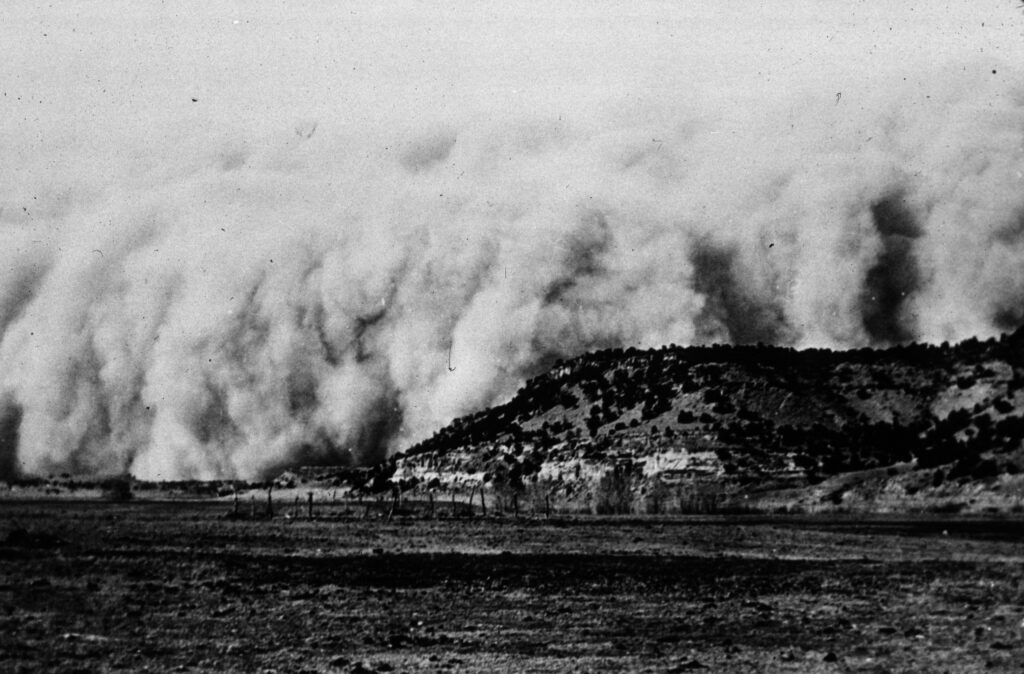
Beginning in 1934, states in the Great Plains were hit with severe drought, causing soil erosion and creating a series of massive dust storms. Combined with the financial crisis of the Great Depression, the Dust Bowl uprooted thousands of small farmers, many of whom headed west in search of a better life.
- 1907: Caroline Henderson and her husband began homesteading in Oklahoma’s panhandle, a region known as “No Man’s Land.”
- 1931: Henderson’s first article about farming life appears in The Atlantic Monthly; she would continue publishing there for years.
- 1934: A severe drought grips the Plains, and the first of many “black blizzards” strips topsoil and buries farms.
- 1935: Henderson writes her famous letter of June 30, describing the dust-covered desolation. Dorothea Lange, hired by the State of California, begins documenting Dust Bowl refugees.
- 1936: In May, Secretary of Agriculture Henry A. Wallace writes to Henderson, praising her contributions to American “understanding of some of our farm problems.”
- 1938: Lange and her husband Paul Taylor begin work on An American Exodus, a book combining her photographs with direct quotes from migrants.
These events formed a national crisis. The Farm Security Administration (FSA), a New Deal agency, was formed to provide relief to migrant refugees, and Lange worked for it for several years, producing some of her best-known images.
How It Was Seen at the Time
Contemporaries understood the Dust Bowl as a battle against nature itself. Henderson’s letters are filled with language of endurance and struggle. In her June 30, 1935 letter, she wrote: “Your continued interest in our effort to ‘tie a knot in the end of the rope and hang on’ is most stimulating.” Her description of the transition from green Kansas to “dust-covered desolation” was a common refrain.
“We wore our shade hats, with handkerchiefs tied over our faces and Vaseline…” — Caroline Henderson, June 30, 1935, letter to Evelyn, published in The Atlantic Monthly, May 1936.
Photographer Dorothea Lange recorded the words of the people she met. At a gas station, a family told her, “We’ve been blown out.” That phrase captured the sense of helplessness and displacement. The prevailing mood was one of grim endurance—people believed they could “hang on” but also feared they might be forced out.
Letters & Diaries
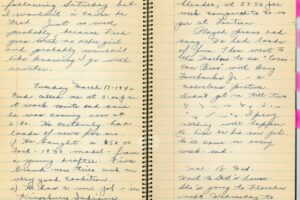
The most significant personal correspondence from the Dust Bowl is that of Caroline Henderson. A Mount Holyoke graduate, she moved to Oklahoma’s panhandle in 1907 to homestead and teach. Her articles and letters, published from 1908 to 1966, offer an intimate portrait of a woman’s life in the Great Plains. Her writing, as noted by editor Alvin O. Turner, “mirrors her love of the land and the literature that sustained her as she struggled for survival.”
In her 1935 letter, Henderson detailed the physical experience of the dust storms: “Our recent transition from rain-soaked eastern Kansas with its green pastures, luxuriant foliage, abundance of flowers, and promise of a generous harvest, to the dust-covered desolation of No Man’s Land was a difficult change to crowd into one short day’s travel.” She also noted that her daughter Eleanor had “laid aside the medical books for a time” to help with the farm work.
These letters were not just personal; they were political. In May 1936, Secretary of Agriculture Henry A. Wallace wrote to Henderson to praise her contributions to American “understanding of some of our farm problems.” Her articles in The Atlantic Monthly had aroused national attention, and they remain frequently cited for their vivid descriptions of the dust storms.
Eyewitness Accounts
While Henderson wrote from the heart of the storm, Dorothea Lange captured the visual and spoken testimony of refugees. In her field notes, she recorded the words of the people she photographed. One of the most famous exchanges occurred when she stopped at a gas station:
“I stopped at a gas station to get some gas, and there was a car full of people, a family there. . . They said, ‘We’ve been blown out.’ . . . They told me about the dust storm.”
This brief account, collected in the Dorothea Lange Digital Archive, shows the human dimension of the disaster. Lange and her husband Paul Taylor, a social scientist from UC Berkeley, were hired by the State of California to document the plight of Dust Bowl refugees. They traveled together with camera and notebook, collecting direct quotes from migrants that would later form the basis of An American Exodus.
Historical Snapshot
| Aspect | Detail |
|---|---|
| Date | 1931–1939 (peak: 1934–1936) |
| Place | Great Plains, especially Oklahoma panhandle (“No Man’s Land”) and California |
| People | Caroline Henderson, Dorothea Lange, Paul Taylor, Secretary Henry A. Wallace, thousands of farmers |
| What Happened | Severe drought and dust storms destroyed crops and homes; thousands migrated west |
| Why It Mattered | It became a national crisis, leading to New Deal programs like the FSA and a new genre of documentary photography |
What People Feared
At the time, the fear was not only of immediate death or injury from the dust, but of a complete breakdown of rural life. Henderson’s letters show a woman worried about her family’s survival, but also about the land itself. She wrote of the “dust-covered desolation” and the sense that the land was being lost. The fear of being “blown out”—the phrase used by the family Lange met—was a real threat. Many feared that the Plains would become uninhabitable.
There was also a fear of the future. With the Great Depression already causing widespread unemployment, the Dust Bowl threatened to create a new class of homeless wanderers. Lange’s photographs of refugees in California were taken to document this threat and to prompt government relief.
What People Expected Would Happen Next
In the mid-1930s, many believed the drought was temporary. Henderson’s letter of June 30, 1935, expressed hope that the family could “tie a knot in the end of the rope and hang on.” She and others expected that the rain would return and the land would recover. However, the storms continued, and by 1938, Lange and Taylor were documenting an ongoing exodus. Some expected the migration to California to continue indefinitely, while others hoped for federal intervention. The creation of the FSA in 1935 showed that the government expected to provide long-term relief.
Contemporary Terminology
The language of the time was vivid and often regional. Key terms included:
- Dust Bowl: The term coined to describe the region affected by dust storms; first used by journalist Robert Geiger in 1935.
- No Man’s Land: The name for the Oklahoma panhandle, reflecting its isolation and harshness.
- Dust storm: A wall of dust that could be hundreds of miles long.
- Blown out: A phrase used by migrants to describe being forced off their land by dust and drought.
- Exodus: Used by Lange and Taylor to describe the mass migration, echoing the biblical story.
Some terms, like “dust pneumonia,” were used by doctors to describe the respiratory effects of inhaling the fine soil. These words were part of a new vocabulary that emerged from the crisis.
Aftermath
The immediate aftermath of the Dust Bowl was the migration of thousands of families to California, where they often found only low-wage agricultural work. The FSA provided some relief, but the crisis only fully eased when the drought ended in the early 1940s and the United States entered World War II, which created new jobs. Lange and Taylor’s book An American Exodus was published in 1939 (though sources say late 1930s), but it was largely overlooked at the time due to the war. Its later reputation has grown, and it now stands as an iconic record of the era.
How Historians See It Today
Contemporary observers saw the Dust Bowl as a natural disaster compounded by the Great Depression. They focused on immediate relief and the human suffering. Today, historians view the Dust Bowl as a man-made ecological disaster, caused by decades of overgrazing and plowing of the Plains. The primary sources—Henderson’s letters and Lange’s photographs—are now recognized as essential documents that humanized the crisis. Turner’s 2003 edition of Henderson’s letters, Letters from the Dust Bowl, shows how her writings were ahead of their time in linking environmental and human concerns. Modern scholarship also emphasizes the role of government intervention and the creation of a new visual language of documentary photography.
Common Misconceptions
Myth: The Dust Bowl was only caused by drought.
The drought triggered it, but the real cause was the destruction of native grasses by decades of plowing and overgrazing.
Myth: All Dust Bowl farmers were uneducated and poor.
Caroline Henderson was a Mount Holyoke graduate and her letters show a highly literate, reflective voice.
Myth: The migrants were welcomed in California.
Many were met with hostility and discrimination, as documented by Lange and Taylor.
Related Primary Sources
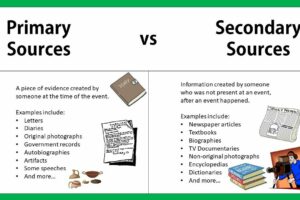
- Caroline Henderson’s letters and articles, collected in Letters from the Dust Bowl, edited by Alvin O. Turner (University of Oklahoma Press).
- Dorothea Lange’s photographs and field notes in the Dorothea Lange Digital Archive at the Oakland Museum of California.
- The Farm Security Administration (FSA) photographic archive at the Library of Congress.
- An American Exodus: A Record of Human Erosion by Dorothea Lange and Paul Taylor (1939).
FAQ
Who was Caroline Henderson?
Caroline Henderson was a Mount Holyoke graduate who homesteaded in Oklahoma's panhandle in 1907. She wrote letters and articles for The Atlantic Monthly from 1931 onward, describing the Dust Bowl conditions. Her writings were praised by Secretary of Agriculture Henry Wallace in 1936 and are now collected in 'Letters from the Dust Bowl.'
How did Dorothea Lange document the Dust Bowl?
Dorothea Lange, with her husband Paul Taylor, was hired by the State of California to document Dust Bowl refugees. She took photographs and recorded direct quotes from migrants, later published in 'An American Exodus' (1939). Her work for the FSA produced some of the most iconic images of the era.

Leave a Reply