
Short Answer
On April 30, 1975, Saigon fell to North Vietnamese forces, ending a war that had torn Vietnam apart for decades. In the final hours, thousands of South Vietnamese civilians and military personnel scrambled to escape, as the United States launched Operation Frequent Wind—the largest helicopter evacuation in history. Among those who fled was Khanh Van Thi Nguyen, a young woman who later typed a vivid account of her escape to the USS Midway. Her story, along with the memoir of a soldier who returned to his family and the diary of a man who fled by boat years later, offers a deeply personal window into a moment of national collapse and personal survival. These diaries and memoirs are not just records of events; they are raw testimonies of fear, hope, and the will to live.
What Happened?
The fall of Saigon on April 30, 1975, marked the end of the Vietnam War. In the days leading up to the capture, the U.S. military executed Operation Frequent Wind, a helicopter airlift that evacuated thousands of American personnel and South Vietnamese civilians from the city. According to the memoir of Trần Đình Trụ, more than 120,000 Indochinese refugees were eventually resettled in the United States after the fall. The evacuation was chaotic; families were separated, and many were left behind.
After the initial evacuation, the refugee crisis continued. At least 800,000 Vietnamese fled by boat over the following years, according to the U.S. Committee for Refugees and Immigrants. They took to the South China Sea in rickety boats, often with meager rations, hoping to reach safety. The sea became a graveyard—an unknown number of refugees drowned, were attacked by pirates, or were denied rescue by passing ships. Some, like Nguyễn Văn Đoàn, who fled in 1981, were imprisoned after being attacked by pirates. Others, like Trần Đình Trụ, made the fateful decision to return to Vietnam to be with their families, only to be imprisoned in reeducation camps.
The fall of Saigon was not a single moment but the beginning of a long, painful exodus. The primary sources—diaries, memoirs, and essays—offer a ground-level view of these events, revealing the personal costs of a geopolitical upheaval.
How It Was Seen at the Time
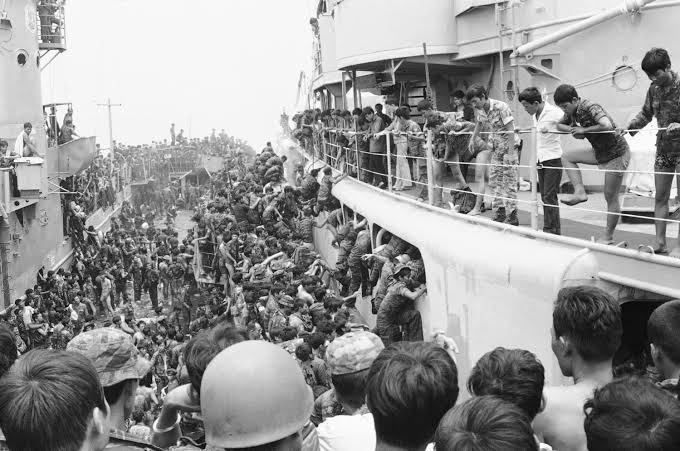
For those who lived through the fall of Saigon, the experience was one of chaos, fear, and uncertainty. In her typed essay, Khanh Van Thi Nguyen described the frantic evacuation to the USS Midway, the overwhelming noise of helicopters, and the desperate crowds. She later wrote of the relief of reaching the ship, but also the sorrow of leaving behind her homeland.
Trần Đình Trụ’s memoir, Ship of Fate, captures the dilemma of a South Vietnamese military officer who had evacuated but decided to return to Vietnam for his wife and children. His account is filled with the tension between duty to family and fear of the new regime. He wrote about the agonizing decision, the uncertainty of the future, and the eventual imprisonment in a reeducation camp.
Nguyễn Văn Đoàn’s diary, written while he was imprisoned in Thailand in 1981, describes the terror of his escape attempt. He fled Vietnam by boat with about 100 people. During the voyage, they were attacked twice by Thai pirates. The first attack resulted in the abduction of a girl; the second time they fought back, killing several pirates. As a result, he and 18 others were arrested and imprisoned for almost a year. His diary is a raw account of fear, violence, and the struggle to survive.
These personal records show that the fall of Saigon was not a simple military event. It was a human catastrophe, experienced by individuals who faced impossible choices and unimaginable dangers. The prevailing mood was one of fear, uncertainty, and a fragile hope for a better future.
Letters & Diaries
The three primary sources that anchor this article are a diary, a memoir, and an essay. Each offers a unique perspective on the fall of Saigon and its aftermath.
- Khanh Van Thi Nguyen’s narrative (circa 2009) is a typed essay, originally written in Vietnamese and translated into English, describing her experience during the fall of Saigon and her evacuation to the USS Midway as part of Operation Frequent Wind. It includes images and is preserved at the University of California, Irvine Libraries (source [1]).
- Trần Đình Trụ’s memoir Ship of Fate (written after 1991) – This memoir tells the story of a Vietnamese military officer who evacuated to the United States but made the dramatic decision to return to Vietnam for his wife and children. It details his trauma as a refugee in limbo, and then as a prisoner in Vietnamese reeducation camps (source [2]).
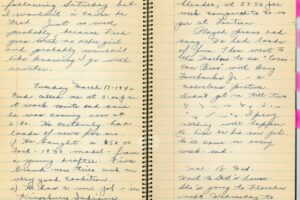
- Nguyễn Văn Đoàn’s diary (1981–1982) – A small journal with a pink paper cover decorated with flowers and a white bunny, used by a Vietnamese refugee during his year in a Thai prison. It describes his escape from Vietnam, two pirate attacks, and the subsequent months of captivity (source [3]).
These documents are not official histories but personal records. They capture the raw emotions, the daily struggles, and the resilience of ordinary people caught up in extraordinary events.
Different Perspectives
The fall of Saigon affected different people in different ways. The three primary sources illustrate three distinct experiences.
Those Who Evacuated
Khanh Van Thi Nguyen’s story represents the experience of the thousands of South Vietnamese who were evacuated by American forces. Her account of the airlift to the USS Midway reflects the relief of being rescued, but also the sorrow of leaving a homeland. She was part of the more than 120,000 Indochinese refugees who eventually resettled in the United States (source [2]).
Those Who Returned
Trần Đình Trụ’s memoir represents the dilemma of those who had to choose between staying in the U.S. and returning to their families. His decision to return to Vietnam, despite the danger, shows the power of family ties. He was eventually imprisoned in a reeducation camp, a fate shared by many South Vietnamese soldiers and officials (source [2]).
Those Who Fled by Boat
Nguyễn Văn Đoàn’s diary represents the later wave of “boat people” who fled Vietnam by sea. His escape in 1981, six years after the fall, shows that the refugee crisis did not end in 1975. His experience with pirates and imprisonment in Thailand highlights the dangers of the sea and the desperation of those who risked everything to escape (source [3]).
What People Feared
The primary sources reveal a catalogue of fears that gripped Vietnamese refugees.
- Reeducation camps: Trần Đình Trụ’s memoir describes his imprisonment in Vietnamese reeducation camps, a fear that haunted many South Vietnamese military personnel and officials. He wrote about the trauma of being imprisoned after returning to Vietnam (source [2]).
- Piracy and violence at sea: Nguyễn Văn Đoàn’s diary recounts two pirate attacks during his boat escape. The first attack led to the abduction of a girl; the second resulted in a violent confrontation. The fear of pirates was widespread among boat people (source [3]).
- Drowning and death: The South China Sea became a “necropolis,” according to the U.S. Committee for Refugees and Immigrants, with an unknown number of refugees drowning or being killed (source [4]).
- Separation from family: The chaos of the evacuation and the exodus separated families. Trần Đình Trụ’s decision to return was motivated by the fear of losing his family forever (source [2]).
These fears were not unfounded. The sources document the realities of reeducation camps, piracy, and death at sea.
Aftermath
The fall of Saigon did not end the suffering. For those who were evacuated, the immediate aftermath was a life in refugee camps, such as the Guam camps, before resettlement in the United States. For those who returned, like Trần Đình Trụ, the aftermath was imprisonment and years of struggle. For those who fled by boat, like Nguyễn Văn Đoàn, the aftermath was prison in Thailand or other Southeast Asian countries. The refugee crisis continued for years, with many Vietnamese people seeking safety in the U.S., Australia, France, and other countries. The personal accounts in these diaries and memoirs provide a human face to the statistics of the refugee crisis.
Historical Snapshot
| Aspect | Detail |
|---|---|
| Date | April 30, 1975 (Fall of Saigon) |
| Place | Saigon, South Vietnam; later the South China Sea and refugee camps |
| People | South Vietnamese civilians, military personnel, and their families |
| What Happened | Saigon fell to North Vietnamese forces; Operation Frequent Wind evacuated thousands; subsequent boat exodus |
| Why It Mattered | The fall ended the Vietnam War and triggered a massive refugee crisis, with over 120,000 resettled in the U.S. and hundreds of thousands more fleeing by boat |
Related Primary Sources
- Khanh Van Thi Nguyen narrative on Operation Frequent Wind – MS-SEA044, Special Collections and Archives, The UC Irvine Libraries. (Source: https://oac.cdlib.org/findaid/ark:/13030/c86m35tj)
- Ship of Fate: Memoir of a Vietnamese Repatriate – Published by University of Hawai’i Press. (Source: https://muse.jhu.edu/book/52572/)
- Diary of Nguyễn Văn Đoàn – Refugee Material Culture Initiative, UCLA. (Source: https://dal.ucla.edu/rmci/node/479)
These primary sources are essential for understanding the human experience of the fall of Saigon. They remind us that history is not just a series of events, but the lived experiences of individuals who faced impossible choices and endured unimaginable hardships.
FAQ
What was Operation Frequent Wind?
Operation Frequent Wind was the U.S. military's helicopter evacuation of Saigon from April 29–30, 1975. It airlifted thousands of U.S. personnel and South Vietnamese civilians from the city to ships, including the USS Midway. It was the largest helicopter evacuation in history and became a symbol of the American withdrawal from Vietnam.
How many Vietnamese refugees fled by boat after 1975?
According to the U.S. Committee for Refugees and Immigrants, at least 800,000 Vietnamese people fled by boat in the years after the fall of Saigon. Many faced piracy, drowning, and denial of rescue, and the South China Sea became a graveyard for many.





Leave a Reply