
Short Answer
On the morning of August 16, 1858, a message that had taken weeks to prepare was finally transmitted across the Atlantic Ocean. Queen Victoria of Great Britain sent a telegram to President James Buchanan of the United States, and it arrived in just 16 hours. For centuries, the Atlantic had been a barrier that took ten days to cross by ship; now it had been shrunk to a single day by a thin copper wire lying on the ocean floor. The achievement was the talk of the age—the Victorian equivalent of the Apollo mission—and it seemed to cheat time and space itself. Yet the cable would work for only a few weeks before falling silent. This is the story of that first transatlantic telegraph cable, told through the reports, letters, and records of the people who lived through it.
What Happened?
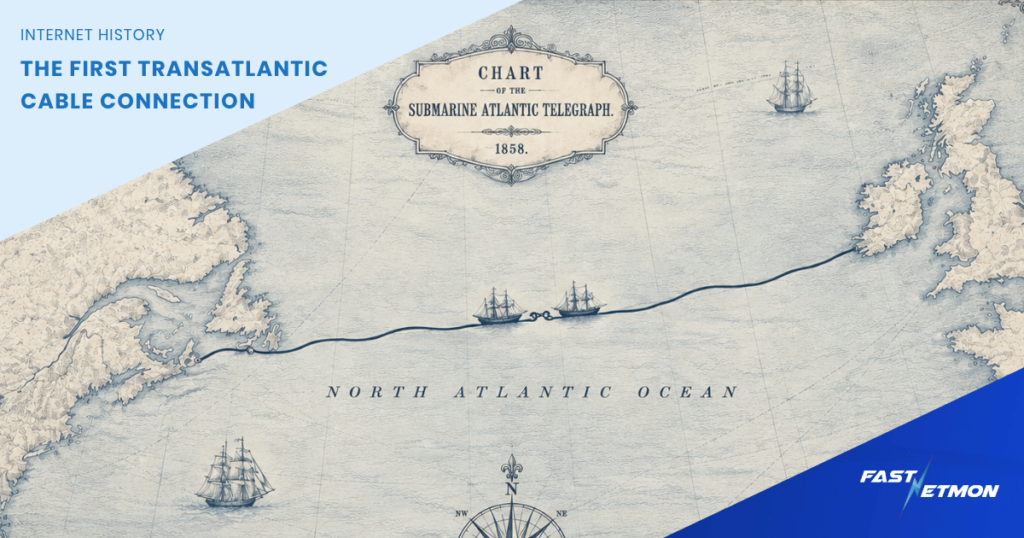
By the early 1850s, telegraph networks had already connected most population centres on both sides of the Atlantic, including a cable beneath the English Channel that linked British and French networks. The next logical step was to bridge the ocean itself. In 1856, an American businessman named Cyrus Field, along with Englishmen John Watkins Brett and Charles Tilson Bright, formed the Atlantic Telegraph Company to undertake the boldest project of the age: laying a cable from Ireland to Newfoundland, a distance of roughly 2,500 nautical miles.
The first attempt came in July 1857. No single ship could carry the entire cable, so the British and American navies each provided one vessel. The American ship Niagara, built in 1845, was the largest in the U.S. Navy, weighing 5,200 tons and capable of 12 knots. The British provided the wooden battleship H.M.S. Agamemnon. The expedition was fraught with bad luck. The cable broke repeatedly, and the ships were forced to return to port with the line lost. But each failure taught the engineers something new.
In the summer of 1858, a second attempt was made. On August 16, the cable was successfully laid, and the first telegraphic message crossed the ocean—Queen Victoria’s congratulatory note to President Buchanan. The message took 16 hours to transmit, a stunning achievement. Yet the cable’s success was short-lived. It worked for only a few weeks before the electrical signal faded and finally died. The dream of a permanent Atlantic telegraph would have to wait, but the first proof had been delivered: the ocean could be bridged.
How It Was Seen at the Time
Contemporaries understood the transatlantic cable as an almost magical feat, a victory of human ingenuity over the natural barriers of distance and ocean. The idea that one could seemingly cheat time and space was to inspire all sorts of people—from businessmen to artists, as noted in a London exhibition exploring the project. The cable was described as the Victorian equivalent of the Apollo mission, a national and international triumph.
“The idea that one could seemingly cheat time and space was to inspire all sorts of people – from businessmen to artists.”
The mood was one of awe and pride. Newspapers celebrated the event as the dawn of a new era of global communication. The fact that the cable failed after a few weeks did not diminish the sense that the impossible had been achieved, if only temporarily. The project was seen as a testament to human perseverance, with each attempt built on the lessons of previous failures.
Historical Snapshot
| Aspect | Detail |
|---|---|
| Date | August 16, 1858 (first successful message); first attempt July 1856 |
| Place | Across the Atlantic Ocean, from Ireland to Newfoundland (and then to New York) |
| People | Cyrus Field, John Watkins Brett, Charles Tilson Bright, Queen Victoria, President James Buchanan |
| What Happened | The first telegraph cable was laid, and a message was sent from Queen Victoria to President Buchanan in 16 hours |
| Why It Mattered | It reduced transatlantic communication from days to hours, paving the way for the global telegraph network |
Timeline
- 1850 – A submarine telegraph cable is laid across the English Channel, linking Britain and France.
- 1856 – Cyrus Field and partners form the Atlantic Telegraph Company to lay a cable across the Atlantic.
- July 1856 – First attempt to lay the cable begins; it ends in failure due to breakage.
- July 1858 – Second attempt begins; the cable is successfully laid.
- August 16, 1858 – Queen Victoria’s message to President Buchanan is transmitted, taking 16 hours.
- October 1858 – The cable fails after a few weeks of service.
What People Expected Would Happen Next
At the moment of the first successful transmission, contemporaries expected the transatlantic cable to become a permanent and reliable channel of communication. They imagined a world in which governments, merchants, and ordinary citizens could exchange messages in minutes rather than days, and they anticipated a dramatic acceleration of commerce and diplomacy. The failure of the cable after a few weeks was a bitter disappointment, but it did not extinguish the dream. Many believed that the lessons learned from the 1858 attempt would lead to a more durable cable, and indeed, the project was revived in the 1860s, culminating in a permanent cable laid in 1866.
Aftermath
The 1858 cable ceased to function within a few weeks, and the signal faded entirely. The failure was a financial and reputational blow to Cyrus Field and his investors, but it also provided crucial technical knowledge. The insulation, the electrical power, and the cable-laying techniques were all improved in subsequent years. In 1866, a new cable was laid that worked permanently, and the first reliable transatlantic telegraph link was finally established. The 1858 attempt, though a short-lived triumph, had proved the concept and laid the groundwork for the global communication network that followed.
How Historians See It Today
Modern historians view the first transatlantic cable as a landmark in the history of technology, not only for its immediate effect but for its long-term significance. The Science Museum notes that today we still rely on submarine cables for global communication, including the fiber-optic cables that carry the Internet. The 1858 project is often cited as an example of Victorian perseverance, a demonstration that even the most daunting engineering challenges could be overcome. Historians also emphasize that the cable’s failure was as important as its success, because the lessons learned from the failure were essential to the eventual permanent connection. The project is now seen as a turning point in the history of globalization, marking the moment when the world began to shrink in terms of communication.
The first transatlantic cable was more than a technical feat; it was a testament to the human desire to connect. The primary sources of the era—letters, newspapers, and the reports of the engineers—capture the excitement and the determination of the people who believed that a wire across the ocean was possible. Their perseverance, despite repeated failures, laid the foundation for the interconnected world we live in today. The story of the cable is a reminder that progress is often born from failure, and that the most ambitious dreams can be achieved through patience and persistence.
FAQ
How long did the first transatlantic cable work?
The first successful cable, laid in 1858, worked for only a few weeks before the signal failed. The cable was the first to send a message across the Atlantic, but the electrical insulation and transmission were not yet reliable enough to last.
Who was Cyrus Field?
Cyrus Field was an American businessman who was the driving force behind the first transatlantic telegraph cable. He formed the Atlantic Telegraph Company in 1856 with British partners and led the efforts to lay the cable, persevering through multiple failures until the 1866 cable was successful.













Leave a Reply