
Short Answer
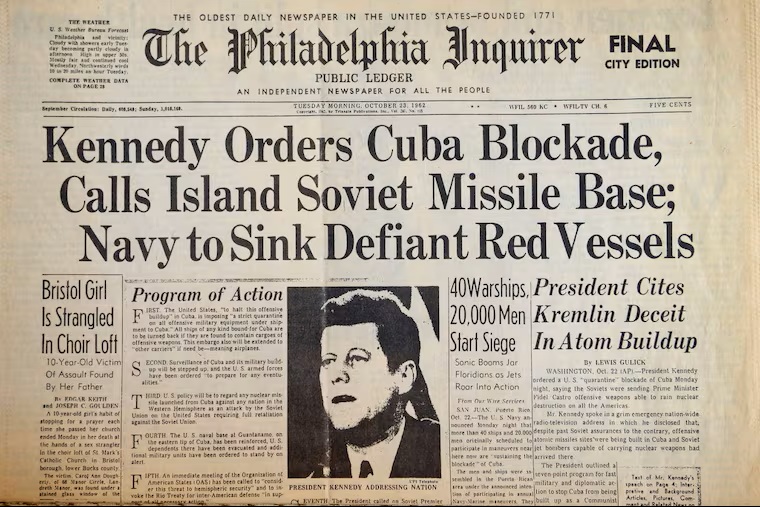
On the morning of October 23, 1962, Americans opened their newspapers to find a world on the edge of annihilation. The previous evening, President John F. Kennedy had delivered an 18-minute televised address revealing that U.S. intelligence had discovered Soviet offensive missile sites in Cuba, and he announced a naval blockade to stop further shipments. The New York Times declared: “A critical moment in the cold war was at hand tonight.” Across the country, front pages from the Oakland Tribune to the Gettysburg Times carried the same story of a superpower confrontation that could plunge the planet into thermonuclear war. For the next thirteen days, newspapers were the lifeline of a public struggling to understand what was happening—and what might come next. This article reconstructs that experience through the pages of the press, showing what people knew, feared, and expected as the world held its breath.
What Happened?
The Cuban Missile Crisis unfolded over thirteen tense days in October 1962, triggered by the discovery of Soviet nuclear-armed missiles on the island of Cuba. The crisis became public on the evening of October 22, when President Kennedy addressed the nation on television and announced a naval quarantine of Cuba to prevent further Soviet shipments of offensive weapons. The following morning, the New York Times headlined: “U.S. Imposes Arms Blockade on Cuba on Finding Offensive Missile Sites; Kennedy Ready for Soviet Showdown.” (source: [2])
The key events, as reported in contemporary newspapers, include:
- October 22: Kennedy’s address; the Oakland Tribune and other papers print the first front-page stories.
- October 23: The New York Times declares a “critical moment in the cold war.” The Organization of American States backs the quarantine.
- October 24: The New York Times reports “Soviet Challenges U.S. Right to Blockade; Interception of 25 Russian Ships Ordered; Cuba Quarantine Backed by United O.A.S.” Soviet ships are intercepted; some veer from the quarantine line.
- October 25: Khrushchev suggests a summit meeting; U.N. Secretary-General U Thant urges both sides to pause.
- October 28: Khrushchev agrees to remove the missiles, and the crisis resolves.
The crisis was a direct confrontation between the United States and the Soviet Union, with the world watching the front pages for any sign of escalation.
How It Was Seen at the Time
Newspapers during the crisis captured the prevailing mood of dread and uncertainty. The New York Times editorialized on October 23: “A critical moment in the cold war was at hand tonight. The President had decided on a direct confrontation with–and challenge to–the power of the Soviet Union.” (source: [2]) The language was stark, emphasizing the imminent threat of nuclear war. Front pages around the world tracked the standoff with headlines that shifted daily from the announcement of the naval blockade to the brink of war and, finally, to a diplomatic resolution (source: [3]). The tone was one of a national crisis, with newspapers acting as the primary conduit for official statements and public anxiety.
Contemporary Newspaper Coverage
The press played a critical role in shaping public understanding of the crisis. The New York Times archive shows a series of major stories accompanying the headlines. On October 23, the paper reported the blockade and Kennedy’s readiness for a Soviet showdown. On October 24, it covered the Soviet challenge and the interception of Russian ships. The Oakland Tribune and other regional papers from across the country—including the Gettysburg Times, Brownsville Herald, and Arizona Daily Sun—published front-page articles each day from October 22 to October 29 (source: [1]). The coverage was not uniform; Soviet newspapers told a vastly different story, denying the existence of offensive missiles and accusing the United States of aggression (source: [3]). The Kennedy administration worked behind the scenes to shape the narrative, but the immediate impact was a public that relied on these headlines for every piece of news.
“U.S. Imposes Arms Blockade on Cuba on Finding Offensive Missile Sites; Kennedy Ready for Soviet Showdown.” — New York Times, October 23, 1962 (source: [2])
What People Knew at the Time
| What People Knew Then | What We Know Now |
|---|---|
| Americans knew that Soviet missiles were being installed in Cuba and that a naval quarantine was in place. They knew the U.S. was demanding their removal. | We know that the missiles were already operational and that the U.S. had a secret deal with the Soviet Union to remove U.S. Jupiter missiles from Turkey in exchange for the withdrawal of Soviet missiles from Cuba. |
| The public was unaware of the secret negotiations and the full extent of the nuclear threat. | Historians now know that the world came closer to nuclear war than previously believed, with some commanders recommending immediate strikes. |
What People Feared
Contemporary newspapers and letters reveal a public gripped by the fear of nuclear war. The New York Times on October 24 described Moscow’s announcement that the Soviet bloc was taking “suitable measures to enhance their combat readiness,” a direct threat of thermonuclear war (source: [2]). People feared that the Soviet ships would not turn back, that the blockade would lead to a shooting war, and that the conflict would escalate to a full-scale nuclear exchange. Civil defense drills and fallout shelter construction were common. The fear was rational, given the immediate possibility of a military clash between the two superpowers.
What People Expected Would Happen Next
Many contemporary observers expected a prolonged standoff or even war. The New York Times on October 23 noted that the President had decided on a “direct confrontation,” implying that the U.S. was prepared for a showdown. Some newspapers speculated that the crisis could lead to a nuclear exchange, while others hoped for a diplomatic resolution. Khrushchev’s suggestion of a summit meeting on October 25 was seen as a potential path to de-escalation, but the outcome remained uncertain until the final days. The public expected that the quarantine would continue and that negotiations would be tense, but few anticipated the sudden resolution on October 28.
Timeline
- October 22: President Kennedy addresses the nation, announces the discovery of Soviet missiles in Cuba and a naval quarantine.
- October 23: The U.S. imposes the blockade; the Organization of American States unanimously supports the quarantine.
- October 24: Soviet ships approach the quarantine line; some turn back. The Soviet Union challenges the U.S. right to blockade.
- October 25: Khrushchev suggests a summit; U Thant proposes a two-week standstill.
- October 27: A U-2 spy plane is shot down over Cuba; the crisis reaches its peak.
- October 28: Khrushchev announces that Soviet missiles will be removed from Cuba.
- October 29: The crisis begins to de-escalate; newspapers report the resolution.
How Historians See It Today
Modern historians view the Cuban Missile Crisis as the closest the world has ever come to nuclear war. While contemporary newspapers portrayed the crisis as a direct confrontation between the U.S. and the Soviet Union, later scholarship has revealed the critical role of back-channel negotiations and the secret agreement to remove U.S. missiles from Turkey. The newspapers of the time, constrained by official secrecy and the pressure of national security, did not fully capture the complexity of the crisis. Historians now emphasize the importance of the thirteen-day period in shaping nuclear arms control policies and the subsequent détente between the superpowers.
The primary sources—newspapers, official statements, and personal accounts—reveal a public that was simultaneously informed and misled, fearful and hopeful. The thirteen days of fear left an enduring legacy in American memory, a reminder of the fragility of the nuclear peace.
FAQ
How did newspapers report the Cuban Missile Crisis in October 1962?
Newspapers in the U.S. published front-page headlines daily, starting with Kennedy's address on October 22. The New York Times provided detailed coverage, including the blockade announcement and Soviet challenges. Soviet newspapers denied the existence of offensive missiles and framed the crisis as U.S. aggression.
What did Americans fear during the 13 days?
Americans feared an imminent nuclear war, especially as Soviet ships approached the quarantine line and a U-2 plane was shot down. Many prepared for nuclear attack, and the press reflected this anxiety with stories about military readiness and diplomatic tensions.












Leave a Reply