
Short Answer
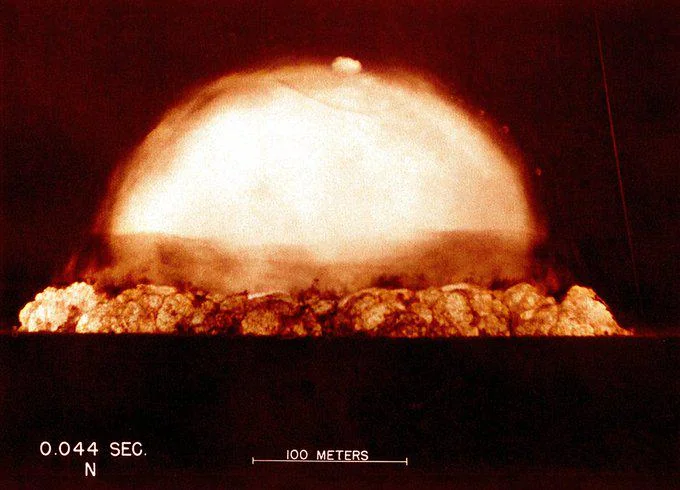
At 5:30 AM on July 16, 1945, the desert floor of the Jornada del Muerto in New Mexico was split by a light brighter than the sun. The first atomic device, code-named “Trinity,” had been detonated. Scientists and military personnel stationed at the base camp ten miles away had braced for something unprecedented, yet the actual event defied expectation. Enrico Fermi, the Nobel Prize-winning physicist, stood behind a board fitted with dark welding glass. Later he wrote: “My first impression of the explosion was the very intense flash of light, and a sensation of heat on the parts of my body that were exposed. Although I did not look directly towards the object, I had the impression that suddenly the countryside became brighter than in full daylight.” In that instant, the atomic age began.
What Happened?
The Trinity test was the culmination of the Manhattan Project, the top-secret Allied effort to develop an atomic weapon. The device, a plutonium implosion bomb, was assembled at a remote site in the New Mexico desert, about 210 miles south of Los Alamos. The test was scheduled for the early morning hours of July 16, 1945, with the detonation occurring at approximately 5:30 AM.
- 5:30 AM: The device exploded with a force equivalent to about 20,000 tons of TNT (though exact figures were not immediately known). The flash was visible for over 200 miles.
- Observers at the Base Camp: Enrico Fermi was stationed ten miles from the site. He reported an intense flash, a sensation of heat, and a pillar of smoke that rose to about 30,000 feet.
- Observers in the Air: Luis Alvarez, a physicist, witnessed the explosion from a B-29 aircraft flying at 24,000 feet above the site. He made sketches of the developing mushroom cloud, which he later included in his report.
- Mushroom Cloud: The fireball quickly transformed into a rising column of smoke with an expanded head, resembling a giant mushroom. Fermi described it as “a huge pillar of smoke with an expanded head like a gigantic mushroom that rose rapidly beyond the clouds.”
- Shock Wave: The shock wave was felt and heard at the base camp, and the pilot of Alvarez’s aircraft reported seeing the wave ripple across the desert.
How It Was Seen at the Time
For the scientists and soldiers present, the Trinity test was not just a technical exercise—it was a moment of profound and often ambiguous awe. The language they used to describe the event mixed scientific precision with religious and apocalyptic imagery. Fermi’s account captures the sensory overload: the flash, the heat, the pillar of smoke. He wrote:
“After a few seconds the rising flames lost their brightness and appeared as a huge pillar of smoke with an expanded head like a gigantic mushroom that rose rapidly beyond the clouds probably to a height of the order of 30,000 feet.”
The prevailing mood was one of intense relief and anxiety. The test had succeeded, but the implications were staggering. Many witnesses later recalled that they felt the ground shake and the heat on their faces even at ten miles. The event was described in the official report by Sir James Chadwick, the Nobel laureate who headed the British Mission to Los Alamos, as a “tremendous success” but also as something that would change the world forever.
Eyewitness Accounts
The most detailed personal accounts come from scientists who were present. Their reports, written within hours or days, offer a window into the immediate reactions of the participants.
Enrico Fermi
Fermi was stationed at the base camp, about ten miles from the detonation. In his report, “My Observations During the Explosion at Trinity on July 16, 1945,” he described the flash and the heat, and then the rising cloud. He also performed a simple experiment: he dropped pieces of paper and watched how far they were displaced by the shock wave, estimating the yield. His account is measured and scientific, yet the underlying emotion is evident in his description of the light.
“I subsequently looked in the direction of the explosion through the dark glass and could see something that looked like a conglomeration of flames that promptly started rising.”
Luis Alvarez
Alvarez observed the test from a B-29 flying at 24,000 feet. His typewritten account, now in the U.S. National Archives, includes two sketches of the mushroom cloud as it developed. He wrote about the detonation itself, the formation of the cloud, and the shock wave’s effect on the aircraft. His report is notable for its careful observation of the cloud’s evolution, which he noted as “a column of smoke with a flat head” that quickly transformed into a mushroom shape.
Sir James Chadwick
Chadwick, who was in Washington D.C. to coordinate nuclear policy, returned to New Mexico to witness the test. He sent an initial report to London on the same day, describing the explosion as “a very great success” and noting the enormous scale of the event. His report was unclassified and conveyed the immediate official assessment.
Official Reports
The immediate official records were composed by scientists and military leaders who needed to communicate the results to Washington and London. The most significant is the “Initial Report by Sir James Chadwick,” dated July 16, 1945, which was sent to the British government. Chadwick’s report confirmed the success of the test and the enormous power of the weapon. He wrote that the explosion was “a very great success” and that “the bomb went off with a force equivalent to about 20,000 tons of TNT.” This was one of the first official documents to state the yield. The report also noted the visual effects, including the mushroom cloud, and the fact that no one was injured.
Another official document is the Alvarez report, which was part of the records of the Office of Scientific Research and Development. It is an eyewitness account, but also an official record of the event. The report includes sketches of the mushroom cloud, which are valuable primary sources for understanding how the cloud developed.
What People Knew at the Time
| What People Knew Then | What We Know Now |
|---|---|
| The test was a success, and the bomb worked. | The bomb’s yield was about 20,000 tons of TNT, and it was the first of many nuclear weapons. |
| Observers knew the explosion was a new type of weapon, but they did not fully understand its long-term health and environmental effects. | We now know that the test released significant radioactive fallout, which affected nearby communities and the environment. |
| The immediate reports focused on the visual and physical effects, such as the flash, heat, and mushroom cloud. | Modern analysis includes the bomb’s role in the Cold War arms race and the ethical debates it sparked. |
Different Perspectives
From the Air: Luis Alvarez
Alvarez’s vantage point at 24,000 feet gave him a unique view of the explosion. He saw the entire cloud formation from above, and his sketches show a sequence of shapes. He reported that the pilot was startled by the brightness and that the shock wave was felt as a sudden jolt. The aerial perspective allowed for a more detached, scientific observation, but the scale was still overwhelming.
From the Ground: Enrico Fermi
Fermi’s ground-level view was closer to the explosion, but he was protected by dark glass. He felt the heat on his skin and described the sensation of the ground shaking. His account emphasizes the sensory overload and the sudden change in the environment. The ground perspective was more visceral, with the heat and the pressure wave being directly felt.
Aftermath
The immediate aftermath of the Trinity test was a mixture of celebration and sober reflection. The scientists at Los Alamos knew that the bomb would soon be used against Japan. The test had been successful, and the weapon was ready. The cloud lingered in the sky for hours, and the radioactive fallout spread over the desert. The official reports were sent to Washington and London, and within days the decision to use the bomb was confirmed. The test also had a profound psychological effect on the participants. Many later expressed regret or moral turmoil, though at the time the focus was on the technical success.
Timeline
- July 16, 1945, 5:30 AM: The Trinity device is detonated.
- 5:30 AM: Fermi and others at the base camp observe the flash and the rising cloud.
- 5:35 AM: Alvarez, flying at 24,000 feet, sketches the mushroom cloud.
- 6:00 AM: The cloud reaches an altitude of about 30,000 feet.
- July 16, 1945: Chadwick sends his initial report to London.
- July 26, 1945: The Potsdam Declaration is issued, and the bomb is later used on Hiroshima and Nagasaki.
The Trinity test was a turning point in history. The eyewitness accounts, preserved in official reports and personal recollections, show how the first atomic explosion was experienced by those who created it. Their words convey the awe and the gravity of the moment, a moment that would redefine war and diplomacy. The primary sources from July 16, 1945, remain a powerful reminder of the human dimension of scientific achievement.
FAQ
What did Enrico Fermi see during the Trinity test?
Fermi, stationed ten miles from the blast, reported an intense flash, a sensation of heat, and then a rising pillar of smoke that formed a mushroom cloud reaching about 30,000 feet. He used a dark glass to protect his eyes and later wrote about the event in his report.
Who witnessed the Trinity test from the air?
Physicist Luis Alvarez witnessed the test from a B-29 aircraft flying at 24,000 feet. He made sketches of the developing mushroom cloud and wrote a detailed account of the explosion and the shock wave.
What was the immediate official reaction to the Trinity test?
The test was reported as a success. Sir James Chadwick sent an initial report to London on the same day, stating that the bomb had been successfully detonated with a force of about 20,000 tons of TNT.


Leave a Reply