
Short Answer
A diary written during a revolution is a primary source.
A historian’s book analyzing that revolution is usually a secondary source.
That sounds simple—until you encounter a newspaper article, memoir, documentary, autobiography, photograph, scholarly article, or book written long ago.
Then the distinction becomes less obvious.
The most useful way to understand primary sources vs secondary sources is not to memorize a list of formats. Instead, think about the role a source plays in your research.
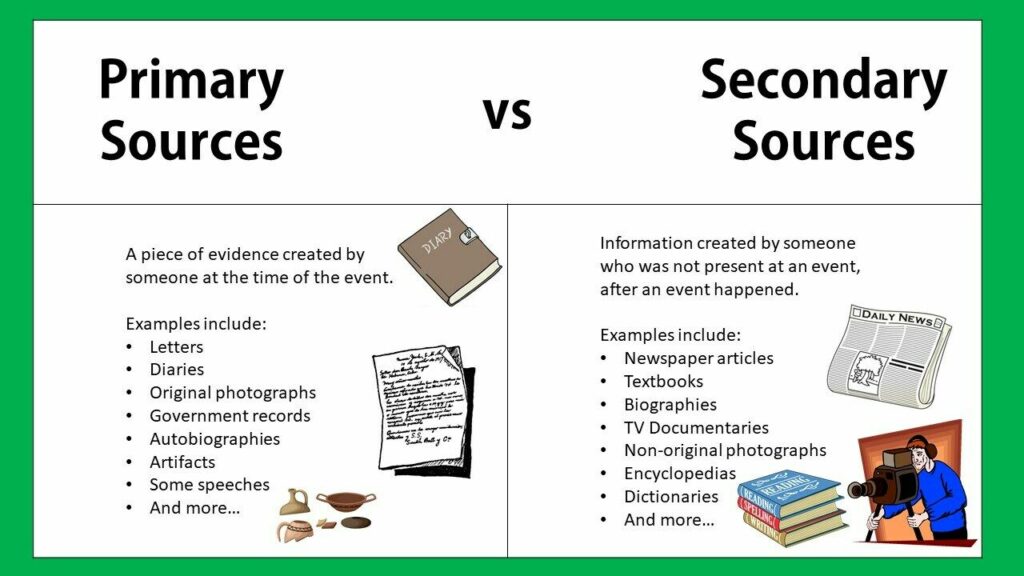
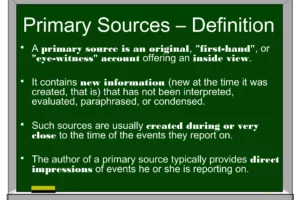
A primary source provides original or direct evidence relevant to the question you are investigating.
A secondary source analyzes, interprets, explains, evaluates, or synthesizes primary evidence and other scholarship.
The Library of Congress describes primary sources as the raw materials of history: original documents and objects connected to the period under study. Secondary sources, by contrast, retell, analyze, or interpret events.
But there is an important complication:
The same source can sometimes be primary for one research question and secondary for another.
Cornell University Library emphasizes that definitions depend on the discipline and the research context; classifying a source makes sense only in relation to what a researcher is investigating.
That principle is the key to understanding the difference.
Primary Sources vs Secondary Sources: Quick Answer
The simplest distinction is:
| Primary Sources | Secondary Sources |
|---|---|
| Provide original or direct evidence | Analyze or interpret evidence |
| Are closely connected to the subject being studied | Usually examine the subject afterward |
| May be created by participants, witnesses, institutions, or contemporary systems | Are usually created by researchers, historians, scholars, or commentators |
| Include letters, diaries, photographs, government records, artifacts, interviews, and original data | Include scholarly books, historical analyses, review articles, biographies, and many textbooks |
| Become evidence that researchers interpret | Help researchers understand and interpret evidence |
| May contain firsthand perspectives | Usually combine multiple sources into an interpretation |
A useful shorthand is:
Primary source = evidence
Secondary source = interpretation of evidence
That distinction is useful, but historical research becomes more interesting once we examine the exceptions.
What Is a Primary Source?
A primary source is original evidence that has a direct relationship to the subject or question being investigated.
The Library of Congress describes primary sources as firsthand records produced by participants or witnesses and notes that they may include documents, letters, diaries, recordings, statistical data, manuscripts, books, articles, and works of art.
For historical research, common primary sources include:
- letters,
- diaries,
- journals,
- photographs,
- maps,
- government documents,
- census records,
- court records,
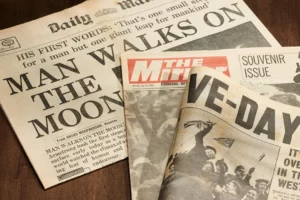
- newspapers from the period,
- speeches,
- political posters,
- advertisements,
- oral histories,
- interviews,
- memoirs,
- military records,
- business ledgers,
- meeting minutes,
- artifacts,
- buildings,
- audio recordings,
- films,
- statistical records.
The National Archives similarly works with primary materials ranging from written documents and photographs to maps, posters, artifacts, sound recordings, and videos.
The important feature is not that the source is old.
It is that the source provides evidence directly relevant to your research question.
What Is a Secondary Source?
A secondary source interprets, analyzes, evaluates, or synthesizes information from primary sources and often from other secondary scholarship.
The Library of Congress characterizes secondary sources as accounts that retell, analyze, or interpret events, commonly from some distance in time or place.
Typical secondary sources in historical research include:
- scholarly history books,
- academic journal articles analyzing historical events,
- biographies written by later researchers,
- historical documentaries,
- literature reviews,
- interpretive essays,
- many textbooks,
- historiographical studies.
Suppose a historian studies hundreds of Civil War letters, military records, newspapers, photographs, and government documents and then publishes a book explaining why a particular campaign failed.
The letters and records are primary sources for that investigation.
The historian’s book is a secondary source.
The book does not merely reproduce evidence. It selects, organizes, compares, contextualizes, and interprets that evidence.
The Fundamental Difference: Evidence vs Interpretation
Consider a simple example.
Imagine a letter written in 1918:
Food is becoming increasingly difficult to find, and people wait for hours outside the shops.
For a historian studying civilian life in 1918, the letter could function as a primary source.
Now imagine a historian writes:
Surviving correspondence suggests that food shortages increasingly affected urban households during 1918.
That interpretation is part of a secondary source.
The historian might support it with:
- letters,
- government ration records,
- newspapers,
- price data,
- diaries,
- photographs,
- municipal reports.
Primary sources provide the underlying evidence.
Secondary sources build arguments from that evidence.
Primary Does Not Mean Better
One of the biggest misconceptions is that primary sources are somehow superior to secondary sources.
They are not.
They perform different jobs.
A primary source can give you direct access to historical evidence, but it might also be:
- inaccurate,
- incomplete,
- biased,
- deceptive,
- misunderstood,
- badly remembered,
- deliberately propagandistic.
A secondary source may provide something a single primary document cannot:
- broader context,
- comparison between many sources,
- knowledge of later developments,
- expert interpretation,
- discussion of competing explanations,
- connections to existing scholarship.
The National Archives notes that firsthand documents reveal dimensions of the past that later histories cannot reproduce, while also emphasizing that historical accounts involve interpretation.
Good historical research therefore does not ask:
Should I use primary sources or secondary sources?
It asks:
How should I use both?
Primary Does Not Mean True
Another common mistake is assuming that because someone witnessed an event, their account must accurately describe what happened.
Imagine five people witnessing a riot.
One watches from a rooftop.
One participates in the demonstration.
One is a police officer.
One owns a nearby shop.
One arrives after most of the violence has ended.
Their accounts may contradict one another.
All five could still be primary sources.
A primary source tells us something directly connected to the past. It does not automatically provide a complete or objective description of the past.
This is why the National Archives encourages primary-source readers to analyze perspective, audience, purpose, context, and other evidence before forming conclusions.
Secondary Does Not Mean Unoriginal
The word secondary can sound as though the source is less important.
That is misleading.
A major scholarly history may represent years of original research.
Its author may have:
- discovered previously unused archives,
- compared thousands of documents,
- reconstructed forgotten networks,
- challenged earlier interpretations,
- translated unfamiliar evidence,
- analyzed large datasets,
- developed a new explanation.
The resulting book is still usually classified as a secondary source because its principal role is interpreting historical evidence.
“Secondary” describes the source’s relationship to evidence.
It does not describe intellectual quality.
The Most Important Rule: It Depends on Your Research Question
This is where the primary-secondary distinction becomes genuinely useful.
Consider a history textbook published in 1950.
Research Question 1:
What caused the American Civil War?
The 1950 textbook is probably a secondary source because it interprets events from the nineteenth century.
Research Question 2:
How was the Civil War taught to American students during the 1950s?
Now the same textbook becomes a primary source.
You are no longer primarily interested in whether its interpretation of the Civil War is correct.
You are studying the textbook itself as evidence of historical education in the 1950s.
Cornell’s research guidance makes this contextual nature of source classification explicit: what counts as primary or secondary depends on the particular research question and academic discipline.
This leads to a better rule:
Do not ask only what kind of object a source is. Ask what role that source plays in your investigation.
Can a Book Be a Primary Source?
Yes.
A book is not automatically secondary.
Suppose you are studying Charles Darwin’s ideas.
An edition of On the Origin of Species published during Darwin’s lifetime could function as a primary source for studying Darwin’s arguments and their development.
A modern historian’s book analyzing Darwin’s intellectual world would generally be secondary.
Similarly, a nineteenth-century novel could become primary evidence for research into:
- literary culture,
- language,
- attitudes toward class,
- gender representations,
- publishing,
- popular culture.
The format does not determine the classification by itself.
Are Newspapers Primary or Secondary Sources?
Newspapers are one of the trickiest examples.
A newspaper published during the event you are studying can often function as a primary source.
Imagine researching the presidential election of 1896.
Newspapers from 1896 may provide primary evidence about:
- campaign rhetoric,
- endorsements,
- political cartoons,
- advertisements,
- public arguments,
- information available to voters.
But suppose a newspaper article published today explains what happened during the 1896 election using historical research.
That article is more likely a secondary source.
Even contemporary newspaper reporting requires careful interpretation.
A newspaper printed during a battle might be excellent primary evidence for what readers were told about the battle, while being less reliable evidence for exactly what happened on the battlefield.
Those are different historical questions.
Is a Photograph a Primary Source?
Usually, yes—when the photograph is directly connected to the subject being studied.
A photograph taken during a 1930 labor strike could provide evidence about:
- participants,
- clothing,
- signs,
- police presence,
- location,
- visual messaging,
- crowd organization.
But photographs are not neutral windows into reality.
Someone chose:
- where to stand,
- when to take the picture,
- what to include,
- what to exclude.
Photographs can also be staged, cropped, retouched, mislabeled, or published with misleading captions.
The National Archives consequently provides dedicated methods for analyzing photographs alongside other types of primary evidence.
Is a Diary a Primary Source?
Usually.
A diary written by someone experiencing the period being studied commonly functions as a primary source.
A diary can reveal:
- personal experiences,
- opinions,
- fears,
- routines,
- relationships,
- rumors,
- beliefs.
But a diary entry still needs critical reading.
A diarist can be wrong.
Private writing is not automatically factual simply because it was not intended for publication.
The diary tells you most securely what the writer recorded or believed.
Whether every event happened exactly as described requires corroboration.
Is a Memoir a Primary Source?
Often, but not always in exactly the same way as a contemporary diary.
Suppose a politician publishes a memoir thirty years after leaving office.
For studying:
how that politician remembered and represented their career, the memoir is clearly primary evidence.
It may also provide firsthand evidence about events in which the author participated.
However, researchers must consider:
- memory,
- hindsight,
- reputation management,
- later political developments,
- ghostwriting,
- selective omission.
The University of Minnesota’s library guidance recognizes that primary sources can include records created at the time of events as well as later memoirs and oral recollections.
The passage of time does not necessarily make firsthand testimony secondary.
Is an Autobiography a Primary Source?
Usually, yes, when researching the author, the author’s experiences, or how the author represented their own life.
But an autobiography may contain secondary commentary too.
Imagine a former president writes:
My administration entered office in January.
That is firsthand testimony about the author’s experience.
But the same autobiography might include:
Historians now agree that the previous decade fundamentally transformed the economy.
That statement summarizes an interpretation rather than direct experience.
A single work can contain different kinds of evidence.
Historical classification is a tool, not a rigid law.
Is a Biography a Primary or Secondary Source?
Usually secondary when written by someone researching another person’s life.
A modern biography of Abraham Lincoln might draw on:
- Lincoln’s letters,
- government records,
- newspapers,
- diaries,
- photographs,
- speeches.
Those underlying records are primary evidence.
The biographer’s interpretation is secondary.
However, that biography could later become a primary source for an entirely different question.
Suppose researchers in 2100 study:
How was Abraham Lincoln represented in popular biographies during the early twenty-first century?
The biography itself would then become historical evidence.
Again, the research question determines the role.
Are Interviews Primary Sources?
An original interview is often a primary source, especially when the interviewee has firsthand knowledge of the subject.
Oral-history interviews can preserve experiences that written archives do not.
But interviews also require critical analysis.
Researchers should consider:
- when the interview occurred,
- how questions were phrased,
- the relationship between interviewer and interviewee,
- memory,
- editing,
- transcription,
- retrospective interpretation.
A recording of an interview is not automatically an objective account of everything discussed.
It is evidence produced through a particular interaction.
Are Government Documents Primary Sources?
Government documents frequently function as primary sources.
Examples include:
- laws,
- census schedules,
- diplomatic cables,
- military orders,
- court files,
- administrative reports,
- meeting minutes,
- regulatory records,
- immigration files.
The National Archives preserves enormous collections of such records and uses them as primary-source material for historical research and teaching.
But official status does not guarantee accuracy.
Government records can reflect:
- bureaucratic categories,
- institutional priorities,
- political incentives,
- incomplete reporting,
- secrecy,
- errors.
An official record should be analyzed, not simply obeyed.
Are Scholarly Articles Primary or Secondary?
The answer depends heavily on the discipline.
This is one reason Cornell emphasizes that primary and secondary sources are defined differently across academic fields.
In History
A scholarly article analyzing nineteenth-century letters is typically a secondary source.
In Experimental Science
A research article reporting the authors’ original experiment and results may function as a primary research source.
A review article synthesizing numerous experiments is secondary.
This is an important reminder:
“Primary source” does not mean exactly the same thing in every academic discipline.
For AsTheySawIt.com, the most relevant distinction is usually the historical one.
Are Documentaries Primary or Secondary Sources?
A modern historical documentary is usually secondary because it:
- selects evidence,
- interviews experts,
- constructs a narrative,
- interprets events.
But parts of the documentary may contain primary material:
- archival footage,
- historical photographs,
- audio recordings,
- eyewitness interviews.
And the documentary itself can become a primary source if you change the research question.
For example:
How did television documentaries in the 1990s portray the Vietnam War?
Now a 1990s documentary is itself evidence.
Is a Digital Scan a Primary Source?
Digitization does not automatically turn a primary source into a secondary source.
If you examine a high-quality digital scan of an original 1864 letter, you are still studying a reproduction of primary evidence.
The Library of Congress provides millions of digitized primary-source items for researchers, students, and educators.
However, digital mediation introduces additional questions:
- Is the scan complete?
- Is the back of the document included?
- Is the date correct?
- Is the catalog description accurate?
- Was the transcription generated by OCR?
- Has the image been altered?
- Is this the original document or a later copy?
The source may remain primary, but the digital representation still needs evaluation.
Primary vs Secondary Source Examples
Here are common examples from historical research.
| Source | Usually Primary or Secondary? | Why |
|---|---|---|
| Soldier’s wartime diary | Primary | Created by a participant during the period |
| Modern history of the war | Secondary | Analyzes historical evidence |
| Photograph taken during a protest | Primary | Contemporary visual evidence |
| Recent article analyzing protest photographs | Secondary | Interprets primary evidence |
| Government census form | Primary | Original administrative record |
| Scholarly demographic history based on censuses | Secondary | Analyzes census evidence |
| Political speech | Primary | Direct record of political communication |
| Book analyzing political rhetoric | Secondary | Interprets speeches and other evidence |
| Memoir by a participant | Usually primary | Firsthand retrospective testimony |
| Biography by a modern historian | Secondary | Interpretation of another person’s life |
| Contemporary newspaper | Often primary | Evidence of contemporary reporting and opinion |
| Modern newspaper retrospective | Usually secondary | Later interpretation |
| Historical artifact | Primary | Surviving material evidence |
| Museum historian’s analysis of the artifact | Secondary | Interpretation |
| Old textbook | Depends | Secondary for the events it describes; primary for studying education when it was published |
The final example is especially important.
There is no universal list that works independently of context.
What Are Tertiary Sources?
Primary and secondary sources are not the only categories researchers encounter.
A tertiary source summarizes or organizes information derived from primary and secondary sources.
Cornell University Library describes tertiary sources as materials that summarize and digest information to provide background on a subject.
Common tertiary sources may include:
- encyclopedias,
- dictionaries,
- introductory reference works,
- bibliographies,
- indexes,
- general timelines,
- some handbooks.
A simplified model is:
Primary → evidence
Secondary → interpretation
Tertiary → summary/reference
Tertiary sources can be excellent for learning terminology, finding dates, gaining background knowledge, and identifying further sources.
They usually should not be the entire foundation of serious historical research.
How Historians Use Primary and Secondary Sources Together
Imagine you want to investigate:
Why did workers participate in a major strike in 1912?
You might begin with secondary sources.
Secondary research could help you understand:
- the industry’s history,
- labor law,
- wages,
- immigration patterns,
- earlier scholarship,
- major interpretations of the strike.
You might then examine primary sources such as:
- workers’ letters,
- union records,
- company correspondence,
- payrolls,
- newspapers,
- police reports,
- photographs,
- speeches,
- court records.
Those primary sources let you test historical arguments.
Perhaps the existing secondary literature emphasizes wages.
But workers’ letters repeatedly mention dangerous conditions.
Company reports reveal production pressures.
Local newspapers emphasize ethnic divisions.
Police records show escalating confrontation.
Now the primary evidence may support, complicate, or challenge the interpretations you found in secondary scholarship.
That interaction is historical research.
Why Start With Secondary Sources?
There is a romantic image of historians entering an archive and discovering history directly from untouched documents.
In practice, secondary sources are often enormously useful before archival research begins.
The National Archives’ research guidance itself notes that preliminary work with secondary sources can help researchers determine which agencies, record groups, and collections are likely to contain relevant primary evidence.
Secondary sources can tell you:
- what questions scholars have already asked,
- which archives contain relevant records,
- important names and dates,
- terminology used during the period,
- which debates remain unresolved,
- which primary collections previous historians used.
Their footnotes and bibliographies can function as maps into the primary evidence.
Why Go Back to Primary Sources?
If excellent historians have already studied a topic, why examine the original evidence?
Because interpretations can change.
A historian may:
- overlook evidence,
- emphasize one perspective,
- misinterpret a document,
- work before archives became available,
- ask different questions,
- rely on an outdated framework.
New primary evidence can also emerge.
Archives may open.
Documents may be digitized.
Private collections may become public.
Researchers may study previously neglected communities.
The National Archives highlights how working with primary materials allows researchers to encounter firsthand records while recognizing that later historical accounts necessarily involve interpretation.
Primary evidence allows you to examine the foundation beneath those interpretations.
The Difference Between a Source and a Claim
This distinction helps avoid a major research mistake.
Imagine a 1944 newspaper says:
Enemy forces have lost 80,000 soldiers.
What does the newspaper prove?
It definitely demonstrates that:
the newspaper published a claim that enemy losses reached 80,000.
Does it prove that exactly 80,000 soldiers were lost?
Not necessarily.
You would need other evidence.
This demonstrates why even a genuine primary source does not automatically establish the truth of every statement it contains.
Similarly, a secondary source written by a respected historian is not automatically correct merely because it is scholarly.
Both require evaluation.
How to Identify a Primary Source
Ask:
1. What am I researching?
Define the historical question first.
2. When was the source created?
Was it produced during or directly connected to the period being investigated?
3. Who created it?
Was the creator a participant, witness, institution, organization, or system directly involved?
4. Does it provide evidence or mainly interpret evidence?
Original records are more likely primary.
Interpretive works are more likely secondary.
5. Am I studying the source itself?
If the object itself is part of your subject, it may function as primary evidence.
That fifth question solves many difficult cases.
How to Identify a Secondary Source
A source is likely secondary when its main purpose is to:
- explain past events,
- analyze primary evidence,
- compare historical interpretations,
- evaluate causes or consequences,
- synthesize previous research,
- reconstruct a historical narrative.
Look at the citations.
A secondary historical work often references many primary documents and other scholars.
Its job is not simply to reproduce those materials but to construct an interpretation from them.
A Simple Test
When uncertain, complete this sentence:
I am using this source as evidence of ________.
Suppose your source is a 1960 history textbook.
If you write:
I am using it as evidence of the causes of the French Revolution, it is functioning mostly as a secondary interpretation.
If you write:
I am using it as evidence of how American schools explained the French Revolution in 1960, it is functioning as a primary source.
That one exercise makes many apparently difficult cases much clearer.
Primary and Secondary Are Roles, Not Permanent Labels
Imagine a historian publishes a groundbreaking book in 1970.
When researching the eighteenth-century event discussed in that book, today’s historian probably treats it as secondary scholarship.
But suppose the research subject is:
The development of historical scholarship during the 1970s.
The same book may now function as primary evidence for the history of the historical profession.
The physical book did not change.
The question changed.
This is why it is often better to think of “primary” and “secondary” as research roles rather than permanent properties attached to objects forever.
Common Mistakes
Mistake 1: Primary Means Old
Wrong.
A social-media post created today can become primary evidence for a researcher studying today’s events.
Mistake 2: Secondary Means Recent
Wrong.
A history book published in 1820 may still be secondary for an event that happened in 1600.
Mistake 3: Primary Means Reliable
Wrong.
A firsthand account can contain errors, propaganda, exaggeration, or deliberate lies.
Mistake 4: Secondary Means Unreliable
Wrong.
A rigorous scholarly secondary source can be extremely valuable because the researcher has compared large amounts of evidence.
Mistake 5: Eyewitness Means Complete Knowledge
Wrong.
A witness sees events from one physical and social position.
Someone can witness an event firsthand and still misunderstand it.
Mistake 6: Every Newspaper Is Primary
Wrong.
The research question matters.
Mistake 7: Every Scholarly Article Is Secondary
Wrong.
In many scientific fields, an article reporting original research is considered primary research. Cornell specifically cautions that the categories vary across disciplines.
Which Is More Reliable: Primary or Secondary Sources?
There is no universal answer.
Reliability depends on:
- the specific claim,
- source creation,
- access to information,
- creator’s incentives,
- methodology,
- context,
- corroboration.
Imagine researching casualty numbers from a battle.
A soldier’s diary is primary evidence.
But the soldier may only know what happened within a few hundred meters of their position.
A modern military historian may have access to:
- records from both armies,
- casualty lists,
- maps,
- medical records,
- archaeological research.
For total casualty estimates, the secondary analysis may be much more useful.
But if your question is:
What did soldiers believe about the battle while it was happening?
The diary could be far more valuable.
Reliability is not simply:
Primary > Secondary
or
Secondary > Primary.
It is:
Which source is appropriate for this particular claim?
Which Should You Cite?
In serious historical writing, usually both.
Use primary sources when you need to establish or illustrate evidence from the period.
Use secondary sources when you need to:
- explain context,
- acknowledge scholarly interpretations,
- compare arguments,
- establish broader patterns,
- locate primary evidence.
A strong history article might therefore say:
A factory inspector reported dangerous machinery in 1908, citing the inspection report.
Then:
Historians have disagreed over whether regulation or labor organization played the larger role in improving conditions, citing relevant secondary scholarship.
The first citation grounds the statement in primary evidence.
The second places the interpretation within historical scholarship.
Primary vs Secondary Sources in the Digital Age
Digital archives have made the distinction simultaneously easier and harder.
A researcher can now move within minutes between:
- scanned nineteenth-century newspapers,
- modern encyclopedia entries,
- digitized government records,
- academic journal articles,
- historical photographs,
- recent blog posts.
Everything appears on the same screen.
That can make fundamentally different sources look equivalent.
A digitized 1880 letter and a webpage written about that letter are not the same type of evidence simply because both appear online.
Always ask:
What is the underlying source?
The Library of Congress makes millions of digitized primary materials available online, demonstrating that digital format itself does not determine whether evidence is primary or secondary.
Quick Classification Exercise
Try classifying these sources.
A diary written in 1944 by a nurse
Usually primary.
A 2025 historian’s book about wartime nursing
Secondary.
A photograph taken in the hospital in 1944
Primary.
A modern encyclopedia article about wartime medicine
Usually tertiary.
A 1944 newspaper article about nurses
Potentially primary, depending on the question.
A nurse’s memoir published in 1980 about experiences in 1944
Potentially primary, especially as retrospective firsthand testimony.
A scholarly article analyzing that memoir
Secondary.
A textbook published in 1965
For studying the historical event described in the textbook:
Secondary.
For studying how the event was taught in 1965:
Primary.
If you understand that last example, you understand the heart of the distinction.
Frequently Asked Questions
What is the main difference between primary and secondary sources?
A primary source provides original or direct evidence relevant to the research question. A secondary source analyzes, interprets, synthesizes, or discusses primary evidence and other scholarship. The Library of Congress describes primary sources as the raw materials of history and secondary sources as works that retell, analyze, or interpret events.
What are five examples of primary sources?
Common examples include diaries, letters, photographs, government records, and contemporary newspapers. Primary sources may also include artifacts, maps, interviews, statistics, speeches, audiovisual recordings, and many other forms of original evidence.
What are five examples of secondary sources?
Common examples include scholarly history books, academic articles analyzing historical evidence, biographies written by later researchers, historical documentaries, and interpretive essays.
Is a newspaper a primary or secondary source?
It can be either. A newspaper produced during the event being investigated may function as primary evidence of contemporary reporting or opinion. A later article analyzing the event is more likely secondary. The research question determines the classification.
Is a biography a primary or secondary source?
A biography written by a later historian is usually secondary. An autobiography or memoir written by the person being studied may function as a primary source.
Is an encyclopedia a primary or secondary source?
An encyclopedia commonly functions as a tertiary source because it summarizes information from other sources rather than presenting new historical evidence or extensive original interpretation. Cornell describes tertiary sources as materials that summarize and digest primary and secondary information.
Can the same source be both primary and secondary?
Yes, depending on the research question. Cornell explicitly emphasizes that primary-source classification depends on disciplinary and research context.
A 1950 history textbook might be secondary for studying the Civil War but primary for studying how Americans in 1950 understood the Civil War.
Are primary sources always firsthand?
Many are firsthand records produced by participants or witnesses, but historical primary evidence is broader than eyewitness testimony alone. Government records, artifacts, statistical datasets, photographs, and institutional records may all function as primary sources. The Library of Congress recognizes a wide range of documentary, statistical, manuscript, recorded, and artistic primary materials.
Are primary sources more trustworthy than secondary sources?
Not necessarily. A primary source can be mistaken or deliberately deceptive. A high-quality secondary source may compare hundreds of independent pieces of evidence and produce a much stronger account of an event.
Is a photograph a primary source?
Usually yes when it was produced during or directly connected to the subject being studied. However, it still requires analysis of creator, date, context, framing, purpose, and provenance.
Is a textbook a secondary source?
Usually, when used to understand the historical event it describes. But the same textbook can become primary evidence when studying education, historical memory, ideology, or publishing during the era in which the textbook was produced.
The Best Way to Remember the Difference
Do not memorize:
diary = primary
book = secondary
That rule will eventually fail.
Instead remember:
Primary sources are the evidence you investigate.
Secondary sources are interpretations you engage with.
Then ask:
Evidence of what?
That final question matters because the role can change.
A political speech may be primary evidence.
A historian’s analysis of it may be secondary.
Fifty years later, that historian’s analysis might itself become primary evidence for someone studying how historians interpreted politics during our era.
Historical sources do not exist in fixed boxes.
Their meaning depends on the questions we bring to them.
Why the Difference Matters
Understanding primary and secondary sources changes how you read history.
A primary source lets you encounter traces left by people, governments, communities, institutions, and objects from another time.
A secondary source lets you encounter what later researchers made of those traces.
The two operate together.
Without primary evidence, historical interpretation loses its foundation.
Without secondary scholarship, individual documents can remain disconnected fragments stripped of context, comparison, and accumulated research.
The National Archives describes primary documents as providing distinctive access to past experience while reminding readers that written history necessarily reflects interpretation.
That relationship is not a weakness of history.
It is how historical knowledge is constructed.
Final Takeaway
The difference between primary and secondary sources can be summarized simply:
Primary sources provide evidence.
Secondary sources interpret evidence.
But the deeper rule is more important:
A source becomes primary or secondary in relation to the question you are asking.
A diary can be primary.
A scholarly book can be secondary.
An old textbook can be either.
A newspaper can be either.
A documentary can be either.
Even a secondary source today may become a primary source for a historian studying our own era in the future.
So when you encounter any historical source, do not ask only:
Is this primary or secondary?
Ask:
What am I trying to learn?
Who created this source?
When and why was it created?
Am I examining it as evidence, or relying on its interpretation of other evidence?
What can this particular source actually tell me?
That is the distinction that matters.
Primary sources allow us to encounter traces of the past as people recorded, represented, administered, remembered, or experienced it.
Secondary sources allow historians to step back, compare those traces, and ask what they collectively mean.
To understand history well, we need both.





Leave a Reply